Do you really need a human in every loop?
Explore rule-based vs risk-based guardrails for AI coding agents and when human review is truly needed in the loop.



No, you do not need a human in every loop, and trying to put one there is how teams stall their move to autonomous engineering.
Here is the pattern we keep seeing. A team starts running AI agents, and to stay safe it puts a person in front of everything the agent does. That worked fine when agents only suggested code, because reviewing a diff is something engineers already do. Then the agents start acting in production, deploying services, restarting workloads, resolving incidents, and the same habit that kept the team safe now keeps it from moving. When we surveyed engineering leaders at a recent Port meetup, half the room said they still gate only code merges and pull requests. That is the same review they ran before agents existed, and it breaks the moment an agent does something a pull request never covered.
The fix is not more gates or fewer gates. It is the right gate in the right place. This piece walks through the two kinds of guardrails that decide when a human gets pulled in, when to use each, and how to run them so your agents move fast without putting production at risk. For where this sits in the wider delivery model, see our guide to the agentic SDLC, and for the foundation underneath it, agent registries and hubs.
{{from_manual_to_autonomous_engineering}}
What human in the loop actually means now
Human in the loop is an oversight model where agents do the work but cannot make irreversible changes without a human's approval.
The phrase gets treated like a single setting you turn on, but it is really an oversight pattern that has been changing under everyone's feet. When agents only proposed changes, a human reviewed every output, and that was enough. Now that agents take real actions, reviewing every action does not scale, so the useful question is no longer whether a human is in the loop. It is what pulls the human in.
There are two answers to that question, and they are the two kinds of guardrail every team ends up needing. They are opposites in how they decide:
- Rule-based gates: a static, deterministic set of rules. You write the conditions in advance, and the gate checks them the same way every time. Nothing is judged in the moment; the answer is already decided by the rules you set.
- Risk-based gates: a live assessment, scored by an agent. An agent weighs the specific action against its current context, produces a risk score, and a human is pulled in only if that score crosses your threshold. The answer is calculated fresh each time.
One is a fixed checklist you own. The other is a judgment an agent makes on the spot. The rest of this piece is about both: when to use each, how to run them, and how to bring them together.
{{cta_explore_port}}
Rule-based guardrails: the gates you define up front
A low-severity incident opens on a non-critical service, and the remediation agent fixes it on its own while everyone keeps working. No one was paged, because a rule said this case never needs a human. That is a rule-based gate doing its job.
A rule-based gate is deterministic, which means you set the condition ahead of time and it fires the same way every time the condition is met. The logic is yours, written down, and it does not change unless you change it. In Port, the eligibility rule above reads from real incident and service data: when severity is low and the service is non-critical, the agent acts alone, and anyone can look at the rule later and see exactly why the agent was or was not allowed to run. That is what makes these gates easy to trust. They are predictable and auditable.
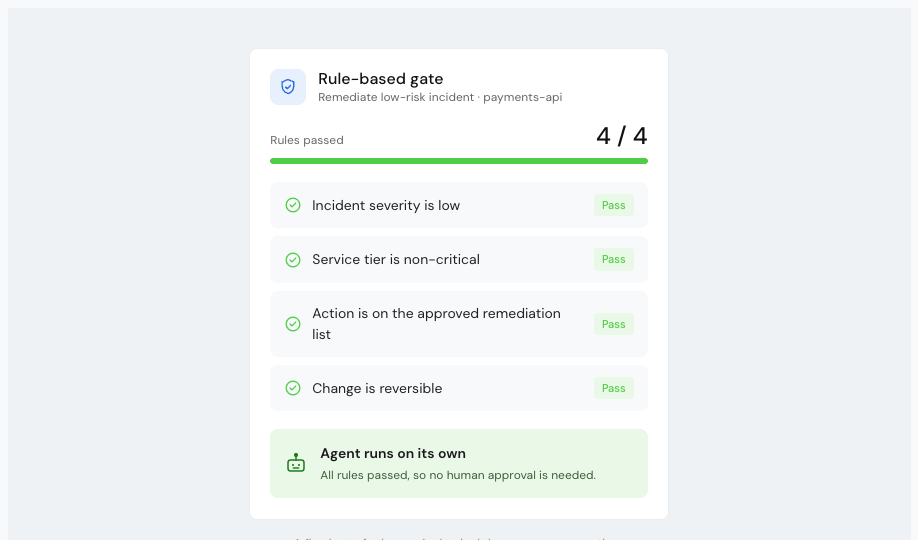
The limit is the flip side of the strength. A rule is only as smart as the conditions you thought to write. It handles the cases you anticipated and the facts you can name in advance, but the moment a decision depends on weighing signals you cannot cleanly enumerate, a fixed rule has nothing to check against.
Risk-based guardrails: AI coding governance that scores the action
An agent proposes a change that looks small, but it sits on a service half your tier-1 systems depend on, so Port scores it as high risk and pulls in a human before anything ships. Nobody wrote a rule for that exact change. The gate worked it out from context.
A risk-based gate is non-deterministic: instead of checking a condition you wrote, it has the agent assess the specific action in its actual context and decide how risky it is right now. This is for the decisions you cannot reduce to a clean rule, where the answer is a judgment over many signals rather than a lookup. Port does this by scoring an action against the context lake, tracing how far a change reaches through the connected graph, which services depend on it, what deployed recently, what it touches downstream, and using that to judge how risky the action actually is. A small, contained change runs. A change that ripples across your tier-1 services pulls in a human. This is the part of AI coding governance that reasons about the situation rather than matching it to a rulebook.
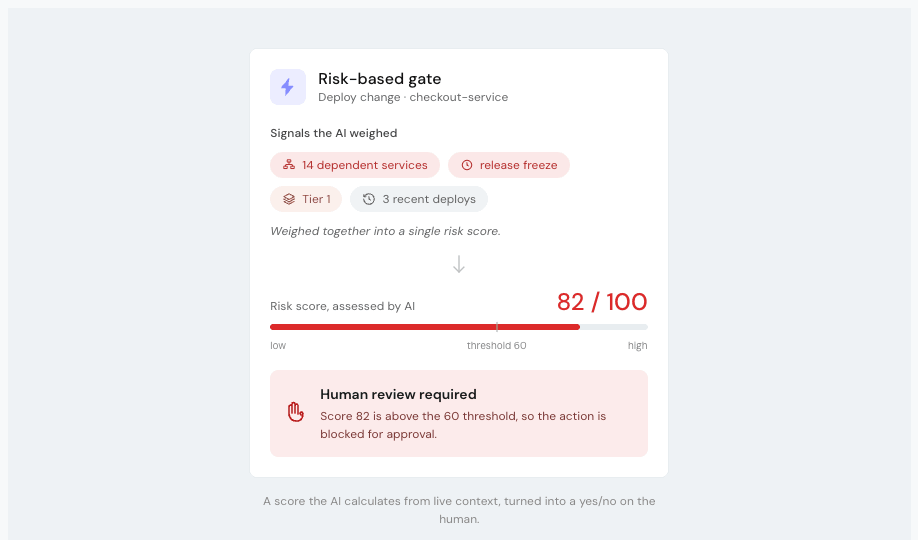
That power comes with its own requirements. Because the decision is a judgment rather than a fixed rule, a risk-based gate needs a threshold you set for when a human gets pulled in, tracing on every decision so you can audit what the AI scored and why, and a fallback to a blocking human review when the model is unsure or the context is thin. Get those right and the gate is trustworthy. Skip them and you have handed an unaudited judgment call to a system you cannot question later.
Matching the gate to the risk
With both kinds of gate in hand, the real question is which one fits a given action. The test is whether you can write the condition down. If you can state the trigger as a rule that is right every time, use a rule-based gate, even for things like time windows. If deciding means weighing signals you cannot reduce to a clean condition, use a risk-based gate.
The dividing line is not whether context matters, since rules handle plenty of context like time and environment. It is whether the decision is a lookup or a judgment. When you can write the condition down, even a detailed one, use a rule, because it will be predictable and auditable. When deciding means weighing signals you cannot fully enumerate, let an agent score it. Most teams run both.
How should we run each gate properly?
Choosing the right gate is not the same as running it well. Done right, human-in-the-loop controls for software development agents come down to the guardrails; each type needs to stay trustworthy, and the two types need different things.
A rule-based gate is only as good as the rule behind it. To run one properly, make the condition explicit and give it an owner, so it can be audited and changed on purpose rather than discovered by accident. Have the condition read from real data, not a hardcoded guess, so "low-risk incident" means an actual low-risk incident. And log every time the gate fires, so anyone can trace later what was gated and why.
A risk-based gate needs guardrails around the judgment itself. Set a clear threshold for the risk score that flips an action from "let it run" to "block for review," and expect to tune it over time. Trace every decision, including what the model scored and what context it used, because a call that changes with context is only trustworthy if you can reconstruct it. And default to the stricter path when the model is unsure, so thin context produces a human review, never a silent pass.
Context is what makes any gate work
Here is the thing both gates have in common, and it is what decides whether either one succeeds: context. A rule-based gate checks conditions, but those conditions are only as good as the data behind them. "Low severity on a non-critical service" means nothing unless the agent actually knows the severity, the service, and its tier. A risk-based gate goes further, because scoring a blast radius or classifying an incident means reading the whole connected picture: what depends on what, what changed recently, who owns it.
Neither gate is reasoning in the abstract. Both are reading your environment, so a gate that reads stale or partial context makes confident, wrong calls. A rule with no real data to check is a guess, and a risk score over thin context just hides a bad guess behind a number. The gates are only ever as trustworthy as the context underneath them.
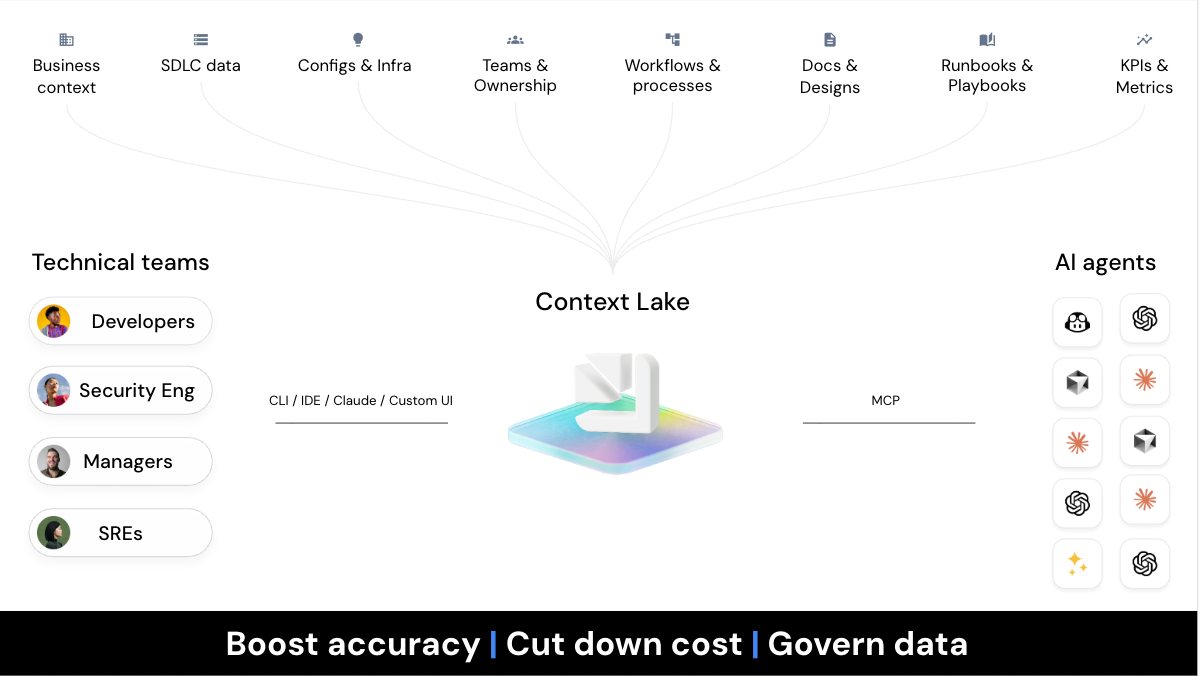
That shared dependency is what turns this into a platform problem rather than a per-workflow one. Both gates need the same live, connected view of your systems, and wiring that view into every workflow by hand is the part that breaks as you scale.
Both gates belong in one platform
Which is where the whole journey lands. Once you accept that you need both rule-based and risk-based gates, that each needs thresholds, tracing, and safe fallbacks, and that both run on the same live context, hand-wiring them into every workflow stops being an option. You need one platform where both kinds of gates are native, composable steps you drop into any agentic workflow, reading from one connected source of truth.
That is what Port provides. A human approval gate is a step in the workflow: the workflow runs, reaches the gate, and pauses for a human decision before anything irreversible happens. Rule-based conditions and risk scores both read from Port's context lake, the connected graph of your services, deployments, ownership, and dependencies, so the same workflow can let low-risk actions run and block the high-risk ones without custom plumbing. And when an action does need a person, the handoff carries context. In a Port incident workflow shown at PlatformCon, the workflow pauses at an approval gate, and on escalation it fires a coding agent node with the full incident context already loaded, the triage summary, the affected service, the recent deployment, and the linked pull requests, so the human and the agent are working from the same picture instead of starting cold.
This is also where oversight stops being a tax on velocity. When the gates and the context live in the platform, a governed workflow is the easy one to build, so teams stop choosing between moving fast and staying safe. The same context lake that feeds your gates feeds your agents and your orchestration, which is what lets autonomous engineering actually scale. For where all of this is heading next, see our guide to the future of agentic engineering.
.png)
FAQ
What is human in the loop in AI?
Human in the loop in AI is an oversight model where autonomous agents do the work but cannot make irreversible changes without explicit human approval.
What are human-in-the-loop software development agents?
Human-in-the-loop software development agents are coding and operations agents that run on their own but pause for a human before any high-risk, state-changing action.
What is the difference between rule-based and risk-based guardrails for AI coding agents?
A rule-based guardrail is deterministic: you define a condition in advance, and it fires the same way every time, like always requiring approval for a tier-1 deploy or blocking deploys during a freeze window. A risk-based guardrail is non-deterministic: an agent scores the risk of the specific action by weighing signals you cannot reduce to a clean rule, like the blast radius of a change. Both depend on good context to be reliable.
When should a human be in the loop for AI coding agents?
Match the gate to the decision. When a fixed fact settles it (service tier, data classification, time window), use a rule. When deciding means weighing signals you cannot enumerate (blast radius, how risky an incident really is, whether an action is anomalous), use a risk-based score, and route only the genuinely risky actions to a blocking human review.
What is AI coding governance?
AI coding governance is the set of controls that decide what AI coding agents are allowed to do and when a human must step in, spanning the fixed rules you write, the risk-based scoring that adapts to context, and the thresholds, tracing, and audit records that make those decisions reviewable.
Run both gates from one platform. Port gives you rule-based and risk-based human approval gates as native steps in any agentic workflow, all reading from one connected context lake.
{{cta_explore_port}}


Get your survey template today
%201.svg)


Download your survey template today


Free Roadmap planner for Platform Engineering teams
Set Clear Goals for Your Portal
Define Features and Milestones
Stay Aligned and Keep Moving Forward
Create your Roadmap


Free RFP template for Internal Developer Portal
Creating an RFP for an internal developer portal doesn’t have to be complex. Our template gives you a streamlined path to start strong and ensure you’re covering all the key details.
Get the RFP template


Leverage AI to generate optimized JQ commands
test them in real-time, and refine your approach instantly. This powerful tool lets you experiment, troubleshoot, and fine-tune your queries—taking your development workflow to the next level.
Explore now
Check out Port's pre-populated demo and see what it's all about.
No email required
LIVE WEBINAR, Aug 18, 2026:
Context-aware Vibe Coding for Platform Engineering
Thursday, October 22 12:00pm EDT⋅6:00pm CET
To learn more about the new capability and to see a live demo, join our upcoming community session with GitHub
Move fast while staying in control
Build governed agentic workflows on one central platform.
See it in action:
Watch this video on generating Terraform with Port, or explore our public demo.
.png)
Check out the 2025 State of Internal Developer Portals report
No email required
Minimize engineering chaos. Port serves as one central platform for all your needs.
Act on every part of your SDLC in Port.
Your team needs the right info at the right time. With Port's software catalog, they'll have it.
Learn more about Port's agentic engineering platform
Read the launch blog
Contact sales for a technical walkthrough of Port
Every team is different. Port lets you design a developer experience that truly fits your org.
As your org grows, so does complexity. Port scales your catalog, orchestration, and workflows seamlessly.
Port × n8n Boost AI Workflows with Context, Guardrails, and Control
Port Builders Session: A Single, Governed Interface for All MCP Servers
Book a demo right now to check out Port's developer portal yourself
Apply to join the Beta for Port's new Backstage plugin


n8n + Port templates you can use today
walkthrough of ready-to-use workflows you can clone
From manual to autonomous engineering
One platform to build, govern, and operate the Agentic SDLC.
Port is open for you to try it
build your first agentic workflow today