Agent Registry vs Agent Hub: Which one do you need?
Compare agent registries and agent hubs to understand their roles, key differences, and which one your team actually needs.


The short answer is that you need both, and the more useful answer is that you can build them as one.
Almost every engineering organization is trying to go AI-first right now, and almost none of them are there yet. The reason is agent sprawl, and it tends to creep in the same way everywhere.
You want agents writing code, triaging tickets, reviewing pull requests, and handling incidents, so that your engineers can spend their time on the harder problems. So teams start building. The trouble is that they build in silos. One team spins up an agent in Cursor, another in Claude, a third on Bedrock, and none of them can see what the others are doing. Within a couple of quarters the organization is running agents it cannot name, owned by people it cannot identify, with access that nobody ever reviewed. Every team has something working on its own machine, and the enterprise as a whole has no way to run any of it at scale.
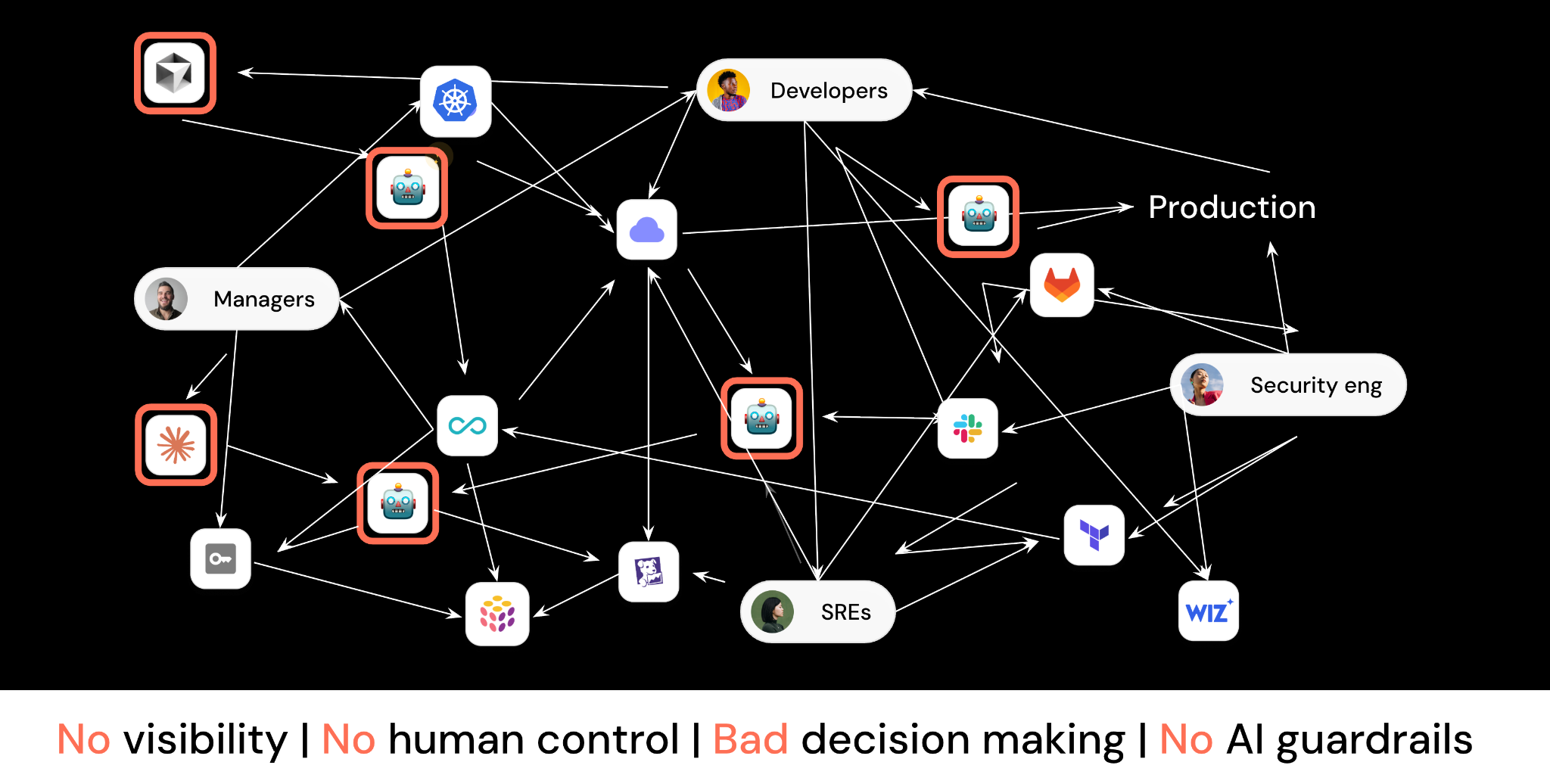
That gap comes down to two separate problems. The first is a governance problem, which is that nobody can see what is running or what each agent is allowed to touch. The second is a reuse problem, which is that nobody can find or trust the agents that already exist. The governance problem calls for an agent registry. The reuse problem calls for an agent hub, which is sometimes called a marketplace.
Most teams build one of these and quietly ignore the other. The better question is whether the two can be the same thing. For where these layers sit in the wider delivery model, see our guide to the agentic SDLC.
{{from_manual_to_autonomous_engineering}}
What is an agent registry? The governance layer
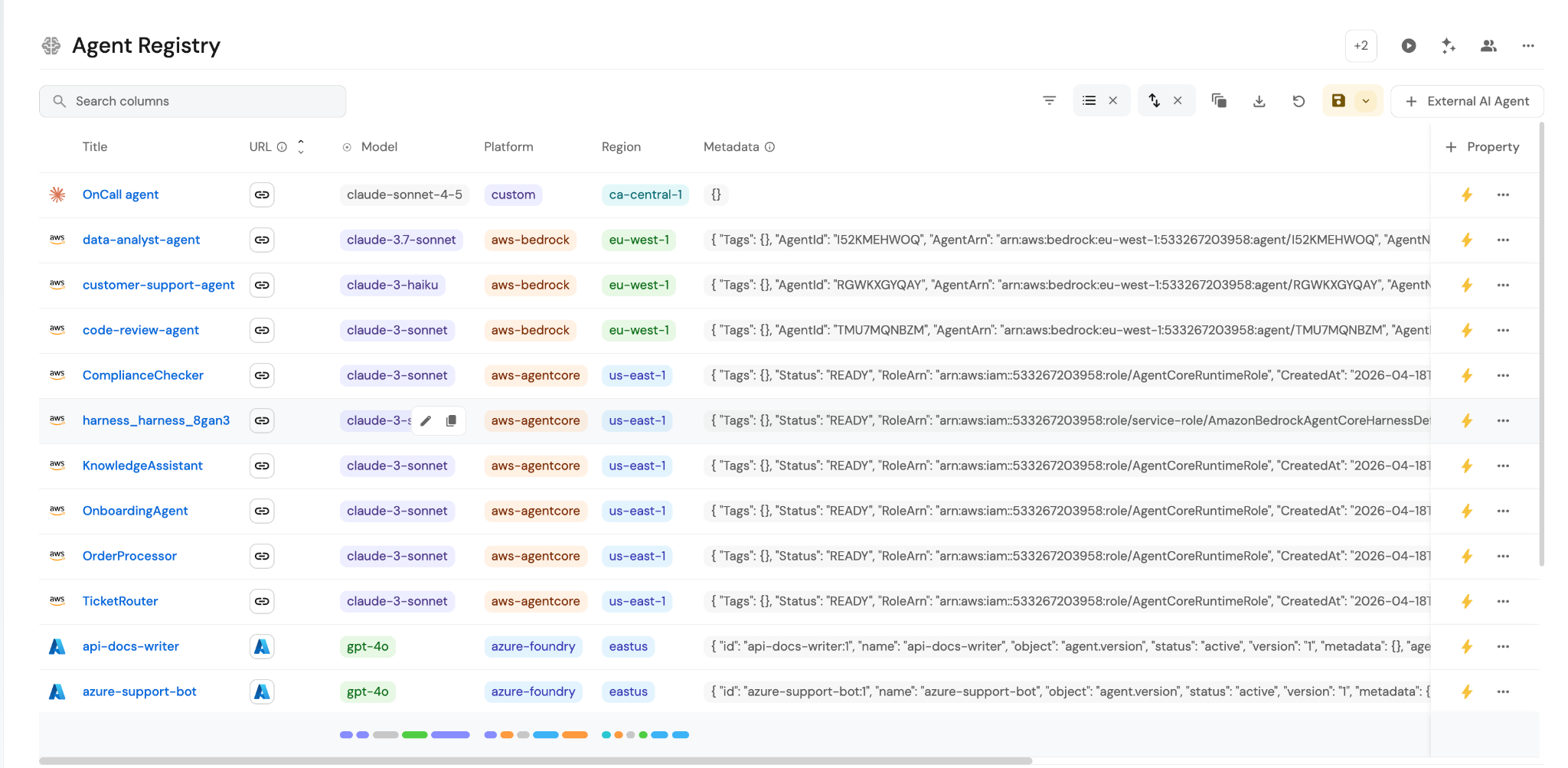
An AI agent registry is a centralized system of record. It stores the identity, ownership, access boundaries, version history, and lifecycle state of every AI agent in your organization.
What a registry really answers is the governance question: which agents exist, and what are they allowed to do? Microsoft's Entra Agent Registry is a good example. It stores agent identities, agent user accounts, and identity blueprints, then connects them to a directory that enforces entitlement policies. The registry becomes the source of truth that every other layer reads from.
Two kinds of consumers query a registry. Platform and security teams query it to audit what is running and to enforce policy. Other agents query it programmatically, over standard APIs, to work out which agent can handle a task before they act.
A registry also runs an approval workflow, and that is what separates it from a static inventory. On the AWS Agent Registry, a record starts as a draft, moves to pending approval, and only becomes discoverable once it is approved. That workflow is the difference between a catalog you can trust and a list of whatever happens to exist.
What is an agent hub? The reuse and enablement layer
An agent hub, also known as an agent marketplace, is the consumption layer. It is where developers discover, share, and deploy agents that have already been approved.
The hub solves the reuse and enablement problem. Where the registry asks what exists and what it can do, the agent hub asks a more immediate question: what can I reuse, and how do I run it right now? A developer opens the hub, searches for an agent that already does the job, and deploys it in a single step instead of building a fifth copy of something that already exists.
The hub also serves a wider audience than the registry. Platform teams curate and approve the agents, developers discover and deploy them, and increasingly non-technical builders consume them too, without needing repo access or any knowledge of the underlying framework. The hub is the distribution layer, in the same way that an app store distributes apps.
Registry vs Hub: which one do you actually need?
A registry and a hub are not competitors. They answer different questions for different people, and they fail in different ways when they are missing.
Laid out like this, the two layers look like a choice. They are not, and the way you build them shows why.
What does it take to build an agent registry and an agent hub?
Most of what an agent registry and an agent hub need, they need in common. Only a few jobs belong to one layer on its own.
The shared rows are the whole point. Auto-discovery, ownership, access control, auditing, and lifecycle management are not one set of registry features and a separate set of hub features. They are a single foundation. The registry adds an authoritative record and an approval gate on top of it, and the hub adds deploy and distribution. To manage ai agents well, you build that shared foundation once and only once. Deeper guardrail patterns, including human approval gates, are covered in Cluster 6: Safety and Guardrails.
What if we could build both agent registry & agent hub in one platform?
Port builds that foundation once and puts both faces on it. In Port, the agent registry and the agent hub are the same catalog. Agents are auto-discovered, governed with RBAC, audited, and managed through their full lifecycle, and that same catalog is the one developers search and deploy from. The governed path is the only path there is, which means the approved agent is also the easy one to ship. Because the agents sit on Port's context lake and its existing permissions model, ai agents management works the way service and resource management already work on the platform your engineers use every day.
Build a registry and a hub as two separate tools instead, and you end up building that shared foundation twice. Now you have two catalogs to keep in sync, two access models to reconcile, and two audit trails that never quite agree. The agents that slip through the gap between them are exactly the ungoverned ones you were trying to avoid.
Setting the foundation for agentic SDLC workflows
A governed, discoverable set of agents is not the finish line. It is the thing that makes everything downstream possible.
Once your agents are registered, access-scoped, and ready to deploy, they turn into building blocks that you can compose into agentic SDLC workflows. A ticket-triage agent hands off to a code-generation agent, a review agent gates the result, and an incident agent pulls ownership and deployment context from the same source when something breaks. Each agent already carries its own identity, permissions, and lifecycle state, so the workflow inherits governance rather than bolting it on after the fact.
This is where autonomous software development really begins. The agents stop merely assisting and start executing, chained into delivery pipelines that run with governance built in from the start. Workflows built on a governed foundation are auditable by default, because every agent in the chain is already a known, owned, access-scoped entity.
The same foundation that runs your agents also runs your skills, your MCP servers, and your workflows, which gives you one agentic platform for the entire SDLC. The agent registry and the agent hub are simply where it starts.
So there is no reason to staff two projects and build one foundation twice. You need both of them, and the right move is to build them as one.
Watch us build an agent registry in Port, end to end.
Build agents your whole organization can find, trust, and run. Our guide shows how to set up the registry and the hub as a single system in Port. Read the guide.
FAQ
What is the difference between an agent registry and an agent hub?
An agent registry is the governance layer. It records who each agent is, who owns it, and what it is allowed to access. An agent hub, also called an agent marketplace, is the enablement layer where developers find and deploy approved agents. The registry answers what exists, and the hub answers what you can reuse.
Do I need both an agent registry and an agent hub?
Yes. A registry without a hub leaves useful agents sitting unused, so teams rebuild what already exists. A hub without a registry hands out agents that nobody has governed. Because the two share a single foundation, the practical answer is to build both as one system rather than as two separate tools.
How does an agent registry help control agent sprawl?
Agent sprawl happens when teams build agents in silos that nobody else can see. An AI agent registry gives you one system of record for identity, ownership, and access, along with an approval workflow before an agent ever becomes discoverable. That visibility is what lets you manage ai agents safely as you scale.
How do the registry and hub support agentic SDLC workflows?
Once agents are registered, access-scoped, and deployable, they become building blocks for agentic SDLC workflows. A triage agent hands off to a code agent, a review agent gates the result, and each one carries its own governance. That shared, governed foundation is where autonomous software development actually starts.


Get your survey template today
%201.svg)


Download your survey template today


Free Roadmap planner for Platform Engineering teams
Set Clear Goals for Your Portal
Define Features and Milestones
Stay Aligned and Keep Moving Forward
Create your Roadmap


Free RFP template for Internal Developer Portal
Creating an RFP for an internal developer portal doesn’t have to be complex. Our template gives you a streamlined path to start strong and ensure you’re covering all the key details.
Get the RFP template


Leverage AI to generate optimized JQ commands
test them in real-time, and refine your approach instantly. This powerful tool lets you experiment, troubleshoot, and fine-tune your queries—taking your development workflow to the next level.
Explore now
Check out Port's pre-populated demo and see what it's all about.
No email required
LIVE WEBINAR, Aug 18, 2026:
Context-aware Vibe Coding for Platform Engineering
Thursday, October 22 12:00pm EDT⋅6:00pm CET
To learn more about the new capability and to see a live demo, join our upcoming community session with GitHub
Move fast while staying in control
Build governed agentic workflows on one central platform.
See it in action:
Watch this video on generating Terraform with Port, or explore our public demo.
.png)
Check out the 2025 State of Internal Developer Portals report
No email required
Minimize engineering chaos. Port serves as one central platform for all your needs.
Act on every part of your SDLC in Port.
Your team needs the right info at the right time. With Port's software catalog, they'll have it.
Learn more about Port's agentic engineering platform
Read the launch blog
Contact sales for a technical walkthrough of Port
Every team is different. Port lets you design a developer experience that truly fits your org.
As your org grows, so does complexity. Port scales your catalog, orchestration, and workflows seamlessly.
Port × n8n Boost AI Workflows with Context, Guardrails, and Control
Port Builders Session: A Single, Governed Interface for All MCP Servers
Book a demo right now to check out Port's developer portal yourself
Apply to join the Beta for Port's new Backstage plugin


n8n + Port templates you can use today
walkthrough of ready-to-use workflows you can clone
From manual to autonomous engineering
One platform to build, govern, and operate the Agentic SDLC.
Port is open for you to try it
build your first agentic workflow today

.png)