Why every engineering org needs an agentic registry
Agents and skills are multiplying inside engineering orgs faster than anyone is tracking them



Agents and skills are multiplying inside engineering orgs faster than anyone is tracking them. In a recent live session, we walked through what's happening on the ground: the teams shipping the most agentic work are also the ones losing the thread fastest. We then showed how an agentic registry solves it, with a hands-on build of a skills registry and an agent registry in Port from scratch.
{{from_manual_to_autonomous_engineering}}
The agent sprawl problem
We see most engineering orgs are on a similar journey: When we polled our customers on what they wanted us to build next, an Agent & Skill Registry was the runaway top answer at 47%, nearly four times the next most-requested capability.
Coding assistants are widely adopted. A few teams have started building agents in their local environments, shipping Slack bots, wiring up infrastructure agents, writing skills for their own workflows. The cutting edge is running agents in production with humans overseeing them.
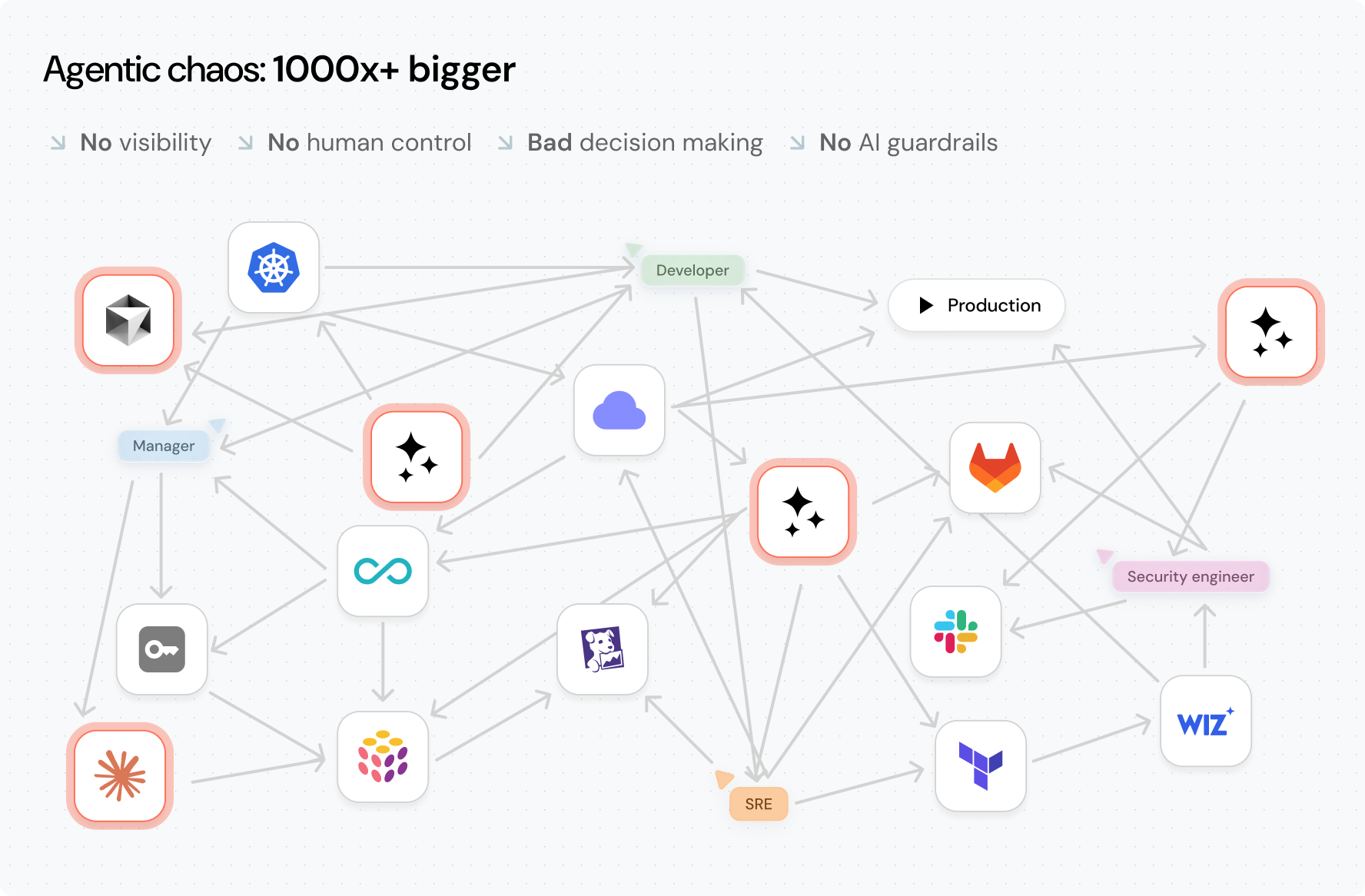
Almost everyone gets stuck in the same place: agent sprawl. One team builds an SRE agent. Another team builds something nearly identical. Every team writes its own skills. Leadership has no idea what exists, what's safe to run, or what's already been solved somewhere else in the org. Duplication compounds, standards don't exist, and nobody can answer the most basic question: who can run what?
How an Agent Registry helps
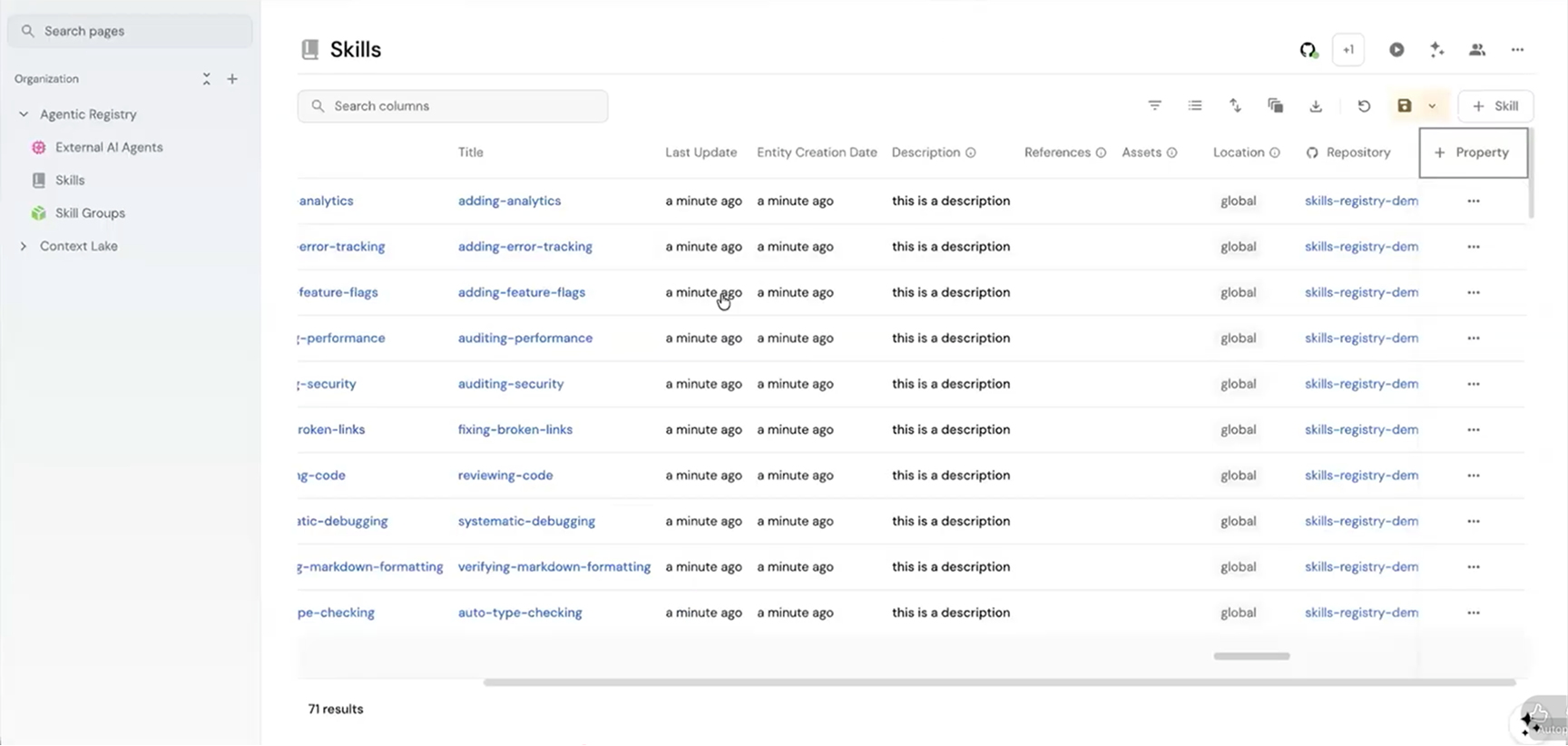
A registry turns on the lights. In practice, that's three registries working together: a Skills Registry for every SKILL.md in your repos, an Agent Registry for every Bedrock, Azure Foundry, or Cursor agent your teams have deployed, and a registry for approved MCP servers.
- Auto-discovery: pull every agent and skill in automatically, with all the source metadata intact.
- Standardization: layer your own attributes on top through a flexible data model. Tag by use case, owning team, environment, lifecycle stage, or whatever your operations need.
- Governance: control who can read each asset, who can run it, which agents are cleared for production, which skills are scoped to a team versus shared company-wide.
From registry to autonomous SDLC
This is where the foundation matters. A standalone list of agents and skills is useful. A registry tied to your context lake, where every agent and skill is connected to the services, teams, and repos it belongs to, is something else entirely.
That connection is what lets you compose agents and skills into workflows. An incident kicks off and the right agent runs against the right service. A vulnerability lands and a skill loops over the repos that pull in the affected dependency. Each workflow runs against real ownership and architecture, not a generic dispatch.
It's also what makes governance real. The attributes you've discovered and added become the rules of access: which team can edit a skill, which agents are cleared to run in production, which skills are eligible to be company-wide versus scoped to one team. RBAC stops being a separate system bolted on the side and becomes a property of the registry itself.
See it in Action
In a recent live session, Matar Peles, Port's Field CTO, built both a skills and an agents registries. The agent registry was pulling agents from AWS Bedrock and Azure Foundry. The Skills registry auto-discovered and ingested skills out of GitHub. We show how developers can then pull skills into Cursor from a central CLI to build agentic workflows.
Check out the recording below for a hands-on demo of the entire process:
Try it for yourself
Check out this step-by-step guide for building an agent registry in Port with AWS Bedrock and Azure Foundry out of the box.
Start building, or book a demo if you'd rather walk through it with us.


Get your survey template today
%201.svg)


Download your survey template today


Free Roadmap planner for Platform Engineering teams
Set Clear Goals for Your Portal
Define Features and Milestones
Stay Aligned and Keep Moving Forward
Create your Roadmap


Free RFP template for Internal Developer Portal
Creating an RFP for an internal developer portal doesn’t have to be complex. Our template gives you a streamlined path to start strong and ensure you’re covering all the key details.
Get the RFP template


Leverage AI to generate optimized JQ commands
test them in real-time, and refine your approach instantly. This powerful tool lets you experiment, troubleshoot, and fine-tune your queries—taking your development workflow to the next level.
Explore now
Check out Port's pre-populated demo and see what it's all about.
No email required
LIVE WEBINAR, Aug 18, 2026:
Context-aware Vibe Coding for Platform Engineering
Thursday, October 22 12:00pm EDT⋅6:00pm CET
To learn more about the new capability and to see a live demo, join our upcoming community session with GitHub
Move fast while staying in control
Build governed agentic workflows on one central platform.
See it in action:
Watch this video on generating Terraform with Port, or explore our public demo.
.png)
Check out the 2025 State of Internal Developer Portals report
No email required
Minimize engineering chaos. Port serves as one central platform for all your needs.
Act on every part of your SDLC in Port.
Your team needs the right info at the right time. With Port's software catalog, they'll have it.
Learn more about Port's agentic engineering platform
Read the launch blog
Contact sales for a technical walkthrough of Port
Every team is different. Port lets you design a developer experience that truly fits your org.
As your org grows, so does complexity. Port scales your catalog, orchestration, and workflows seamlessly.
Port × n8n Boost AI Workflows with Context, Guardrails, and Control
Port Builders Session: A Single, Governed Interface for All MCP Servers
Book a demo right now to check out Port's developer portal yourself
Apply to join the Beta for Port's new Backstage plugin


n8n + Port templates you can use today
walkthrough of ready-to-use workflows you can clone
From manual to autonomous engineering
One platform to build, govern, and operate the Agentic SDLC.
Port is open for you to try it
build your first agentic workflow today