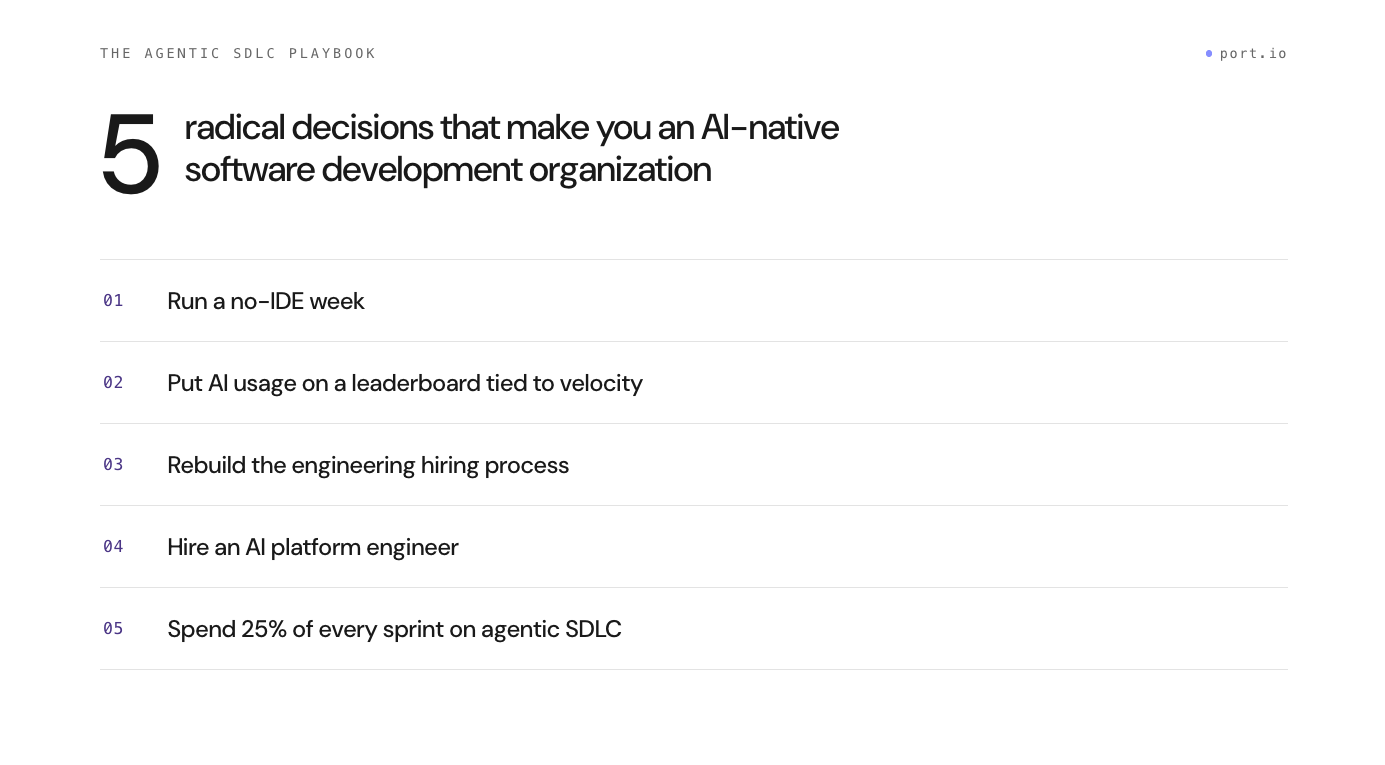
5 radical decisions that make you an AI native software development organization
The 5 team decisions that make you AI native software development: no-IDE weeks, AI hiring, platform engineers, agentic SDLC.



AI driven software development is what happens when your engineers use AI to write code faster. AI native software development is what happens when you redesign the org around that fact: how you hire, how you measure, how you staff, and how you spend sprint time. The first is a tool upgrade. The second is a different operating model, and most teams are doing the first while telling themselves they have done the second.
Buying everyone a Copilot license does not make you AI native. It makes you a team with AI driven software development bolted onto the old workflow. Becoming native takes a handful of decisions that feel uncomfortable, because they change behavior rather than just budget. Here are five of them, and for each one, a company that has already shipped a version of it.
{{from_manual_to_autonomous_engineering}}
Decision 1: Run a no-IDE week
Pick one week and ask engineers to work through claude code without seeing the IDE output. Prompt engineering vs Coding. They describe the change they want, let a terminal-first agent plan and draft it, then review, correct, and ship. The point is not to abandon the IDE forever. The point is to break the muscle memory of hand-writing code as the default, because that habit is the single biggest thing standing between AI driven software development and the real thing.
The hardest part of this shift is behavioral, not technical, so the fix has to be behavioral too. Coinbase is the clearest precedent. After buying enterprise licenses for Cursor and Copilot, CEO Brian Armstrong was told adoption would take a quarter or two, so he "went rogue" and gave every engineer until the end of the week to onboard. A few who ignored it without a reason were let go. A no-IDE week is the gentler version of the same idea: a forced, time-boxed change that makes people actually use the tools they already have access to. It also matches where the tooling has moved, since terminal-first agents like Claude Code became the most-used AI coding tool among engineers in 2026, overtaking both Copilot and Cursor.
One guardrail. Keep the experiment off the paths that move money or touch production-critical systems, where Armstrong himself warned against shipping code nobody fully understands.
Decision 2: Put AI usage on a leaderboard, then tie it to velocity
Make AI powered software development visible. Show which teams are shipping with agents, what share of merged diffs were AI-assisted, and who is finding workflows worth copying. Then judge all of it by what actually ships, not by how many tokens got burned.
Coinbase runs a monthly program it calls AI Speed Runs, where the team using AI best that month trains everyone else, and it tracks the share of code written by AI, which sat around 40% with a target of 50%. Shopify went further into the performance system: CEO Tobi Lütke declared that "Reflexive AI usage is now a baseline expectation", and the company folded a rating of how AI-native each person is into its 360 review cycle.
Here is the part many teams get backwards. A token count measures input, not value, and a leaderboard that rewards token burn only teaches people to burn tokens. The number that matters is velocity and the quality of what reaches production, so tie the leaderboard to delivery signals like cycle time and shipped pull requests rather than raw consumption. Used that way, the leaderboard surfaces the engineers worth learning from instead of turning into a surveillance dashboard.
Decision 3: Rebuild the engineering hiring process
If AI native software development is the actual job, the interview has to test the actual job. That means letting candidates use AI in the room, and usually requiring it. Stop grading whiteboard recall and start watching how someone directs an agent, reads what it produces, and catches the places where it is confidently wrong.
Canva has already rebuilt its technical interview around exactly this. For backend, frontend, and machine learning roles it retired the old computer-science-fundamentals screen and replaced it with an AI-assisted coding interview, where candidates bring their own tool, Copilot, Cursor, or Claude, and solve a realistic problem while sharing their screen. The task is chosen so that a single prompt cannot finish it. Instead of asking for a classic algorithm like Conway's Game of Life, an interviewer hands the candidate something open-ended, for example: design a control system that manages aircraft takeoffs and landings at a busy airport. The candidate has to clarify the requirements, decide where the AI helps and where it does not, then read, correct, and harden whatever the model produces.
What Canva scores is the interaction, not the output. How does the candidate break down an ambiguous brief, when do they reach for the agent, and do they catch the flaws in what it returns before that code would ever reach production? The pilot made the point sharply, because candidates with little AI experience often struggled, not because they could not code, but because they could not tell when a confident answer was wrong. That judgment is the skill you are hiring for, since within a year "can you use AI" is a box everyone checks. Some of Canva's own engineers were uneasy at first and worried the change was just "vibe-coding sessions", and the worry only settled once it was clear that code fluency and technical depth were still the bar, tested in the context engineers actually work in.
Decision 4: Hire an AI platform engineer
AI native software development quietly changes who counts as a builder. Engineers shift from writing most of the code to directing the agents that write it, and people who never shipped before start shipping through natural language. More builders is the goal, but it carries a risk: if every builder stands on their own foundation, the same shift that speeds the org up also fragments it. Every team picks its own models, wires up its own agents, and lets token costs land on the invoice with no attribution, while agents call internal systems with no shared guardrails. Someone has to own the ground all these builders stand on, and that person is the AI platform engineer.
The role is no longer hypothetical. It shows up in real 2026 job postings, and analyses of those listings converge on the same responsibilities: agentic infrastructure, multi-provider model portfolios, evaluation systems for non-deterministic output, and governance that can survive a security and compliance review. The pressure behind the hire is concrete, because Gartner forecasts that 40% of enterprise applications will include task-specific AI agents by the end of 2026, up from under 5% a year earlier.
The load-bearing word in the title is platform. Microsoft spent its 2026 Build cycle pushing employees across the company to build and run their own AI agents, but it did that on top of what it calls "a secure, governed, and extensible platform" it built first. That order is the whole point. When the foundation comes first, the new builders inherit paved roads: the conventions, the access rules, and the shared context that make an agent behave the same way no matter who launched it. When the foundation comes last, you spend the next year cleaning up what a hundred people built without it. The platform engineer is the person who makes building safe and consistent at scale, so a flood of new builders becomes leverage instead of sprawl.
Underneath that person sits a control plane: an agent registry so the org knows what is running, cost attribution per team, policy and access controls that apply before an agent executes, and a shared home for the context, skills, and MCP connections agents depend on. This is the layer Port was built to be, the agentic engineering platform that keeps agentic AI for software development running on shared rails instead of a hundred private setups. Hire the person, then give them the platform to own.
Decision 5: Spend 25% of every sprint building your agentic SDLC
Carve out a fixed slice of every sprint, call it a quarter of capacity, for engineers to build the agentic workflows that automate their own pipeline. The review bots, the test-generation agents, the incident triagers, the release automation. Not someday, and not "if there is time left over." A protected, recurring allocation.
The structural precedent is Google's 20% time, which Larry Page and Sergey Brin formalized in their 2004 IPO letter by encouraging engineers to spend "20 percent of their time" on what they thought would most benefit the company, a policy that produced Gmail, AdSense, and Google News. Your version is narrower, because the 25% is aimed squarely at agentic SDLC workflows rather than open exploration, and that focus is the point.
The 2026 evidence says that investment is the difference between a productivity bump and a step change. When Amazon ran structured pilots across more than fifty ordinary teams, working their normal backlogs with no handpicked engineers, the teams that adopted new tools and new practices together pulled clearly ahead of the ones that just added AI to the old workflow, with a median productivity gain around 4.5x and some teams past 10x on deployment velocity. The teams that won treated AI as an engineering investment rather than a tool rollout. They built steering files and agent context so the agents understood the codebase, and they shifted testing left so agents could run the tests and correct themselves before a human ever looked. None of that ships inside a license. Engineers have to build it, and building it takes protected time.
Hand that building to the developers themselves rather than to a central team writing workflows on everyone's behalf. Two things follow. First, you capture the long tail, the messy, team-specific automations that no central group would ever know to write, because the engineer who feels a particular piece of toil every day is the one who automates it. Second, and this matters more than it looks, the engineer who builds the agent that reviews their own team's pull requests stops seeing AI as the thing coming for their job and starts seeing it as the thing they made. Ownership is the cleanest antidote to the fear, and Microsoft saw the same effect when it pushed employees to build their own agents instead of handing them finished ones.
Google's history also carries the warning. Under delivery pressure, unprotected innovation time decays fast, and Atlassian found its own version shrank to barely 1% of working hours once deadlines crowded in. So protect the allocation like real sprint work, with owners and review, not as a hopeful suggestion. This is the decision that compounds, because every workflow an engineer builds this sprint quietly pays back in every sprint after it.
The hard part is courage, not tooling
None of these five decisions are about better models, because everyone has the same models. They are about being willing to change how the org runs, and the thing that stops most leaders is not budget or technology. It is fear, and it lives in the engineers.
That fear is rational. When a developer hears that AI will write half the code, what often registers is that the craft they spent a decade building is being automated away, and that the next layoff has their name on it. You cannot mandate that feeling out of existence. Coinbase's firings made the priority clear but left some of the team resentful of the heavy hand. Canva's engineers pushed back before they came around. A memo that declares AI non-optional moves the policy, not the fear underneath it.
The way through is to hand engineers the wheel instead of taking it. Make them the builders of the agentic workflows, the way Decision 5 does, so AI becomes the thing they made rather than the thing done to them. Make their judgment the new bar in the interview, the way Decision 3 does, so the message is that human discretion matters more now, not less. Give them a platform to build on, the way Decision 4 does, so the new world feels like better tools rather than a smaller seat. Fear turns into ownership when the engineer is the one holding the controls.
Coinbase, Shopify, Google, Canva, and Microsoft did not wait for the fear to pass or for a finished playbook to arrive. They moved, absorbed the resistance, and adjusted. You do not have to run all five at once. Pick the decision your org would resist the most, because the resistance is usually pointing straight at the change that matters, then run it this quarter and let it show you how native you really are.
Common questions
What is the difference between AI native and AI driven software development?
AI driven software development means engineers use AI tools to produce code faster inside an otherwise unchanged workflow. AI native software development means the organization itself is redesigned around AI: hiring, performance measurement, team structure, and sprint planning all assume agents are part of how software gets built.
What does agentic AI for software development actually automate?
Agentic AI for software development handles multi-step engineering work with limited supervision, such as drafting features end to end, generating and running tests, reviewing pull requests, triaging incidents, and executing release steps. The engineer shifts from writing each line to directing the agent and reviewing its output before it ships.
Do you need an AI platform engineer for AI powered software development?
Once more than a few teams adopt AI powered software development, yes. Without an owner, model choices, agents, and integrations fragment across the org, costs go unattributed, and agents run without shared guardrails. An AI platform engineer builds the control plane that keeps all of it governed, observable, and consistent.


Get your survey template today
%201.svg)


Download your survey template today


Free Roadmap planner for Platform Engineering teams
Set Clear Goals for Your Portal
Define Features and Milestones
Stay Aligned and Keep Moving Forward
Create your Roadmap


Free RFP template for Internal Developer Portal
Creating an RFP for an internal developer portal doesn’t have to be complex. Our template gives you a streamlined path to start strong and ensure you’re covering all the key details.
Get the RFP template


Leverage AI to generate optimized JQ commands
test them in real-time, and refine your approach instantly. This powerful tool lets you experiment, troubleshoot, and fine-tune your queries—taking your development workflow to the next level.
Explore now
Check out Port's pre-populated demo and see what it's all about.
No email required
LIVE WEBINAR, Aug 18, 2026:
Context-aware Vibe Coding for Platform Engineering
Thursday, October 22 12:00pm EDT⋅6:00pm CET
To learn more about the new capability and to see a live demo, join our upcoming community session with GitHub
Move fast while staying in control
Build governed agentic workflows on one central platform.
See it in action:
Watch this video on generating Terraform with Port, or explore our public demo.
.png)
Check out the 2025 State of Internal Developer Portals report
No email required
Minimize engineering chaos. Port serves as one central platform for all your needs.
Act on every part of your SDLC in Port.
Your team needs the right info at the right time. With Port's software catalog, they'll have it.
Learn more about Port's agentic engineering platform
Read the launch blog
Contact sales for a technical walkthrough of Port
Every team is different. Port lets you design a developer experience that truly fits your org.
As your org grows, so does complexity. Port scales your catalog, orchestration, and workflows seamlessly.
Port × n8n Boost AI Workflows with Context, Guardrails, and Control
Port Builders Session: A Single, Governed Interface for All MCP Servers
Book a demo right now to check out Port's developer portal yourself
Apply to join the Beta for Port's new Backstage plugin


n8n + Port templates you can use today
walkthrough of ready-to-use workflows you can clone
From manual to autonomous engineering
One platform to build, govern, and operate the Agentic SDLC.
Port is open for you to try it
build your first agentic workflow today