Introducing Port AI Builder: the first vibe coding experience built for platform engineering
The way platform teams build is changing. Describe what you want, and Port delivers a production-grade SDLC use case - wired to your org's context, with your approval at every step.




AI made everyone a builder. PMs ship internal apps. Finance teams automate their own workflows. And engineers, the most capable builders in the company, spin up whatever they need with the tools already at their disposal.
The instinct to build didn’t stop at the platform - it just got slowed down. Building a new integration, an incident response agent, or a scorecard that blocks risky deploys means modeling data, wiring integrations, automations, and encoding what production-ready means. That requires expertise across SRE, DevOps, architecture, governance - and days to weeks of development before it shipped, while the rest of the org waited.
Today that changes. Port AI Builder is the industry’s first purpose-built vibe coding experience designed for platform engineering and development teams. Teams can now create and operate agentic workflows and platform enhancements using natural language, with human-in-the-loop review and approval built in. What took days ships in minutes, production-ready from day one.
{{from_manual_to_autonomous_engineering}}
Why we built this
AI is already delivering significant impact across the software lifecycle - improving delivery velocity and developer performance. Developers and Platform teams are looking to scale their use of agents to eliminate toil, remove bottlenecks, and improve delivery across the SDLC stages. And they expect to build their agents and their platform work using vibe-code, not by hand.
But prompt-driven development for agentic SDLC use cases only delivers value on top of a solid foundation: one with context, guardrails, governance, and visibility. Without it, teams move fast in the wrong direction: agents that don't hold up in production, compliance gaps, duplicated work across the org.. Platform engineering teams need to enable builders across the org to reliably contribute agents to the SDLC, while maintaining governance and visibility. Port AI Builder does that.
What Port AI Builder does
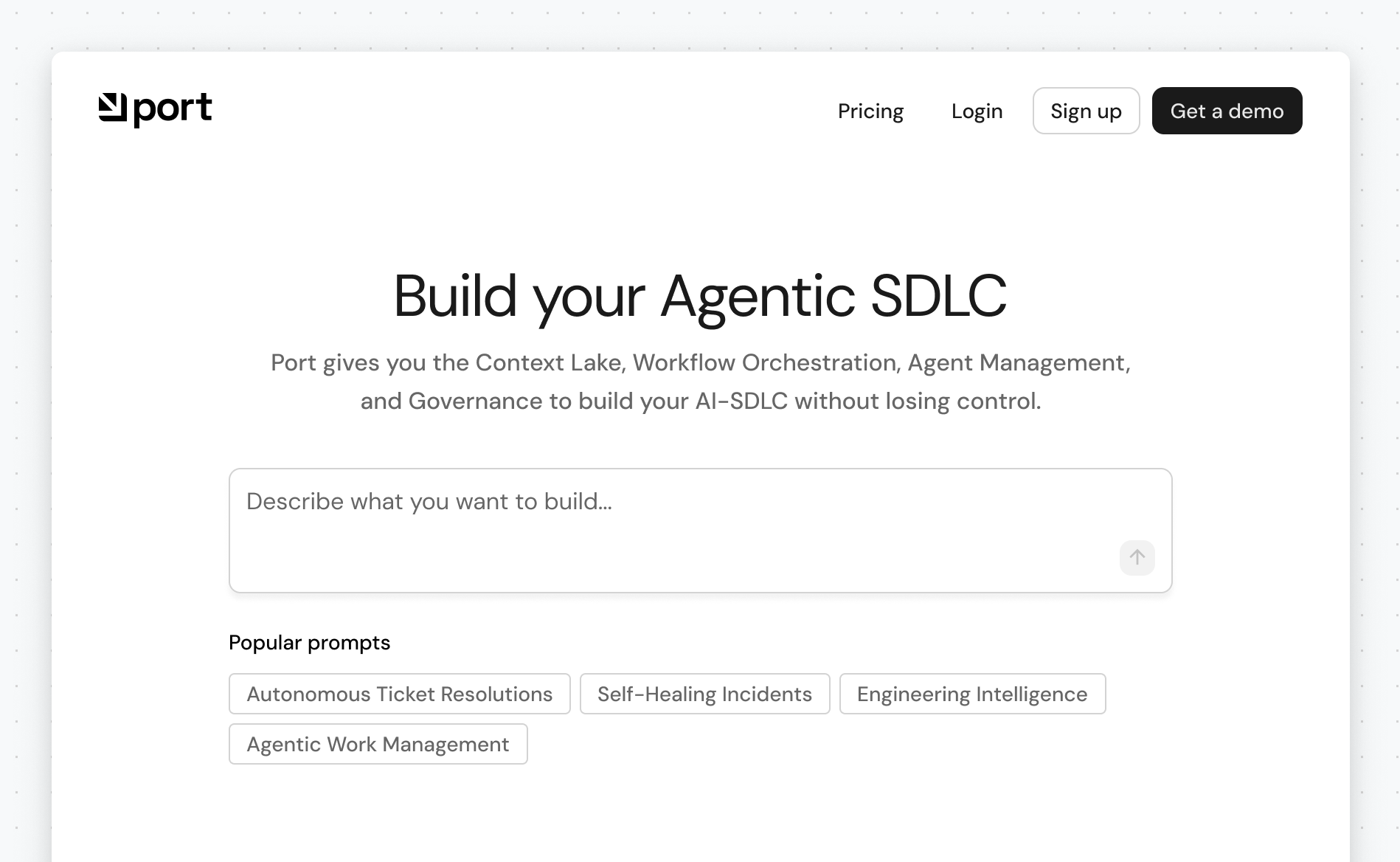
Port AI Builder lets teams build, customize, and run production-grade agentic workflows and platform use cases using natural language.
This is Port AI graduating from answering your questions to doing the work. Until now, you could ask Port AI “what is a scorecard” or “when did my agent last run”. Now, you can tell it to “build a scorecard that blocks deployments when services miss my standards”, or “build an agent to triage incidents” - and it happens.
Two things set Port AI Builder apart:
- It knows your domain
Deep domain skills spanning SRE, DevOps, architecture, security, AI governance, data modeling, and UX are baked in, so Port AI Builder builds like a senior platform engineer from the first prompt. It knows what a production-ready incident workflow looks like, which blueprint fits your data model, and how scorecards wire into CI/CD gates. You don’t have to translate platform concepts into prompts or debug the output. You get expert knowledge with every prompt and a comprehensive solution - without the learning curve.
- It knows your organization
Through Port's Context Lake, it delivers context-aware development: knowing your specific enterprise context (teams, tooling, environments, governance controls, etc.), it reads from real-time organizational data to produce solutions hardened for production and tightly integrated with your stack and processes, running reliably from day one.
Inspired by Claude, Cursor, and Lovable, Port brings the speed and accessibility of vibe coding to platform engineering, with the domain intelligence and context-aware development that modern software delivery demands.
How it works?
Plan mode: from a goal to an approved plan
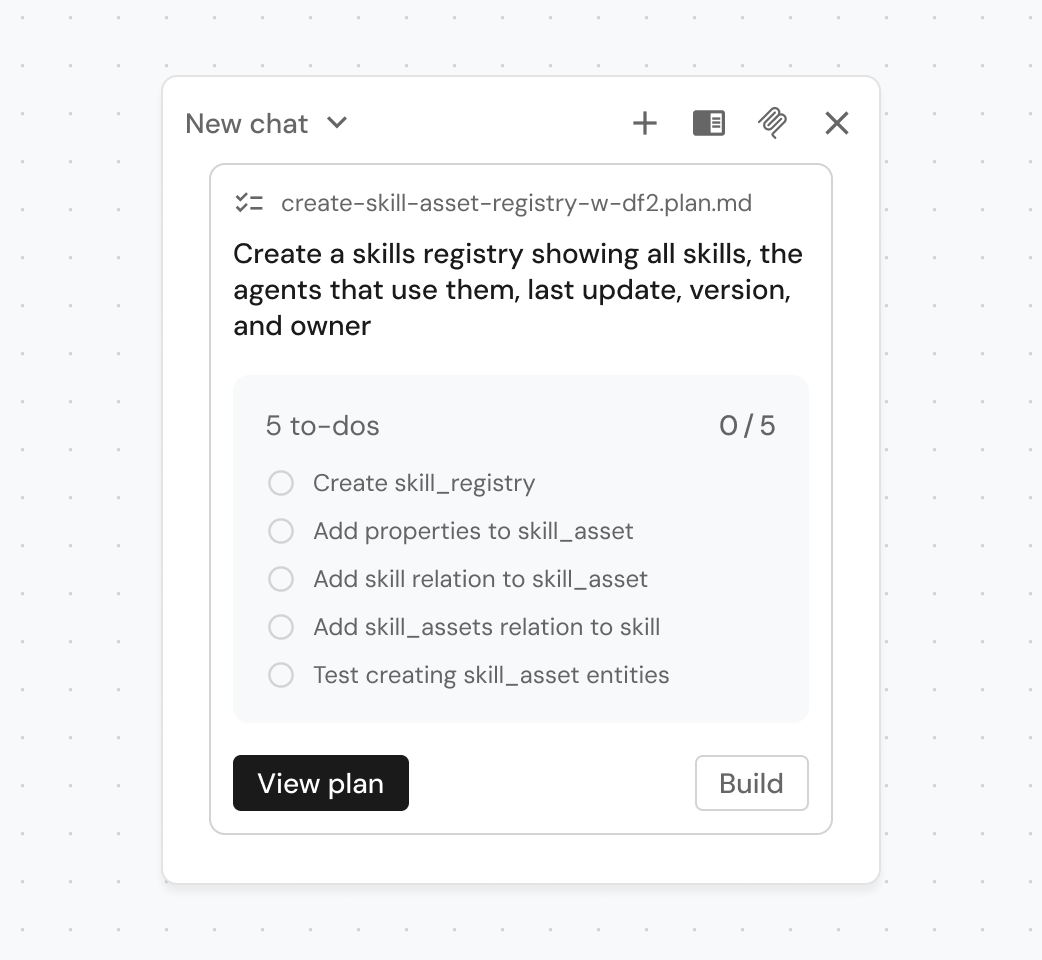
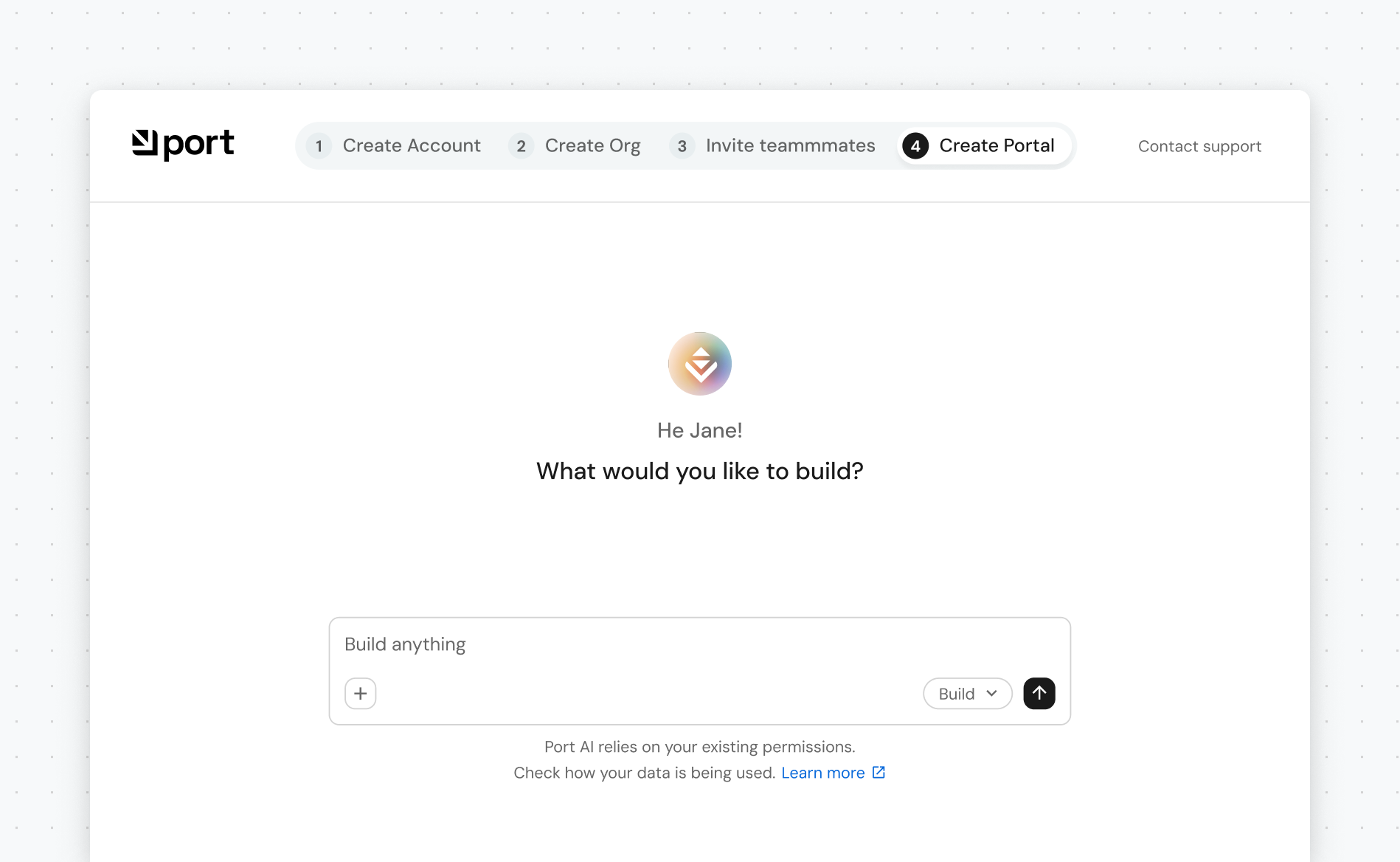
You describe what you want. Before building anything, Port AI reads your environment through the context lake and asks clarifying questions: which of the systems do you want to connect, who should have access, etc.
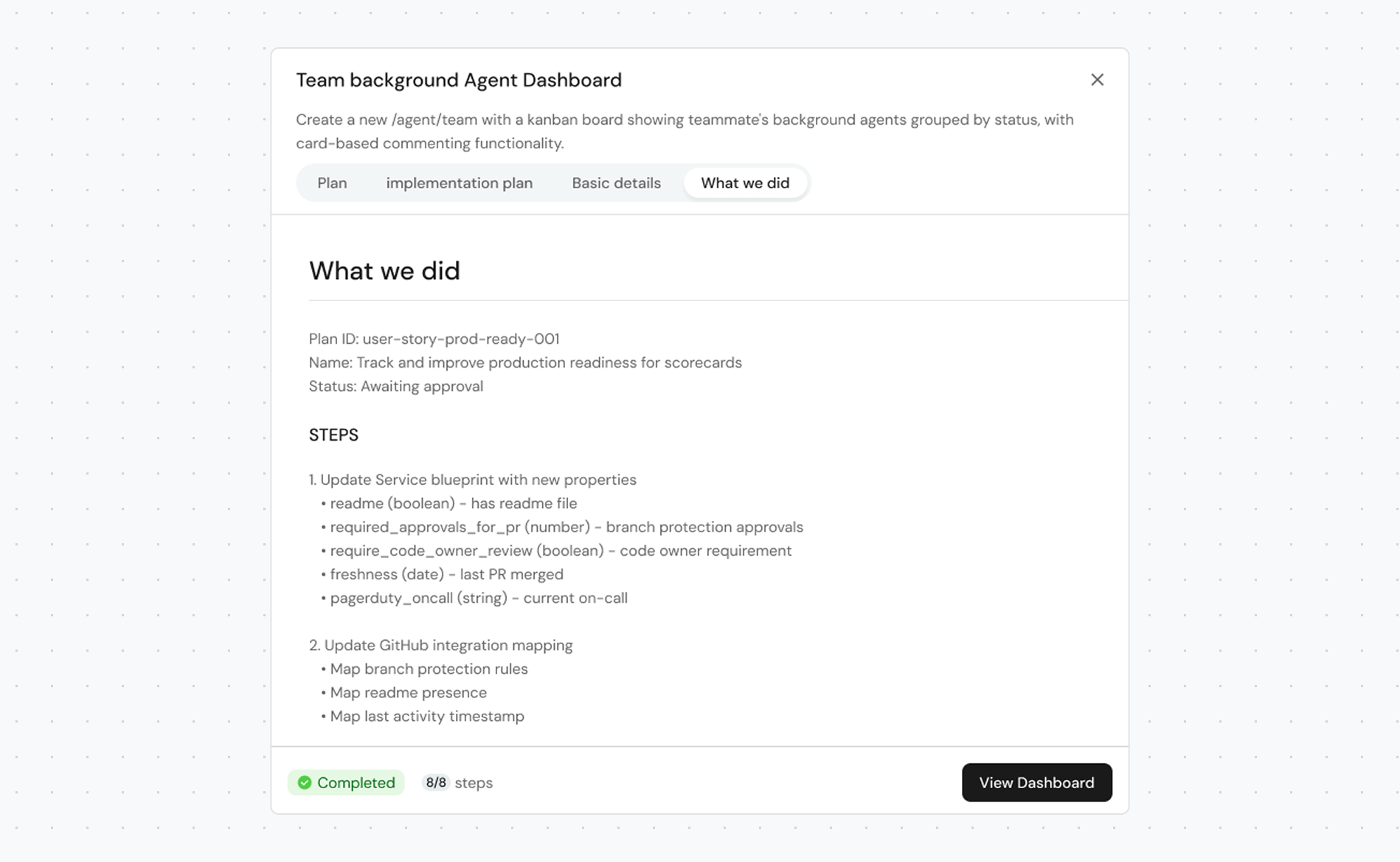
Port AI then drafts a structured, numbered plan that covers everything your use case needs: new blueprints, integration mappings, dashboards, and more. You review the plan, iterate, update or remove any step, and finally approve.. Every plan is automatically versioned and saved for traceability, so you can see what was proposed and why.
When you approve, execution moves to Build mode.
Build mode: from plan to running solution
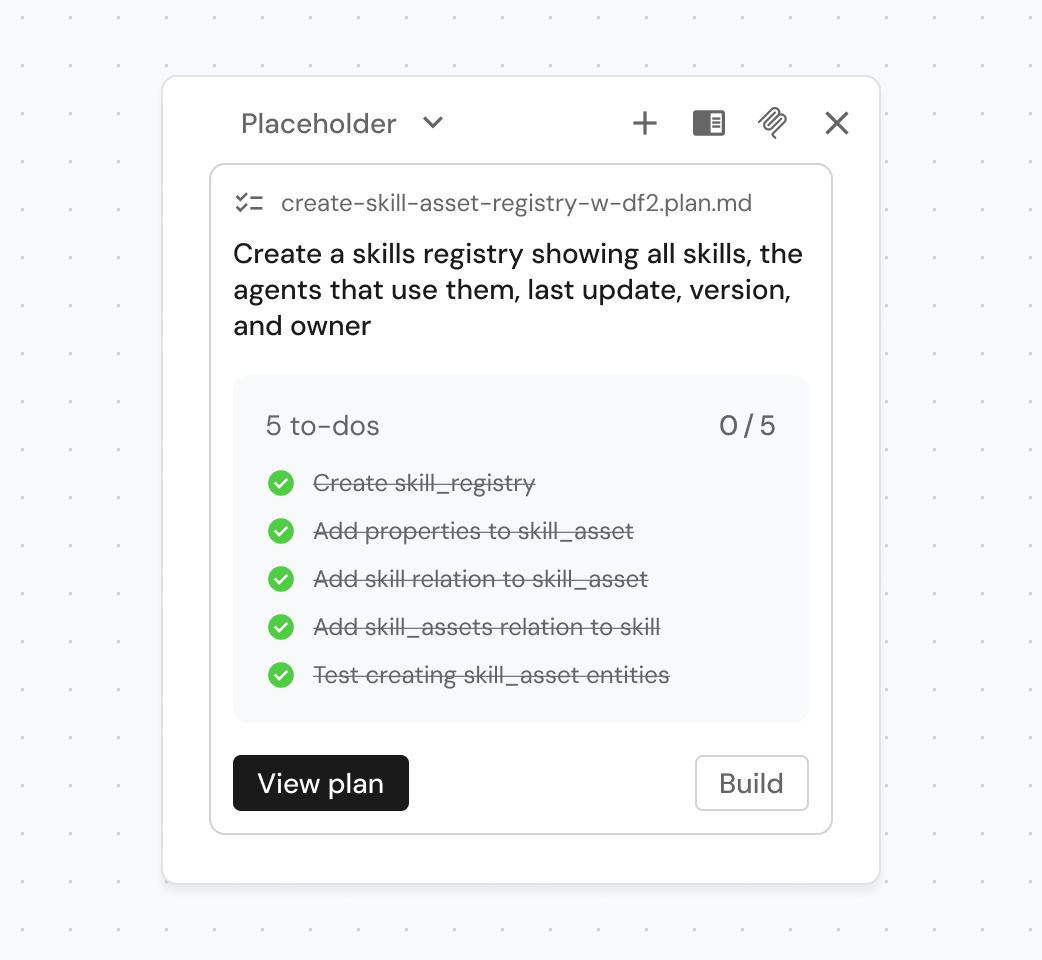
In Build mode, Port AI executes. For simple, scoped changes you can start here directly: ask it to update a blueprint or add a dashboard and it does it. More complex use cases route through Plan mode first.
Port AI builds the complete solution one layer at a time: the data foundation (entities, relationships, integrations), the measurement layer (scorecards to check against the standards you set), the action layer (workflows and triggers), the visibility layer (customizable, live dashboards), then validates and ships.
What you can build
Here is just a taste of what you can build with Port:
"Build an AI agent that monitors, deploys and automatically opens a rollback PR when error rates spike." Port builds an agentic workflow with deployment monitoring, error-rate triggers, and human-in-the-loop approval before rollback. You get a self-healing pipeline where agents catch and fix regressions before engineers see them.
"Build a skill registry that tracks every AI skill and agent running across our engineering org." Port builds a skill registry mapping skills to owners, surfaces which agents are active and where, and flags duplicates before they turn into sprawl. Teams stop building the same thing twice.
"Create an incident triage workflow that automatically identifies the root cause." Port builds an agentic incident triage workflow that correlates signals, runs root cause analysis, and routes to the right owner. First-line tickets resolve themselves, so engineers stop firefighting.
"Build an agent that blocks non-compliant deployments and recommends the safest rollout for everything else." Port wires scorecards into your CI/CD gates and builds a risk-scoring workflow that pulls from your observability and incident data. Services that miss standards don't ship. For releases that pass, the agent scores blast radius and change scope, and recommends Canary, Blue-Green, or full rollout. Release meetings become optional.
"Build a resource management workflow where developers provision on demand and an agent cleans up what's idle." Port builds self-service provisioning workflows with approval guardrails. An agent monitors usage and deprovisions whatever sits idle. Humans provision what they need. Agents reclaim what nobody’s using.
"Build an engineering intelligence hub for our leadership team." Port pulls DORA and AI impact metrics, service health scores, and ownership data from across your stack. Leadership sees deployment frequency, change failure rate, and where delivery is slowing. Not a dashboard to interpret. A live view that shows what needs attention, who owns it, and what to do about it.
Summary
Port AI Builder enables more builders across the engineering org through self-service, natural language development that eliminates the learning curve and cuts time to value. Teams build and customize agentic SDLC solutions faster without waiting on specialized expertise, while governance and operational controls are built in. Speed and reliability, no tradeoff.
See it in Action
Watch the short product demo:
{{cta_webinar_aug_18}}
Get started today
Port AI Builder is available on all Port plans. Sign up now to start building, or book a demo if you want to walk through AI Builder with us.


Get your survey template today
%201.svg)


Download your survey template today


Free Roadmap planner for Platform Engineering teams
Set Clear Goals for Your Portal
Define Features and Milestones
Stay Aligned and Keep Moving Forward
Create your Roadmap


Free RFP template for Internal Developer Portal
Creating an RFP for an internal developer portal doesn’t have to be complex. Our template gives you a streamlined path to start strong and ensure you’re covering all the key details.
Get the RFP template


Leverage AI to generate optimized JQ commands
test them in real-time, and refine your approach instantly. This powerful tool lets you experiment, troubleshoot, and fine-tune your queries—taking your development workflow to the next level.
Explore now
Check out Port's pre-populated demo and see what it's all about.
No email required
LIVE WEBINAR, Aug 18, 2026:
Context-aware Vibe Coding for Platform Engineering
Thursday, October 22 12:00pm EDT⋅6:00pm CET
To learn more about the new capability and to see a live demo, join our upcoming community session with GitHub
Move fast while staying in control
Build governed agentic workflows on one central platform.
See it in action:
Watch this video on generating Terraform with Port, or explore our public demo.
.png)
Check out the 2025 State of Internal Developer Portals report
No email required
Minimize engineering chaos. Port serves as one central platform for all your needs.
Act on every part of your SDLC in Port.
Your team needs the right info at the right time. With Port's software catalog, they'll have it.
Learn more about Port's agentic engineering platform
Read the launch blog
Contact sales for a technical walkthrough of Port
Every team is different. Port lets you design a developer experience that truly fits your org.
As your org grows, so does complexity. Port scales your catalog, orchestration, and workflows seamlessly.
Port × n8n Boost AI Workflows with Context, Guardrails, and Control
Port Builders Session: A Single, Governed Interface for All MCP Servers
Book a demo right now to check out Port's developer portal yourself
Apply to join the Beta for Port's new Backstage plugin


n8n + Port templates you can use today
walkthrough of ready-to-use workflows you can clone
From manual to autonomous engineering
One platform to build, govern, and operate the Agentic SDLC.
Port is open for you to try it
build your first agentic workflow today