What is a service?
"Service" means something different to every team. Here's a precise definition, a litmus test, and a catalog schema, plus why AI agents make getting this right urgent.


"Agents magnify the DevOps & infra best practices you have, or the lack of practices you have."
That's what one of our customers told us recently and he’s a platform engineer at a Fortune 500 finance company. And the practice that trips up the most teams is how they define a "service" in their software catalog.
Is it a repo? A Kubernetes deployment? A business capability like "payments" or "checkout"? A Lambda function?
It may not seem like an issue, but once a company grows past a few teams, that ambiguity creates friction you can feel but can't easily point to - like an incident where you don't know who to page.
So if you don't have an agreed-upon definition, it's probably one of the most impactful things you can align on.
Here's how we think about it:
How we define "service" at Port
The definition we've agreed on internally: a service is a deployable unit owned by a single team that exposes a stable interface to other systems.
Owned by a single team is clear, but what are deployable units and stable interfaces?
Deployable unit means that your team can change it, release it, and roll it back without requiring other teams to deploy their services at the same time.
Stable interface means that the way other systems interact with the service (API, events, etc.) changes slowly and backward-compatibly so consumers don’t break when the service evolves.
Quick litmus test: is it a service?
If you can answer yes to all of these, it's probably a service:
- Can you deploy it independently, without coordinating with another team?
- If it goes down at 2am, is there one clear owner to page?
- Can you roll it back without rolling back something else?
- Does it have its own CI/CD pipeline (or a distinct stage in a shared one)?
And a few signs it's not a service:
- A shared library that other teams import (that's a dependency, not a service)
- A repo that contains three things deployed on different schedules (that's three services, not one)
- A Helm chart that bundles unrelated containers (that's packaging, not a service)
There's no true universal answer here and some companies might have multiple definitions of service internally (which is fine). The goal is getting to agreement in your engineering department so that your catalog, your on-call, and your scorecards all reference the same thing.
Best practices: what a service should look like in your catalog
Once you've agreed on the definition, the next question is: what are the most important properties that a service should have, and what should it connect to?
If we were starting from scratch, here's how we would make a service work for us in a software catalog:
At a bare minimum, services should have some core properties:
- Owning team: just one team (so you know who to turn to when something needs fixing)
- Lifecycle stage: production, staging, deprecated, experimental (so humans and agents know what's active and what to leave alone)
- Tier/criticality: P0 revenue-critical vs. P3 internal tooling (drives SLO targets and incident response)
- Language/framework: useful for scorecards and security scanning
- Deploy target: where it runs (EKS cluster, Lambda, Cloud Run, etc.)
- Repo: link to source (but remember: the repo is not the service)
- Communication channel: link to Slack or Teams channel (so you or an agent knows where to page the owning team)
On its own, a service isn't worth that much. It needs to be connected to other things to be truly valuable.
Some key connections your service should have:
- Depends on: what other services does this call at runtime?
- Consumed by: what other services rely on this service?
- Owned by: Both a property and a connection to the owning team
The connections matter more than the properties. Without dependencies, you can't calculate blast radius. Without "Owned by" linked to a team with on-call data, incident routing breaks.
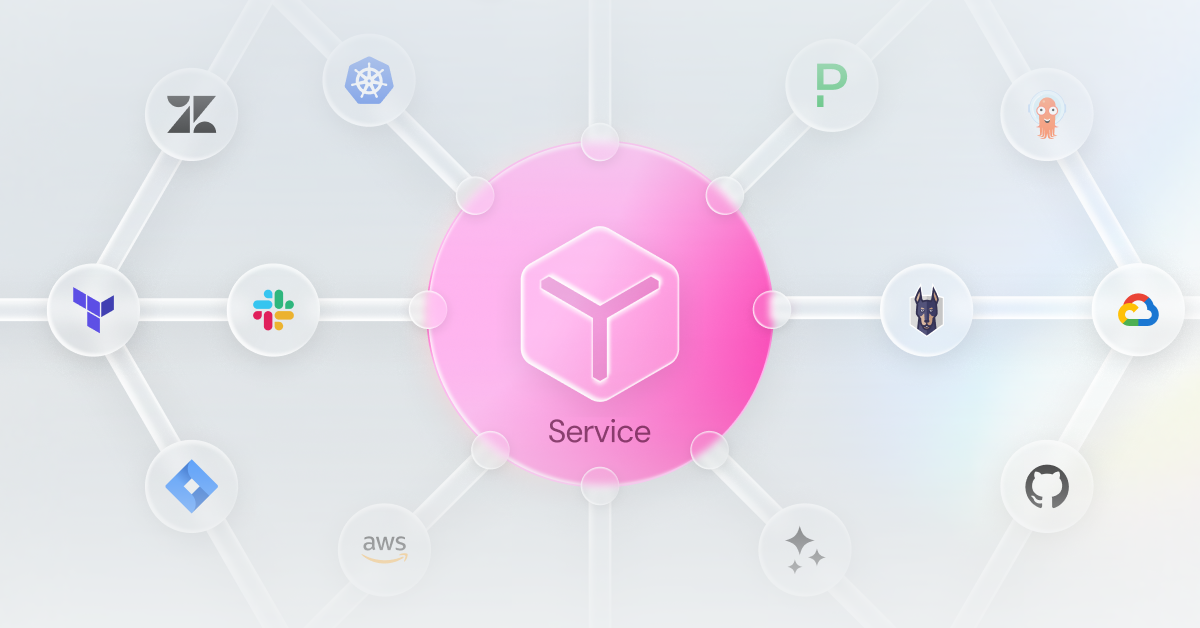
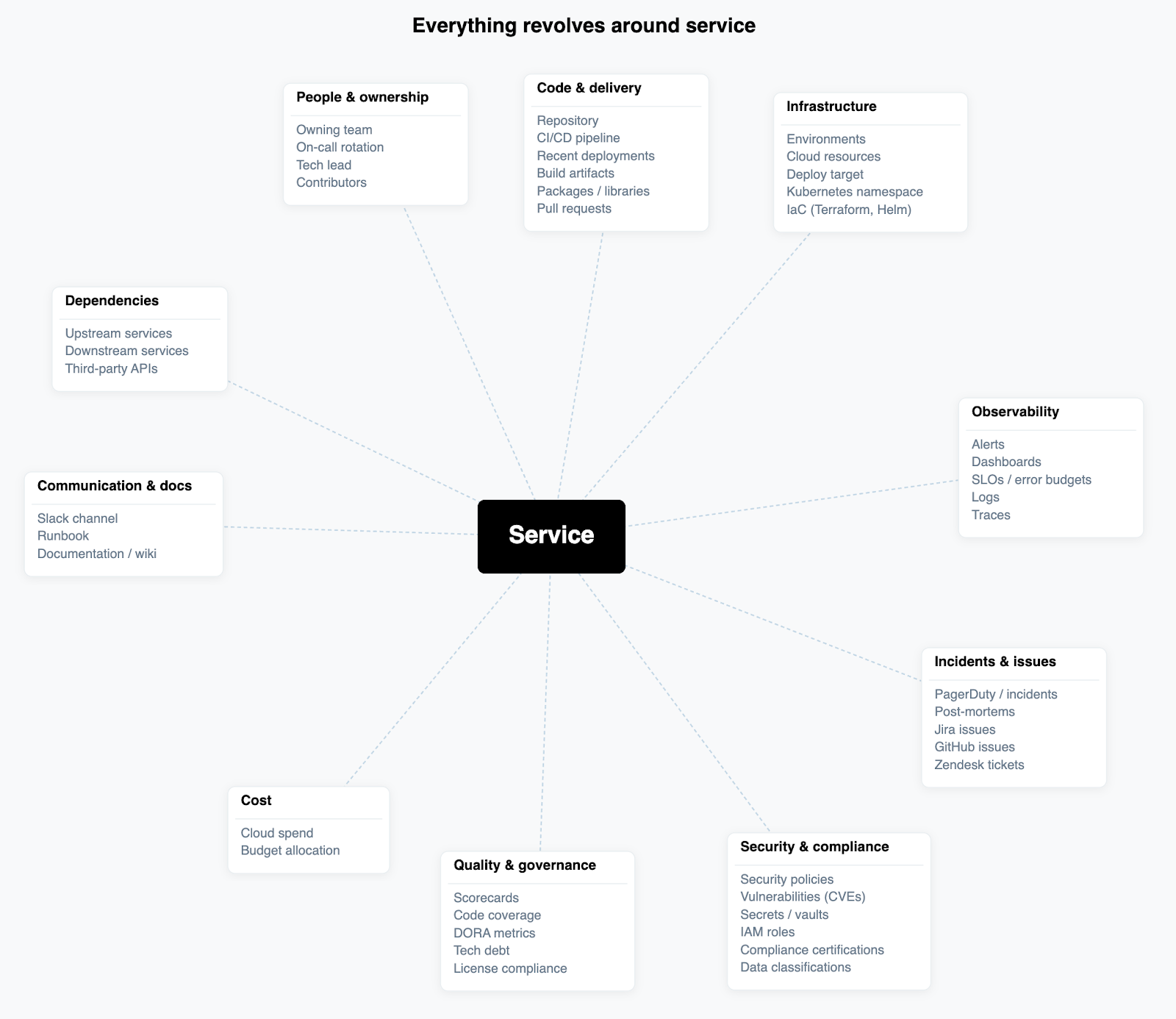
Internally at Port, our services have over 70 connections to other types of data in Port, more than any other data type in our software catalog. Our services connect to other services, teams, environments, deployments, packages, cloud resources, incidents, scorecards, and many more. For us, service is the center of gravity for everything else.
Defining a service matters more now than ever
Picture a P1 incident at 2am. A latency spike is hitting checkout. With a clean service definition, your on-call engineer opens the catalog, sees checkout-service, sees it depends on payment-gateway and cart-service, sees the owner is Team Payments, and starts debugging. The blast radius to other services is clear. The escalation path to senior engineers is clear. Time to action would be just minutes.
Let's run the same incident with fuzzy definitions. "Checkout" in the catalog is actually three things deployed on different schedules by two different teams. The on-call engineer that got paged only owns half the runtime. They spend 30 minutes figuring out what's actually broken and who else to pull in. By the time the right people are in the war room, the outage has been going on for an hour.
Remember how one of our customers said this? "Agents magnify the best practices you have, or the lack of practices you have."
This is why defining a service matters now more than ever.
As agentic workflows are taking over our SDLC, they will do their best work with well-defined data, starting with services. Give an agent a well-defined service and it triages the incident in minutes. Give it the fuzzy version and it looks for a root cause in the wrong repo.
How to get started
- Test if your services are services. Run each service through the litmus tests above. If you can deploy it independently and it's owned by one team, it's a service. If not, it may be a dependency, a sub-component, or multiple services bundled together.
- Audit them against reality. Pull up a few recent incidents and compare what broke against what your catalog says. If the incident damaged three things the catalog calls one service, your definitions might be off.
- Build the schema. Decide which core properties and relations are important to connect to your services. We recommend starting with owner, lifecycle, tier/criticality, and dependencies.
- Make it the contract, company-wide. Once the definition and schema are agreed on, treat them like infrastructure. New services must be created from the template. Existing ones get migrated. If there are exceptions, they should get documented, not ignored.
You don't need a definition that covers every edge case. You need a shared one that's precise enough for both humans and agents to rely on.


Get your survey template today
%201.svg)


Download your survey template today


Free Roadmap planner for Platform Engineering teams
Set Clear Goals for Your Portal
Define Features and Milestones
Stay Aligned and Keep Moving Forward
Create your Roadmap


Free RFP template for Internal Developer Portal
Creating an RFP for an internal developer portal doesn’t have to be complex. Our template gives you a streamlined path to start strong and ensure you’re covering all the key details.
Get the RFP template


Leverage AI to generate optimized JQ commands
test them in real-time, and refine your approach instantly. This powerful tool lets you experiment, troubleshoot, and fine-tune your queries—taking your development workflow to the next level.
Explore now
Check out Port's pre-populated demo and see what it's all about.
No email required
LIVE WEBINAR, Aug 18, 2026:
Context-aware Vibe Coding for Platform Engineering
Thursday, October 22 12:00pm EDT⋅6:00pm CET
To learn more about the new capability and to see a live demo, join our upcoming community session with GitHub
Move fast while staying in control
Build governed agentic workflows on one central platform.
See it in action:
Watch this video on generating Terraform with Port, or explore our public demo.
.png)
Check out the 2025 State of Internal Developer Portals report
No email required
Minimize engineering chaos. Port serves as one central platform for all your needs.
Act on every part of your SDLC in Port.
Your team needs the right info at the right time. With Port's software catalog, they'll have it.
Learn more about Port's agentic engineering platform
Read the launch blog
Contact sales for a technical walkthrough of Port
Every team is different. Port lets you design a developer experience that truly fits your org.
As your org grows, so does complexity. Port scales your catalog, orchestration, and workflows seamlessly.
Port × n8n Boost AI Workflows with Context, Guardrails, and Control
Port Builders Session: A Single, Governed Interface for All MCP Servers
Book a demo right now to check out Port's developer portal yourself
Apply to join the Beta for Port's new Backstage plugin


n8n + Port templates you can use today
walkthrough of ready-to-use workflows you can clone
From manual to autonomous engineering
One platform to build, govern, and operate the Agentic SDLC.
Port is open for you to try it
build your first agentic workflow today