How to build a context layer for your AI SDLC
Learn what a context layer is, what goes into one, whether to build or buy one, and how it cuts AI agent costs across the SDLC.


.png)
A context layer is a single, continuously updated model of your engineering estate that agents and people query instead of hitting a dozen tools one at a time. It holds your services, who owns them, what depends on what, what is running where, and which actions an agent may take, with the relationships between all of it already resolved. When an agent asks "who owns the checkout service” and it is mid-incident, it reads one place and gets an answer instead of stitching together three API calls and hoping the names line up.
Gartner names context accumulation as the main cost driver for custom-built agents, because every task reassembles a context window and every step reingests it, and in Port's own measurements a context layer cut per-query agent cost by 80%. The layer is where both the safety and the economics of agents get decided, and a better model does not hand it to you.
This piece answers five questions:
- What is a context layer, and what goes in one?
- Should you build it or buy it?
- What can you run on top of it?
- What is the ROI, and how do you measure it?
- How do you start building one?
What is a context layer for AI systems?
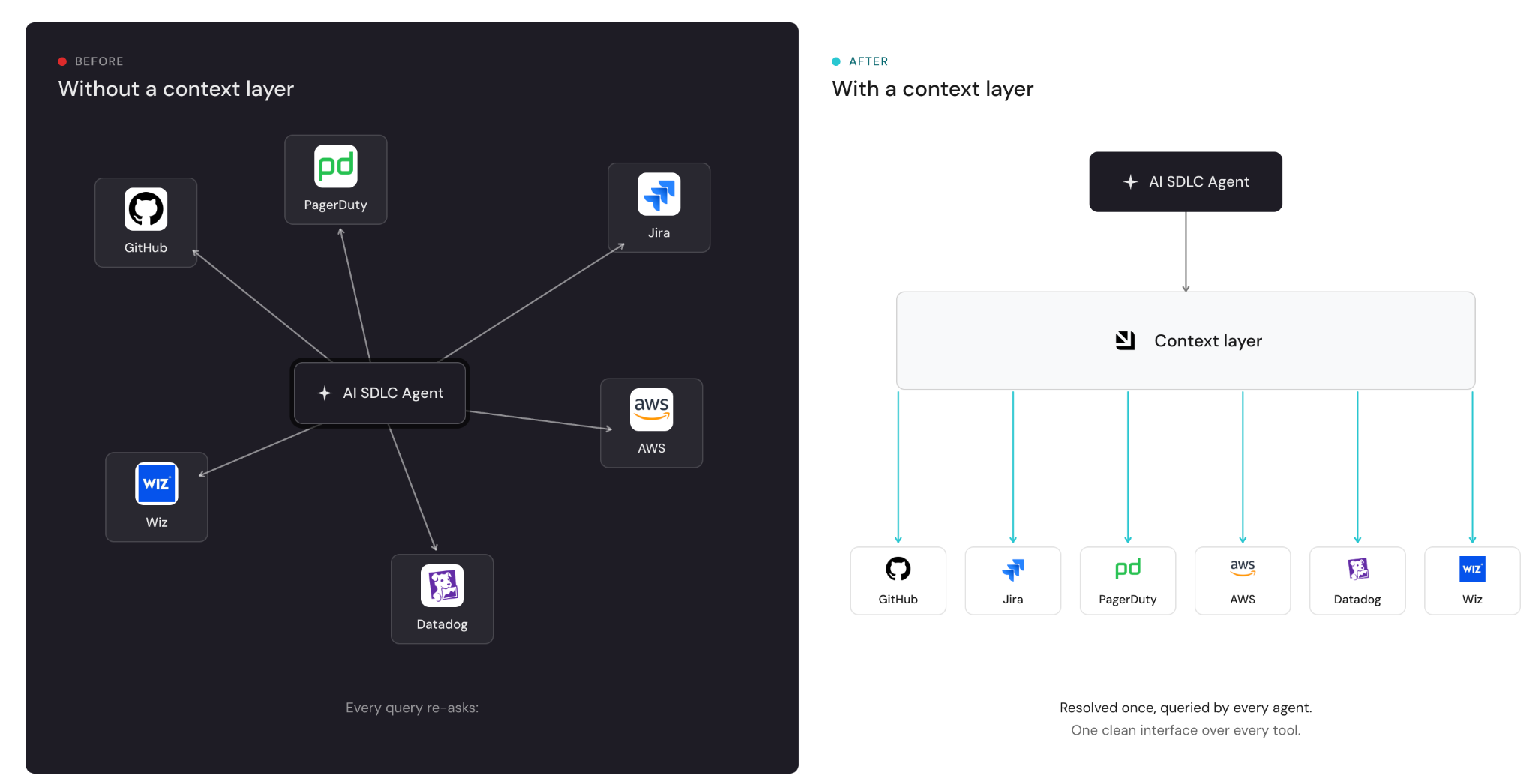
A context layer is the layer of organizational knowledge between your agents and your raw tools. Your agent already has tool access. It can call the GitHub API and list every repository. Ask it "which services does the platform team own," and it stalls, because that relationship lives in no API. The context layer is where that relationship, and thousands like it, are modeled once and served to every agent that needs them.
The cleanest way to see what belongs in it is to split what a model can work out on its own from what it cannot. A strong model infers a lot from source code. It infers nothing about the live state of your organization, because that state is not in the code.
Everything on the right is live, organizational, and specific to you. It changes by the hour, and it is exactly what an agent needs before it does anything consequential. A context layer is where that context stays accurate and queryable.
{{from_manual_to_autonomous_engineering}}
Why a context layer matters in the AI SDLC
Without one, agents fail in a predictable way, and they fail worse as you add more of them. Port calls the pattern agent sprawl. You connect one agent to GitHub and Jira, it works for you, and then someone asks to roll it out to the org. Three walls appear at once. Security review of each data source, often through an AI committee, slows every new connection. Tool overload fills the context window with competing schemas, which makes the agent slower, costlier, and less accurate. And the knowledge gap remains, because even with every tool connected the agent still cannot say who owns a service, since that was never in a tool to begin with.
A context layer resolves all three. Access is governed in one place, the agent queries one interface, and the ownership-and-dependency knowledge that raw APIs never held is modeled explicitly. Feed an agent ungoverned, unstructured data and you get hallucinated relationships, duplicated work, and the occasional unsafe change. Give it a structured model of your estate and its behavior turns far more deterministic, which is what you want when it is about to open a PR against production.
Components of a unified context layer
A useful context layer holds four kinds of context, exposes one interface to agents, and wraps the whole thing in governance. The four are domain knowledge (your services and how they relate), operational state (what's happening right now), the human layer (ownership, standards, and policy), and the actions an agent is allowed to take. Each gets its own section below. Port structures its Context Lake this way, so those sections use its building blocks (blueprints, relations, scorecards, self-service actions, automations, and the MCP server) as the concrete implementation.
Domain knowledge: the context layer and its relations
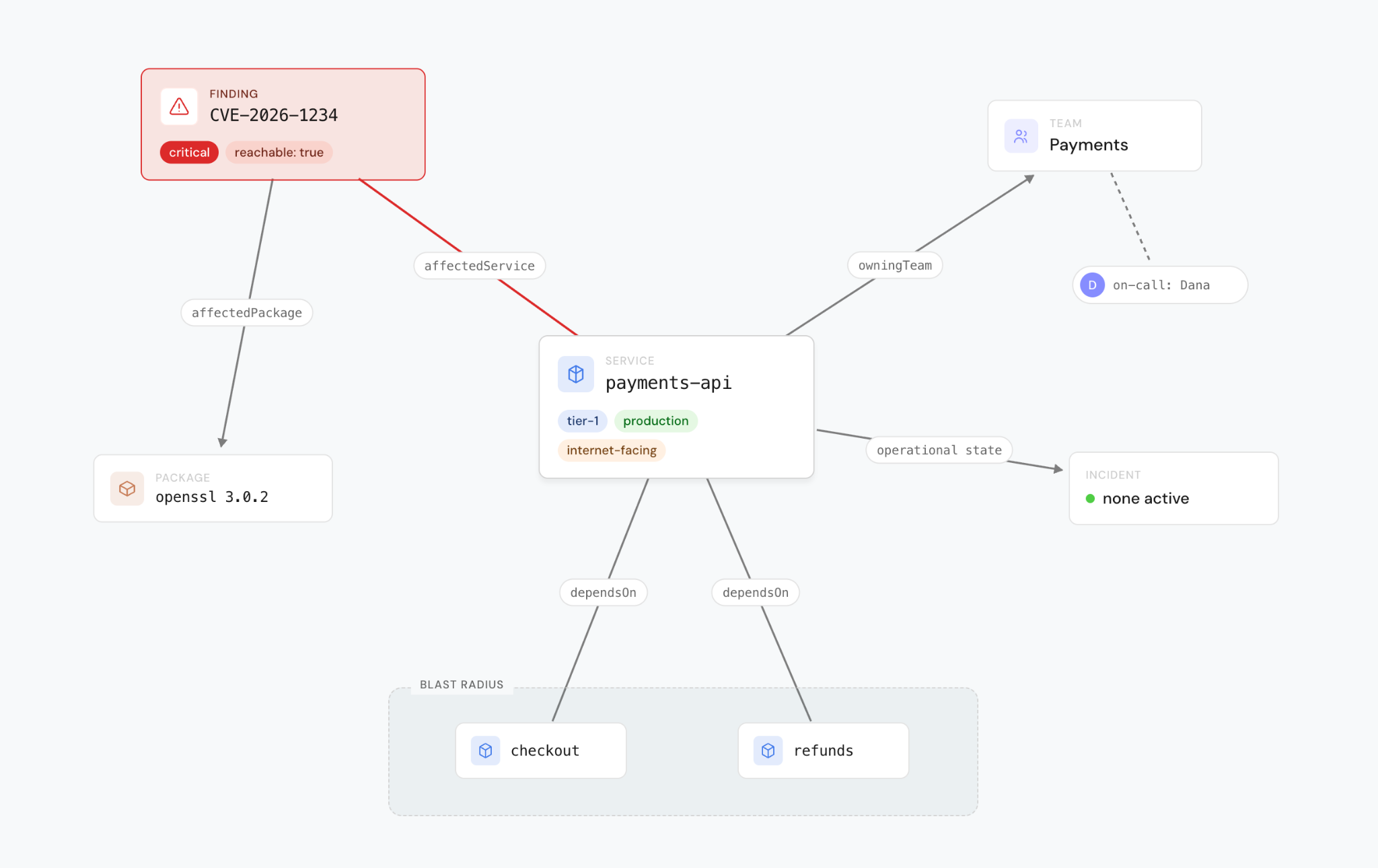
This is the structural core: your services, packages, environments, deployments, and the connections between them. In Port you model it with blueprints, which define the shape of each asset type, and relations, which connect them into a graph.
Those relations turn a flat list of services into a graph an agent can traverse. dependsOn gives you blast radius, owningTeam gives you routing, and internetFacing with lifecycle gives you exposure. A finding from a scanner then relates into the same graph, so a vulnerability is never a free-floating ticket but a node attached to a specific service, package, and environment.
Operational state
Domain knowledge tells you how things are wired. Operational state tells you what is happening now: active incidents, in-progress deployments, runtime health, current on-call. This context goes stale fastest, and a model can never infer it from a repo. An agent that knows a service is mid-incident, or inside a change freeze, makes a safer decision than one that does not.
The human layer: engineering metadata
Human layer context engineering is the practice of capturing what lives in your engineers' heads and nowhere in an API: ownership, standards, policies, and the local conventions that make your estate yours. At one company DevOps owns Datadog, at another the SREs do. Both are reasonable, and an agent cannot guess which is true for you. This is business context in the literal sense, the decisions your organization has made about how it operates, and it is what lets an agent route work to the right team and apply the right policy. Onboard an agent this way, as you would a junior engineer, and it stops guessing at how your organization works.
{{from_manual_to_autonomous_engineering}}
Actions and tools
A context layer that only answers questions is half a layer. The other half is the set of actions an agent may take: self-service actions and automations that trigger CI/CD, provision infrastructure, open a PR, or file a ticket. Exposing these through the same layer means the agent sees what it is permitted to do and nothing else, which gives it autonomy inside a boundary you set.
The agent interface: MCP
Agents reach the whole layer through one interface, the MCP server, rather than connecting to each tool. Because the data is already related, one natural-language query resolves what used to be a chain of calls.
Behind that query the server traverses the graph (list_entities with the relatedTo operator) and returns reachability, owner, and downstream dependents in one response. The agent never reasons about how GitHub, PagerDuty, and your scanner connect, because the connection is already in the model.
A context layer is not raw vector memory
A context layer is not the "memory" people bolt onto agents with a vector store, and the difference matters. Raw vector recall returns fuzzy, unstructured snippets ranked by similarity. A context layer as AI memory returns structured, typed, governed facts with explicit relationships, so "who is on call for payments" comes back as a definite value from a definite field rather than the three most similar paragraphs the agent once saw. Only the structured layer is safe to let an agent act on.
The rule that matters most: freshness
An agent acting on a stale graph is worse than one acting on no graph. Here is the failure in concrete terms: a fix for a critical CVE merges at 9 a.m., and if the finding entity still reads open at 10, your remediation agent opens a second PR against the already-patched dependency, a human reviews and merges it, and now you have two conflicting version bumps and an audit trail that says the same finding was fixed twice. Stale ownership does the same thing to incidents, paging a team that handed the service off a month ago. So the hard part of a context layer is not holding the context, it is keeping it fresh enough to act on. Continuous ingestion, plus mirror and aggregation properties that recompute at sync time rather than at query time, are what keep the model current. Guard freshness hardest, because everything else the layer promises depends on it.
Building vs buying a context layer
The build-vs-buy call is cleaner than most once you separate the primitives from the model. The primitives are the context layer engine, the relation graph, the ingestion connectors, the governance controls, the action framework, and the MCP interface. Building those yourself recreates years of infrastructure and commits you to maintaining connectors against a moving target of tool APIs forever, which is rarely where your differentiation lies. The model is your data: which blueprints you define, how you relate them, what "production-ready" means here, which actions you expose. That is genuinely yours, and no vendor can pre-build it, because it encodes decisions only you have made.
So the honest framing is buy the primitives, build the model. A bought platform is an empty shell on day one, and the value shows up only after you model your estate, typically a basic context layer with a few actions in a week or two and broader coverage over the following weeks. If you are choosing a platform, weigh how flexible its data model is, how it keeps data fresh, and whether governance is native rather than bolted on. If you are weighing a full in-house build, ask whether maintaining ingestion connectors and an RBAC layer is a business you want to be in.
Three agents you can build on top of a context layer
One context investment carries many agents, and they share a shape. Each takes a trigger, grounds it in the context layer, plans an action, passes a governance gate, executes, verifies the result against the context layer, and records the chain for audit. Here are three worth building, from the highest-urgency one down.
1. Autonomous security remediation
Cogent Security's analysis of roughly 69,000 CVEs found the average time from disclosure to a working exploit fell from about 125 days in early 2025 to roughly half a day by April 2026, as reported by SiliconANGLE. Manual patching cannot operate on that clock, and fix generation is exactly the part frontier models are commoditizing. What stays slow and dangerous is everything after the fix is written: contextualizing it, gating it, deploying it, and confirming it held without breaking production.
A remediation agent on the context layer runs the loop that closes that gap.
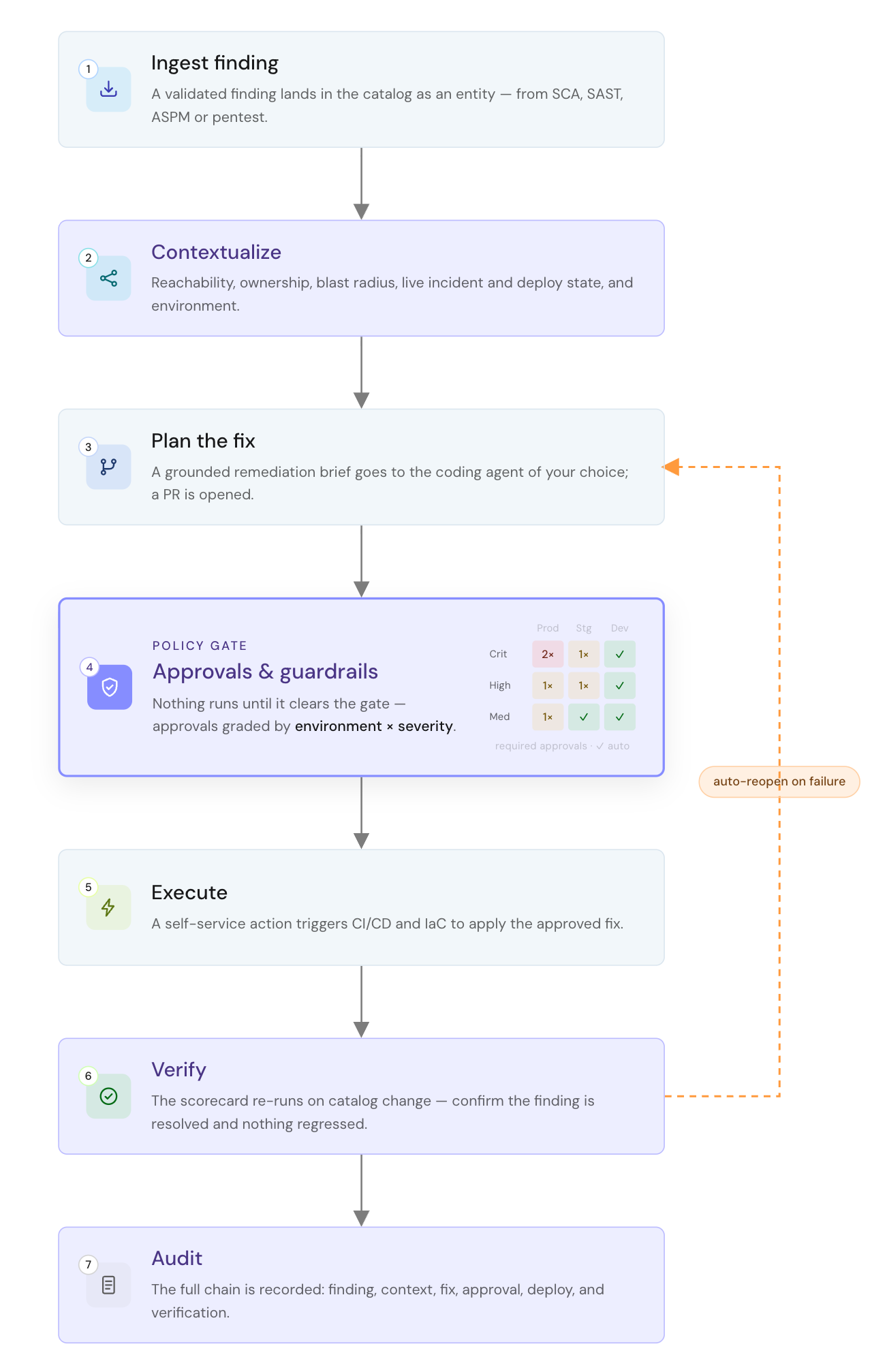
The context layer supplies the un-inferable and governance-critical steps (contextualize, gate, verify, audit) and orchestrates the rest. It does not detect the vulnerability or write the patch. Your scanner finds it and your coding agent fixes it. The layer owns the part no one else owns well, which is shipping the change safely across a real estate under policy. The policy gate makes autonomy safe to switch on. You grade it by environment and severity, so a dependency bump in staging can execute on its own while a critical fix in production waits for a human.
2. Incident response and triage
An alert tells you something broke. The slow part is everything between that and the moment an engineer has the context to start diagnosing: the service's tier, its recent deploys, its dependents, and its owner, pulled into one place. An incident agent grounded in the context layer runs that assembly and hands back a triaged incident.
It reads the affected service from the context layer along with its tier and SLA. It checks operational state for a deploy that lands near the alert, which is the first thing a responder would suspect. It walks the ownership relation to the current on-call and pages that person rather than a stale rotation. It walks dependsOn to list what else is at risk, then opens a fresh channel, attaches the relevant runbooks, and proposes a first action. Anything that touches production stays behind an approval gate, so the engineer still makes the call. What the agent removes is the manual scramble to gather that context at 2 a.m., not the judgment about what to do with it. You wire it to fire the moment an incident lands.
3. Production-readiness and drift remediation
This agent runs off scorecards, Port's rules engine over the context layer. You define what "production-ready" means as a set of rules, and every service is scored against them continuously.
The agent watches for the drop. When a service falls from Gold to red, because a critical finding appeared or an owner went missing, an automation invokes it with the failing entity in hand. It reads which rule broke and why, walks the ownership relation to the responsible team, and generates a brief for that specific gap rather than a generic warning. For a missing owner it opens a PR against the CODEOWNERS file. For a new critical finding it hands the coding agent the same remediation brief the security loop uses. Once the change merges, the scorecard re-evaluates on the context layer update, and the agent confirms the level returned to green before it closes the loop and records the chain. The context layer is both the trigger and the proof.
All three agents run the same loop. Once the context layer exists, adding the second and third is mostly configuration, not new infrastructure, because they draw on the same model and the same governance.
Context layer ROI
The return shows up in three places: what you spend on agents, the quality of what they produce, and how you govern them. A remediation or incident agent also moves numbers a platform or security lead already reports, including mean-time-to-remediate, exposure-window hours, and change-failure rate, so you make the case in numbers leadership already tracks. Those outcomes come from the three returns below.
Lower cost
Context accumulation drives agent spend more than anything else. Every task assembles a context window, and each step reingests a growing pile of tool schemas and intermediate results, so the token bill compounds across a workflow. Without caching, the thousandth run of a common query costs the same as the first, and agent queries repeat in slight variations thousands of times a month.
Port measured this. We ran 1,000 common SDLC queries across four setups and three models, 12,000 runs in total, and counted tokens per query.
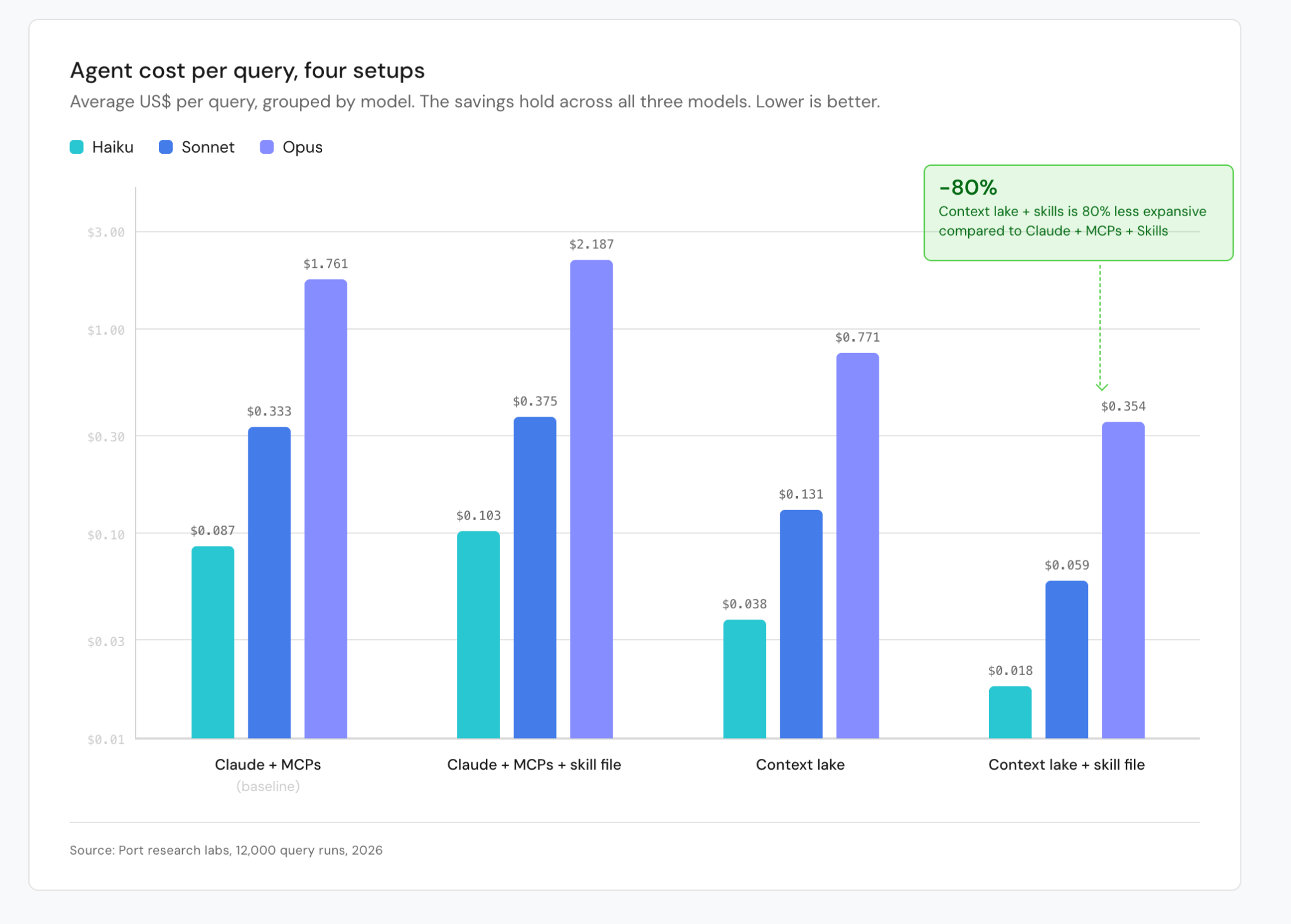
On Opus that moved the average query from $1.76 to $0.35, which brings an expensive model into range for everyday questions instead of reserving it for critical ones. One result surprised us. Adding a skill file to raw MCPs made things worse, because the agent followed it as a checklist and ran every step in order rather than reasoning about what it needed. The same file over the context lake helped, because the data was already joined and the file only had to point at the right entry point. The mechanism is the one from the components section. Pre-joined data lets the agent read one entity instead of working out how three tools connect, and mirror and aggregation properties compute fields like service.on_call and open_incident_count at ingestion instead of per query. A context layer moves that work from inference time to ingestion time, so you pay to build the relations once and every query after is cheaper.
Higher quality
Scattered data holds more than one truth, and an agent forced to reconcile them mid-query picks one and moves on, sometimes the wrong one. Take a single payments service. It is payments-api in GitHub, payment-svc in PagerDuty, and PAY in Jira. Its CODEOWNERS file names the platform team, while its PagerDuty schedule points at a different rotation that was patched in during an on-call swap and never reconciled. Ask a direct-to-MCP agent who to page, and it has to guess which identifier is the same service and which source wins, with no rule to tell it. It resolves that silently and returns a confident answer that pages the wrong team. A context layer settles the mapping once at ingestion into one canonical service entity, with every identifier attached and a single owner field, so every agent reads the same answer. Quality improves because the agent stops guessing at reconciliation and starts reading settled facts, and that makes its output repeatable instead of plausible.
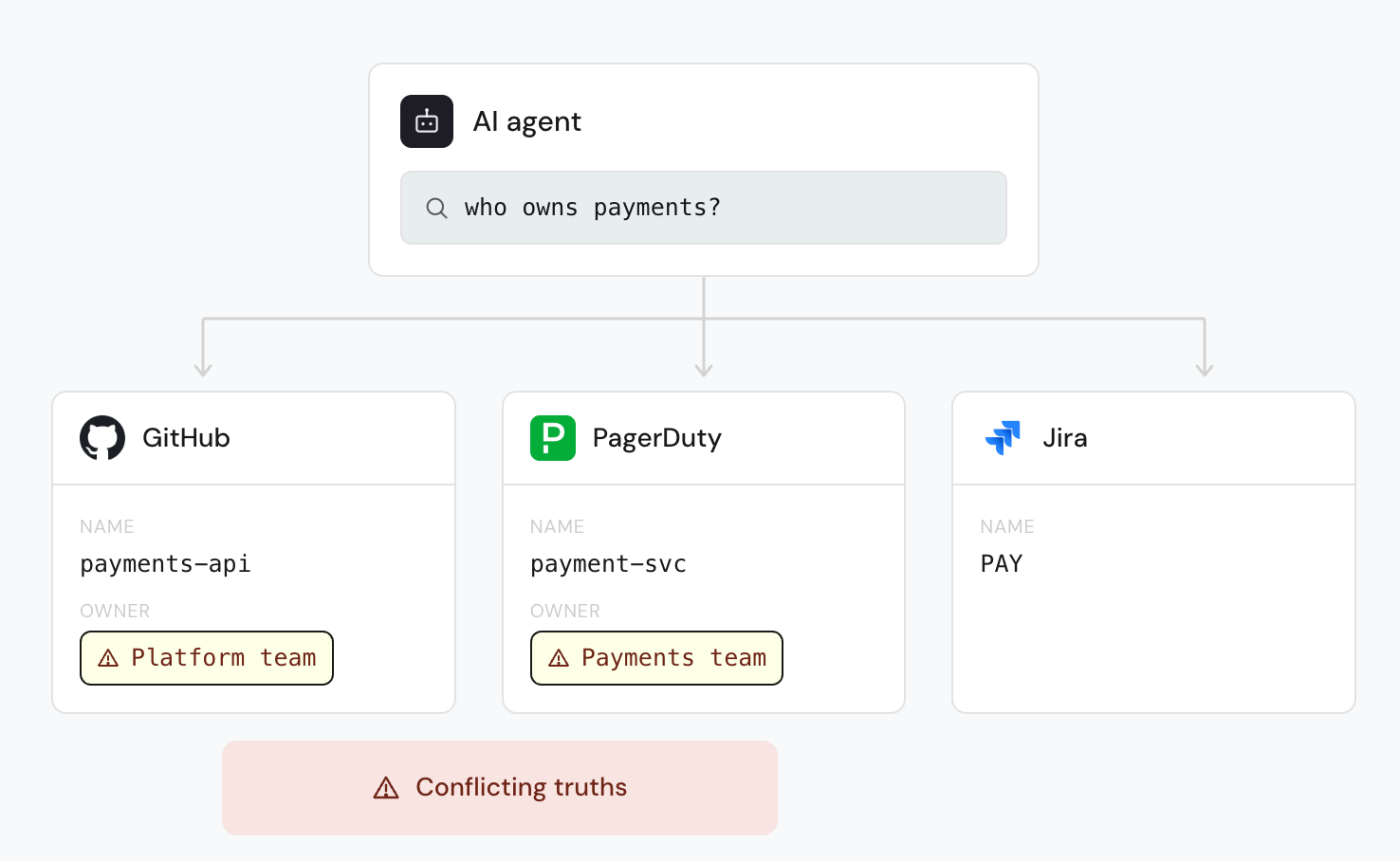
Governance in one place
Governing scattered data means governing each tool on its own, and no one can answer the question that matters, which is what a given agent can see and do across all of them. Every MCP server needs its own access review, which is why many organizations stand up an AI committee to approve data sources one at a time. A context layer puts access control, approvals, guardrails, and audit in one place. In Port an agent runs with the requesting user's permissions, so it sees only what that user can see and runs only what that user can run. Every action passes the same policy gate, graded by environment and severity, and every invocation is logged as a record you can export for a SOC 2 review or a CISA remediation deadline. Instead of reconstructing what an agent touched from a dozen tool logs, you read one chain, which is the difference between hoping an agent stayed in bounds and being able to prove it.
Context layer vs semantic layer
These get compared often, and they are complementary rather than competing. A semantic layer sits over your data warehouse and gives BI tools and analysts a consistent definition of metrics, so "revenue" means the same thing in every dashboard. Its job is agreement on the meaning of data for analytics. A context layer sits over your engineering estate and gives agents and engineers a live, related model of your systems and the actions allowed on them. Its job is grounding and governed action for operational work across the SDLC.
You can run both. If your agents need to reason about business metrics, a semantic layer feeds clean definitions in. When the question is operational, such as whether a service is safe to change right now and who owns it, that answer comes from the context layer.
How to start building your context layer
You do not need the whole layer before it pays off. Start narrow and let it grow.
- Model three blueprints and the relations between them. Service, Team, and Environment is enough to answer ownership and exposure questions on day one.
- Wire in two integrations that keep those entities fresh, usually your Git provider and one operational tool such as PagerDuty, so the model reflects reality rather than a one-time snapshot.
- Expose the model through the MCP server and point one agent at it. Then run the acceptance test: without hopping across tools, the agent should answer who owns a service, what depends on it, whether it is mid-incident, who is on call for it, and whether it is inside a deploy window. Any question it misses tells you exactly which blueprint or relation to model next.
- Build one gated agent end to end. The remediation loop is the highest-urgency place to start, and incident triage is the lowest-risk. Pick one, put a policy gate in front of any action that touches production, and instrument MTTR and cost from the first run.
The model gets more valuable with every blueprint you add and every agent you point at it, because the relationships you build once are reused by everything downstream. The teams that get real work out of agents in 2026 will not be the ones with the best models, since everyone has the same models. They will be the teams that spent the time building the layer those agents can stand on.
FAQS
Is a context layer the same as a knowledge graph?
It contains one. The context layer of entities and relations is a knowledge graph of your engineering estate, but a context layer adds the parts a graph alone lacks: continuous ingestion to keep it current, governance over who and what can read or act on it, and an action framework so agents can do work, not just answer questions.
Does a context layer replace MCP?
No, it concentrates on it. Instead of connecting an agent to a dozen MCP servers with a dozen schemas, you connect it to one MCP server that fronts the whole layer. MCP stays the protocol; the context layer becomes the single endpoint worth pointing it at.
Can a vector database serve as an AI context layer?
Not on its own. Vector recall returns similar text, which is useful for documents but unsafe as a basis for action. An agent about to open a PR against production needs typed facts and explicit relationships, not the three most relevant paragraphs. Use vectors for unstructured knowledge and the context layer for facts and actions.
How long does it take to stand one up?
A basic context layer with a few blueprints, live integrations, and one or two self-service actions typically takes a week or two. Broad coverage across a large estate takes weeks more, and the modeling work never fully ends, because the estate keeps changing. That is the point of buying the primitives: the ongoing work is your model, not your infrastructure.
Who should own the context layer?
Platform engineering. Agent cost, agent quality, and agent governance all trace back to the structure of the data the agents are given, and platform teams already own that structure for humans. Treating the context window as a managed resource with a budget is the same discipline, extended to agents.


Get your survey template today
%201.svg)


Download your survey template today


Free Roadmap planner for Platform Engineering teams
Set Clear Goals for Your Portal
Define Features and Milestones
Stay Aligned and Keep Moving Forward
Create your Roadmap


Free RFP template for Internal Developer Portal
Creating an RFP for an internal developer portal doesn’t have to be complex. Our template gives you a streamlined path to start strong and ensure you’re covering all the key details.
Get the RFP template


Leverage AI to generate optimized JQ commands
test them in real-time, and refine your approach instantly. This powerful tool lets you experiment, troubleshoot, and fine-tune your queries—taking your development workflow to the next level.
Explore now
Check out Port's pre-populated demo and see what it's all about.
No email required
LIVE WEBINAR, Aug 18, 2026:
Context-aware Vibe Coding for Platform Engineering
Thursday, October 22 12:00pm EDT⋅6:00pm CET
To learn more about the new capability and to see a live demo, join our upcoming community session with GitHub
Move fast while staying in control
Build governed agentic workflows on one central platform.
See it in action:
Watch this video on generating Terraform with Port, or explore our public demo.
.png)
Check out the 2025 State of Internal Developer Portals report
No email required
Minimize engineering chaos. Port serves as one central platform for all your needs.
Act on every part of your SDLC in Port.
Your team needs the right info at the right time. With Port's software catalog, they'll have it.
Learn more about Port's agentic engineering platform
Read the launch blog
Contact sales for a technical walkthrough of Port
Every team is different. Port lets you design a developer experience that truly fits your org.
As your org grows, so does complexity. Port scales your catalog, orchestration, and workflows seamlessly.
Port × n8n Boost AI Workflows with Context, Guardrails, and Control
Port Builders Session: A Single, Governed Interface for All MCP Servers
Book a demo right now to check out Port's developer portal yourself
Apply to join the Beta for Port's new Backstage plugin


n8n + Port templates you can use today
walkthrough of ready-to-use workflows you can clone
From manual to autonomous engineering
One platform to build, govern, and operate the Agentic SDLC.
Port is open for you to try it
build your first agentic workflow today