How to build an AI Software Factory: Roles, Workflows, ROI measurement
Discover what an AI software factory is, why it beats coding assistants, and who owns it in your engineering organization today.


The rise of AI has changed what limits an engineering organization: not how many engineers you can hire, but how much of the SDLC you can hand to agents. Almost every org has rolled out AI coding assistants; far fewer ship faster, because an assistant speeds up only the coding stage, and coding was rarely the slow part. Review and testing were, so faster code just backs up.
Shipping faster end to end takes a different blueprint: not an assistant that helps a developer write code, but agents that run the delivery process itself, from request to deployed change. That shift, from AI-assisted to AI-led engineering, is not something a better model gets you alone. Picture your SDLC as a software factory: the whole line running as production, with the process, guardrails, shared context, and audit trail that keep agents predictable as you scale. The shift is less about any single model than the system around it, and the teams pulling ahead build that system deliberately rather than waiting on the next release.
The short version
- Inside an AI-native software factory: your agents and teams, plus a harness for orchestration, context, governance, and measurement.
- Why do you need one: assistants speed up one stage and push the bottleneck downstream while agents sprawl ungoverned; a factory runs the whole line.
- How platform engineering changes: from building a portal to building the software factory.
- Roles: DevOps owns the machines, platform engineering builds and governs, engineers operate and extend, and the VP R&D sets how far autonomy goes.
- Three workflows to start with: self-healing incidents, ticket to PR, and auto security remediation.
Why you need an AI software factory
Speed. Assistants speed up one stage and leave the rest of the line where it was, so delivery does not get faster end to end. Ship more code and the same senior reviewers still gate every merge, so the pull request queue becomes the constraint. More changes reach production, so on-call absorbs more incidents, each opening with manual context-gathering.
.png)
A factory fixes this by running the whole line. A review agent clears low-risk pull requests so seniors see only what needs judgment; on an incident, the shared system of record hands the agent the service, its owner, deploys, and dependencies in seconds. We consistently see the same pattern: the coding stage gets faster first, and the gains stall until review, testing, and incident work move onto the line beside it.
Governance. Run dozens, then hundreds, of agents and the next problem is agentic chaos: agents, skills, and tools wired in everywhere with no visibility. Three failures follow.
- Quality falls on bad context. With no shared source of truth, an agent guesses which service owns a failing endpoint, and pushing more context in makes it worse: the model lacks an engineering semantic layer.
- Cost runs unchecked. Token spend climbs with no line back to the work delivered. See our research on how the Context Lake cuts ~80% of token use.
- Security is wide open. Agents reach sensitive data and hold more MCP access than they need, so one could deploy on a Sunday and you would not know.
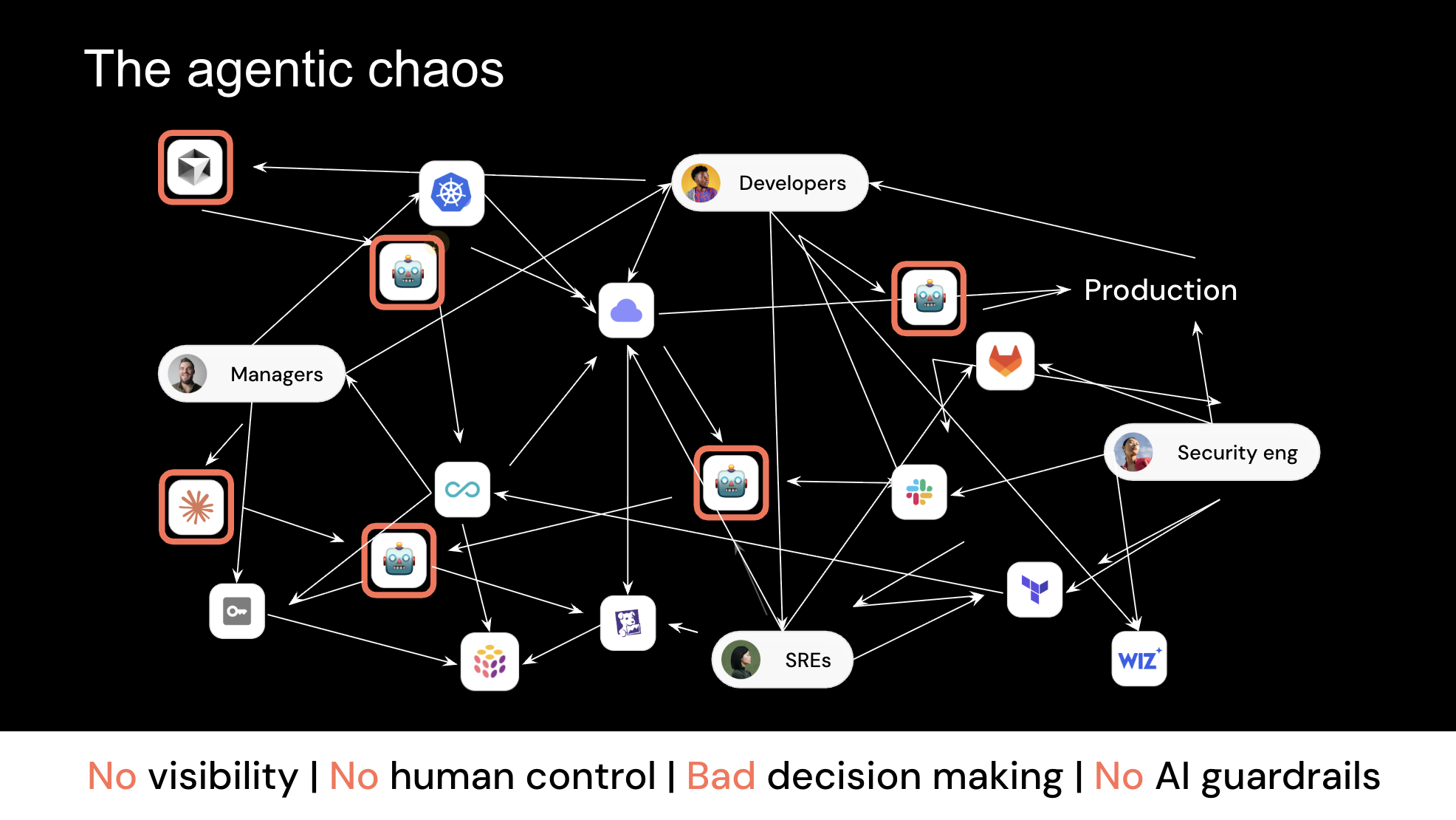
A factory gives governance one place to live: a registry of every agent and what it can touch, scoped context, cost tied to work delivered, and permissions with a full audit trail. That layer is the agentic SDLC platform, the one you build the software factory with. We caution against letting it form by accident; retrofitting governance onto hundreds of agents already in production is far harder than scoping it in from the start.
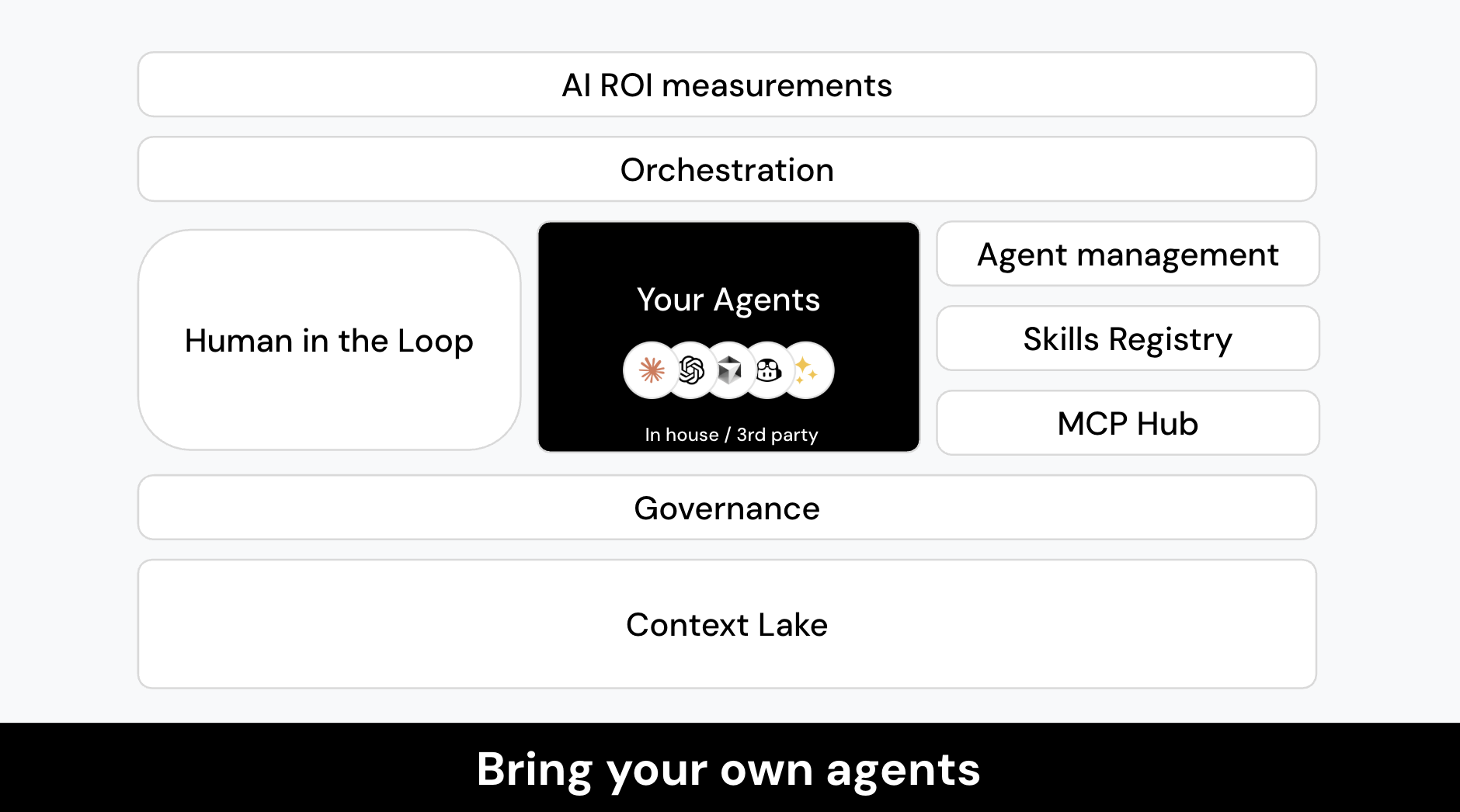
What should an AI-native software factory include?
You already have the workers and machines (engineers and their tools), and the agents are yours too, built on Bedrock, third-party platforms, or in-house. A software factory makes them work in sync, connecting what you already run rather than replacing it. Its pillars:
How the platform engineering role changes
Building the factory lands on one team whose mandate has shifted. Platform engineering used to mean building a developer portal; that work is largely finished. The mandate now moves up: it builds the harness that runs the lifecycle for people and agents alike. We expect this to become the defining remit of platform teams, closer to running an internal operating system than shipping a catalog of self-service tools.
- The platform serves agents too. Agents read the same data and act across the lifecycle, so they need context and scoped permissions.
- Every team builds its own line. It ships strong defaults and a shared context layer; teams build on top.
- Governance stays central. One foundation means permissions, audit, and guardrails live in one place.
Roles and responsibilities: who builds, governs, and operates it
CI/CD is the foundation everything rests on. Agents run the line only as far as that pipeline is automated and trustworthy, so fix flaky tests or manual deploy steps before handing any stage to an agent. In practice we recommend treating pipeline reliability as the first milestone; every stage you automate downstream inherits whatever trust the pipeline already has, or lacks.
3 workflows to start with in a software factory
Run one line end to end, starting where output is verifiable, risk is limited, and mistakes are cheap to undo. The teams that succeed here resist automating everything at once, and prove one line works before extending the pattern.
1. Incident response. A PagerDuty alert triggers the workflow. An agent pulls the affected service, owner, deploys, and dependencies from the Context Lake and proposes a root cause. The line scores risk; low-risk changes go to another agent, riskier ones to the on-call engineer, who approves in Slack.
2. Ticket and bug resolution. A well-scoped ticket goes to an agent that writes the fix and opens a pull request. A second agent reviews, tests run, and anything clearing all three merges or waits for a human by the risk you set.
3. Security remediation. The workflow watches for configuration that drifts from standard, opens the fix, and escalates risky changes for approval. The standard holds continuously, not in a quarterly audit.
How to measure quality and ROI
Measurement is where the factory earns or loses its budget. Track whether the line is faster, safer, and cheaper, and how much runs without a human. Do not optimize for token spend or share of code written by AI; those measure activity, not outcome. In our experience both become vanity metrics that rise while delivery does not, which is why we anchor measurement to throughput, safety, and cost per unit of work shipped.
What: Software Factory. How: Agentic SDLC Platform
Port is the agentic SDLC platform you build your software factory with: the Context Lake, workflow orchestration, agent management, and governance for your AI-SDLC, without losing control. Watch how dLocal built their software factory with Port.
What is a dark software factory?
A dark software factory has the lights off: machines do the work, so no one needs to see. The term is borrowed from plants that run with no one on the floor; the idea traces to Bob Bemer’s 1968 paper on the economics of program production. As Google engineer Addy Osmani puts it, it is where “code ships that no human has read.”
It is AI-led engineering at its limit, the direction the frontier is moving, with a human kept in the loop for anything touching money, data, or safety. We do not expect most teams to run fully dark soon, nor to want to; the nearer-term goal is choosing, deliberately, which stages earn that autonomy.
Do’s and don’ts
Do
- Build the Context Lake first; every agent reasons over it, so it must exist before the workflows.
- Get CI/CD solid; agents run the line only as far as it is automated and trustworthy.
- Climb the maturity curve one stage at a time, like an agile project.
- Let teams build their own workflows on the shared foundation; that earns buy-in.
Don’t
- Let agents, skills, and tools sprawl without a registry; ungoverned, they become the new microservices sprawl.
- Rush to fully AI-led. Start high-value and low-risk, then move up.
- Chase vanity metrics like token spend or percent of code written by AI.
FAQ
How is a software factory different from an agentic SDLC platform?
The agentic SDLC platform is the technology layer you build with. The software factory is what you get when you run delivery as a production line on it.
Who owns the AI software factory?
Platform engineering builds and governs it, engineers operate and extend it, and the VP of R&D or CTO owns its direction. DevOps owns the machines underneath.
Do I need to replace my existing tools to build one?
No. The agentic SDLC platform acts as a harness on top of your current stack and your own agents, which keep doing their jobs.
What tools do I need to build a software factory?
Your existing stack (cloud, Git, CI/CD, observability), your own agents, and an agentic SDLC platform to orchestrate and govern them, like Port.
Should we build the software factory ourselves?
You can, and some will. The question is whether orchestration, governance, an agent registry, and a context layer are your edge or undifferentiated plumbing. For most teams it is the second, which argues for buying the harness.
Does building a software factory mean hiring fewer engineers?
No. It reshapes the work and expands how much you can build. Engineers move up a level, from writing every line to running the line.
How do I start if all I have today is coding assistants?
Pick one workflow with a clear success signal, like incident triage, build the system of record it needs, and run it with a human approving every step. Then remove the human from steps you trust, one at a time.


Get your survey template today
%201.svg)


Download your survey template today


Free Roadmap planner for Platform Engineering teams
Set Clear Goals for Your Portal
Define Features and Milestones
Stay Aligned and Keep Moving Forward
Create your Roadmap


Free RFP template for Internal Developer Portal
Creating an RFP for an internal developer portal doesn’t have to be complex. Our template gives you a streamlined path to start strong and ensure you’re covering all the key details.
Get the RFP template


Leverage AI to generate optimized JQ commands
test them in real-time, and refine your approach instantly. This powerful tool lets you experiment, troubleshoot, and fine-tune your queries—taking your development workflow to the next level.
Explore now
Check out Port's pre-populated demo and see what it's all about.
No email required
LIVE WEBINAR, Aug 18, 2026:
Context-aware Vibe Coding for Platform Engineering
Move fast while staying in control
Build governed agentic workflows on one central platform.
See it in action:
Watch this video on generating Terraform with Port, or explore our public demo.
.png)
Check out the 2025 State of Internal Developer Portals report
No email required
Minimize engineering chaos. Port serves as one central platform for all your needs.
Act on every part of your SDLC in Port.
Your team needs the right info at the right time. With Port's software catalog, they'll have it.
Learn more about Port's agentic engineering platform
Read the launch blog
Contact sales for a technical walkthrough of Port
Every team is different. Port lets you design a developer experience that truly fits your org.
As your org grows, so does complexity. Port scales your catalog, orchestration, and workflows seamlessly.
Port × n8n Boost AI Workflows with Context, Guardrails, and Control
Port Builders Session: A Single, Governed Interface for All MCP Servers
Book a demo right now to check out Port's developer portal yourself
Apply to join the Beta for Port's new Backstage plugin


n8n + Port templates you can use today
walkthrough of ready-to-use workflows you can clone
From manual to autonomous engineering
One platform to build, govern, and operate the Agentic SDLC.
Port is open for you to try it
build your first agentic workflow today