Port vs. Jellyfish: Which approach to Engineering Intelligence is right for you?
Compare Port and Jellyfish across Engineering Intelligence, AI impact, DevEx, software context, governed workflows, and measurable outcomes.



Jellyfish and Port both help organizations understand and improve engineering performance, but they take different approaches. Jellyfish is a dedicated Engineering Intelligence solution focused on analytics and decision support. Port provides the same focused Engineering Intelligence while also connecting findings to software context, owners, standards, and governed workflows, so humans and agents can act on insights and see the metric move..
Engineering leaders have more data than ever about delivery performance, developer experience, engineering investment, and AI adoption. The harder problem is turning that data into action and measuring whether it improved engineering and business outcomes.
When a performance issue or improvement opportunity is identified, three questions matter:
- What needs to improve, where, and who owns it?
- What should happen next, and can a person or agent act safely through a governed workflow?
- Did the action produce the intended engineering or business outcome?
This guide explains where each platform is strongest, how their approaches differ, and which one is the better fit for your organization.
What is Jellyfish?
Jellyfish is a software engineering intelligence platform focused on engineering performance, investment, developer experience, and the impact of AI. Its product suite spans AI Impact, Operational Effectiveness, Business Alignment, DevEx, and DevFinOps.
Its key use cases include:
- Delivery and operational performance, including DORA metrics, workflow analysis, forecasting, and capacity planning
- Engineering investment and resource allocation across business initiatives
- AI tool adoption, usage, spend, workflow behavior, and impact on delivery
- Developer experience surveys and benchmarks connected to delivery and system metrics
- Automated financial reporting, including software capitalization and R&D tax credits
What problem does Jellyfish solve?
Engineering data is distributed across planning, source control, delivery, incident management, surveys, finance, and AI tools. Jellyfish brings this data together so organizations can answer questions such as:
- Where is engineering capacity being invested?
- Is delivery becoming faster or more predictable?
- Are platform investments improving developer experience?
- Which AI tools are being adopted, and are they improving delivery?
- How should engineering work be reported to finance or the board?
Without a shared analytics layer, teams must reconcile this data manually. Reporting is slow, definitions vary, and each executive review can become a new data-gathering exercise. Jellyfish reduces this work through repeatable metrics and dashboards that connect engineering activity, investment, delivery, and business priorities.
How does Jellyfish solve it?
Jellyfish connects to the tools where work is planned, built, reviewed, deployed, and operated. Its patented Work Model normalizes activity from these tools into consistent allocations, metrics, and trends.
On top of this data foundation, Jellyfish packages products for specific use cases. Operational Effectiveness provides DORA and workflow metrics across teams, repositories, and services. DevEx combines operational data with developer feedback. AI Impact connects AI adoption, usage, and spend with workflow behavior and delivery outcomes. DevFinOps applies engineering activity data to software capitalization and R&D tax reporting.
Data Hub adds custom metrics, dashboards, and natural-language queries. Jellyfish Assistant helps users explore changes in delivery, allocation, and AI impact, while its MCP server exposes Jellyfish data available to compatible AI clients and agentic workflows.
The predefined data model helps organizations establish consistent reporting quickly. Jellyfish can identify what needs to improve, surface recommendations, and, within DevEx, track improvement actions. However, the governed workflows used to assign ownership, manage permissions and approvals, and execute those improvements generally run in other engineering tools. This handoff can separate leadership priorities from engineering execution and make it harder to measure whether an action produced the intended outcome.
Two approaches to Engineering Intelligence
Approach 1: Run Jellyfish as a dedicated engineering intelligence layer
Organizations can use Jellyfish as a point solution for measuring engineering performance, identifying improvement opportunities, and supporting leadership decisions.
Jellyfish ships a purpose-built intelligence and decision-support layer with predefined analytics, benchmarks, developer surveys, engineering investment analysis, AI impact measurement, and DevFinOps. Its predefined model can reduce the configuration required to establish standardized reporting.
Advantages
- Broad set of ready-made dashboards, metrics, and reports
- Predefined model for engineering investment and resource-allocation calculations
- Smaller initial stakeholder group because the dashboards primarily serve engineering managers and leaders
Tradeoffs
- A finding may show what needs improvement without making clear what engineering change is required, which service is affected, or who should own the next step
- Standards, recommended actions, and governed human or agentic workflows generally live in other systems
- When findings, actions, and outcomes are separated, it becomes harder to measure improvement and demonstrate ROI
Port can also be deployed with a focused Engineering Intelligence scope, covering delivery performance, DORA metrics, developer experience, and AI impact. Port AI and custom agents can surface insights from the Context Lake and approved external systems through MCP connectors, while connecting findings to the relevant services, teams, and owners. AI Builder can accelerate implementation by generating the data model, integrations, metrics, and dashboards from natural-language instructions
.png)
Approach 2: Make Port Engineering Intelligence part of an Agentic SDLC platform
Port brings Engineering Intelligence into its Agentic SDLC platform, connecting insights, governed action, and measurable outcomes in one place. Leaders can see what matters and why, while engineering teams can understand what needs to improve and act through human or agentic workflows. This creates a closed loop from engineering insight to agentic action to measurable impact.
The example below shows how AI adoption data can lead to a validated decision, governed execution, and a measurable cost outcome.
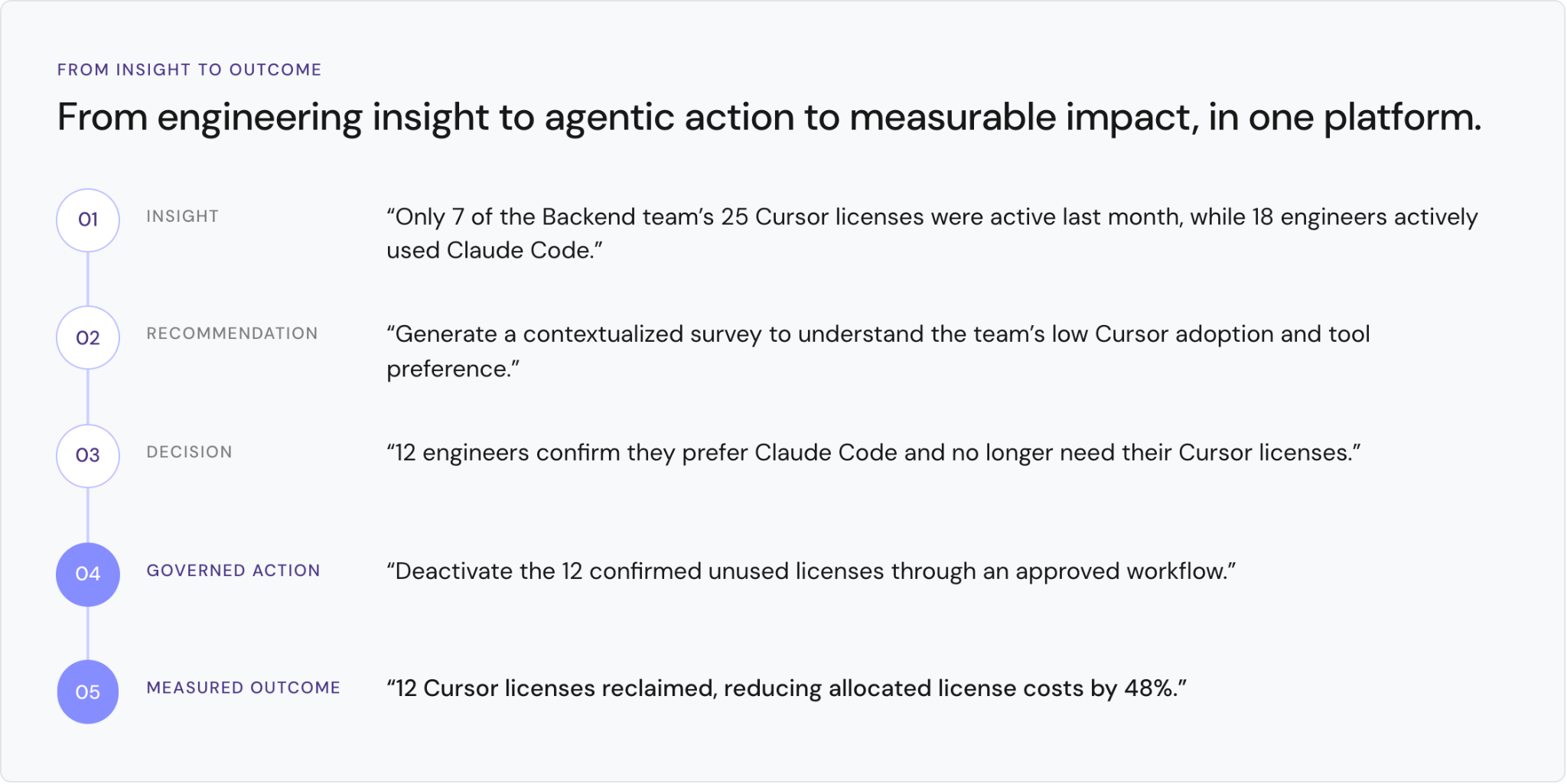
This aligns with Gartner’s forecast that Developer Productivity Insights Platforms (DPIP) will increasingly expand beyond manager-focused dashboards to support developer enablement and provide context for agentic workflows.
Advantages
- A shared platform connects leadership priorities with engineering execution, consolidating Engineering Intelligence, software context, governance, workflows, and agent management
- Engineering teams can see what needs improvement, why it matters, which services and teams are affected, and how to act
- Findings, decisions, actions, and outcomes remain connected, making it easier to measure improvement and demonstrate ROI
Tradeoffs
- Teams must agree on the baselines, targets, and outcomes they want to achieve
- Port does not provide the same extensive library of predefined reports as Jellyfish
- Specialized DevFinOps use cases, including software capitalization and R&D tax reporting, may require custom implementation
For Port, these approaches are not mutually exclusive. Organizations can start with a focused Engineering Intelligence scope and expand into the broader Agentic SDLC model as their needs mature.
.png)
Port vs. Jellyfish: capability comparison
Both platforms measure engineering metrics, such as DORA, Delivery Performance, AI adoption and impact. The difference appears after the insight. Jellyfish is an Engineering Intelligence product. Jellyfish is purpose-built for Engineering Intelligence and does not position itself as a general-purpose software catalog, standards engine, developer self-service platform, workflow orchestrator, or agent-governance layer. It can identify where to improve and recommend what to do. Execution, governance, and outcome tracking require other systems.
Jellyfish provides a specialized intelligence and decision-support layer. Port extends Engineering Intelligence into software context, standards, governed execution, and agent management. Organizations using Jellyfish may need additional platforms to connect findings to executable engineering workflows.
How to choose
Choose Port when:
- You do not want findings and recommendations to stop at a dashboard. You want people and agents to act on them through governed workflows, then measure whether those actions improved the original metrics
- Leaders need to understand what matters and why, while engineering teams need the ownership context and workflows to improve it
- Engineering Intelligence needs to reflect your organization through a flexible data model, with DORA metrics, DevEx surveys, AI impact analysis, and team-specific scorecards
- You want to consolidate Engineering Intelligence, software catalog, shared context, standards, workflow orchestration, governance, and agent management in one platform
dLocal’s rollout shows this model in practice. Port gave its dCoder agent the software context and governance needed to act safely, while Engineering Intelligence measured the resulting impact. By connecting context, agentic action, and measurement in one platform, dLocal increased autonomous ticket coverage to 45% while reducing lead time and MTTR by 50%.
The bottom line
Jellyfish provides predefined engineering analytics, industry benchmarks, engineering investment allocation, AI impact analysis, and DevFinOps. Port connects engineering findings to software ownership, standards, and governed execution, so teams can act and measure the result in the same platform and data model.
The deciding question is whether you need a dedicated intelligence layer or an integrated improvement loop connecting engineering insight, agentic action, and measurable impact.
Explore Engineering Intelligence in Port.
Frequently asked questions
Is Port a direct alternative to Jellyfish?
Yes, when the evaluation focuses on Engineering Intelligence, including delivery performance, DORA metrics, DevEx, AI impact, and continuous improvement. The products are not identical in scope. Jellyfish is a point solution and decision-support tool, while Port includes Engineering Intelligence within a broader Agentic SDLC platform.
What are the alternatives to Jellyfish?
Alternatives include Port, LinearB, Swarmia, Faros AI, and DX (now part of Atlassian). The main difference is whether you need ready-made analytics or a broader platform connecting insight, action, and impact.
Can Port be used only for Engineering Intelligence?
Yes. Organizations can begin with metrics, surveys, dashboards, service and ownership context, and AI-powered insights. They can add scorecards, workflows, agents, custom AI Skills, and MCP connectors later if they want to connect findings to governed action on the same platform.
Can Port and Jellyfish be used together?
Yes. Jellyfish can run specialized analytics, benchmarks, or financial reporting while Port supplies software context, scorecards, governance, and workflow orchestration. The tradeoff is maintaining overlapping data, integrations, and models.
How are Port and Jellyfish packaged?
Jellyfish offers packages for AI Impact, Developer Productivity, and DevFinOps, with pricing available by quote. Port includes Engineering Intelligence within its broader platform.
Compare Jellyfish pricing and Port pricing.


Get your survey template today
%201.svg)


Download your survey template today


Free Roadmap planner for Platform Engineering teams
Set Clear Goals for Your Portal
Define Features and Milestones
Stay Aligned and Keep Moving Forward
Create your Roadmap


Free RFP template for Internal Developer Portal
Creating an RFP for an internal developer portal doesn’t have to be complex. Our template gives you a streamlined path to start strong and ensure you’re covering all the key details.
Get the RFP template


Leverage AI to generate optimized JQ commands
test them in real-time, and refine your approach instantly. This powerful tool lets you experiment, troubleshoot, and fine-tune your queries—taking your development workflow to the next level.
Explore now
Check out Port's pre-populated demo and see what it's all about.
No email required
LIVE WEBINAR, Aug 18, 2026:
Context-aware Vibe Coding for Platform Engineering
Move fast while staying in control
Build governed agentic workflows on one central platform.
See it in action:
Watch this video on generating Terraform with Port, or explore our public demo.
.png)
Check out the 2025 State of Internal Developer Portals report
No email required
Minimize engineering chaos. Port serves as one central platform for all your needs.
Act on every part of your SDLC in Port.
Your team needs the right info at the right time. With Port's software catalog, they'll have it.
Learn more about Port's agentic engineering platform
Read the launch blog
Contact sales for a technical walkthrough of Port
Every team is different. Port lets you design a developer experience that truly fits your org.
As your org grows, so does complexity. Port scales your catalog, orchestration, and workflows seamlessly.
Port × n8n Boost AI Workflows with Context, Guardrails, and Control
Port Builders Session: A Single, Governed Interface for All MCP Servers
Book a demo right now to check out Port's developer portal yourself
Apply to join the Beta for Port's new Backstage plugin


n8n + Port templates you can use today
walkthrough of ready-to-use workflows you can clone
From manual to autonomous engineering
One platform to build, govern, and operate the Agentic SDLC.
Port is open for you to try it
build your first agentic workflow today