Why we made our product roadmap public
Port's product roadmap is publicly available to anyone who wants to see it. I wrote about why we did it and how our community has shaped Port through it.


Port's product roadmap has been public since we were six months old. Before we had a sales team or more than one product manager. Our product was bare bones compared to what we have today.
We were a new SaaS company asking engineers to trust us. And we had to earn it.
So we decided to run like an open source company without being one.
We open sourced our integrations framework (Ocean) so users could extend the product themselves. We put a live demo on the site with no gate because we trusted it to hold up. We built a Slack community instead of controlling the conversation. We launched a free tier so people could try the product without talking to anyone first.
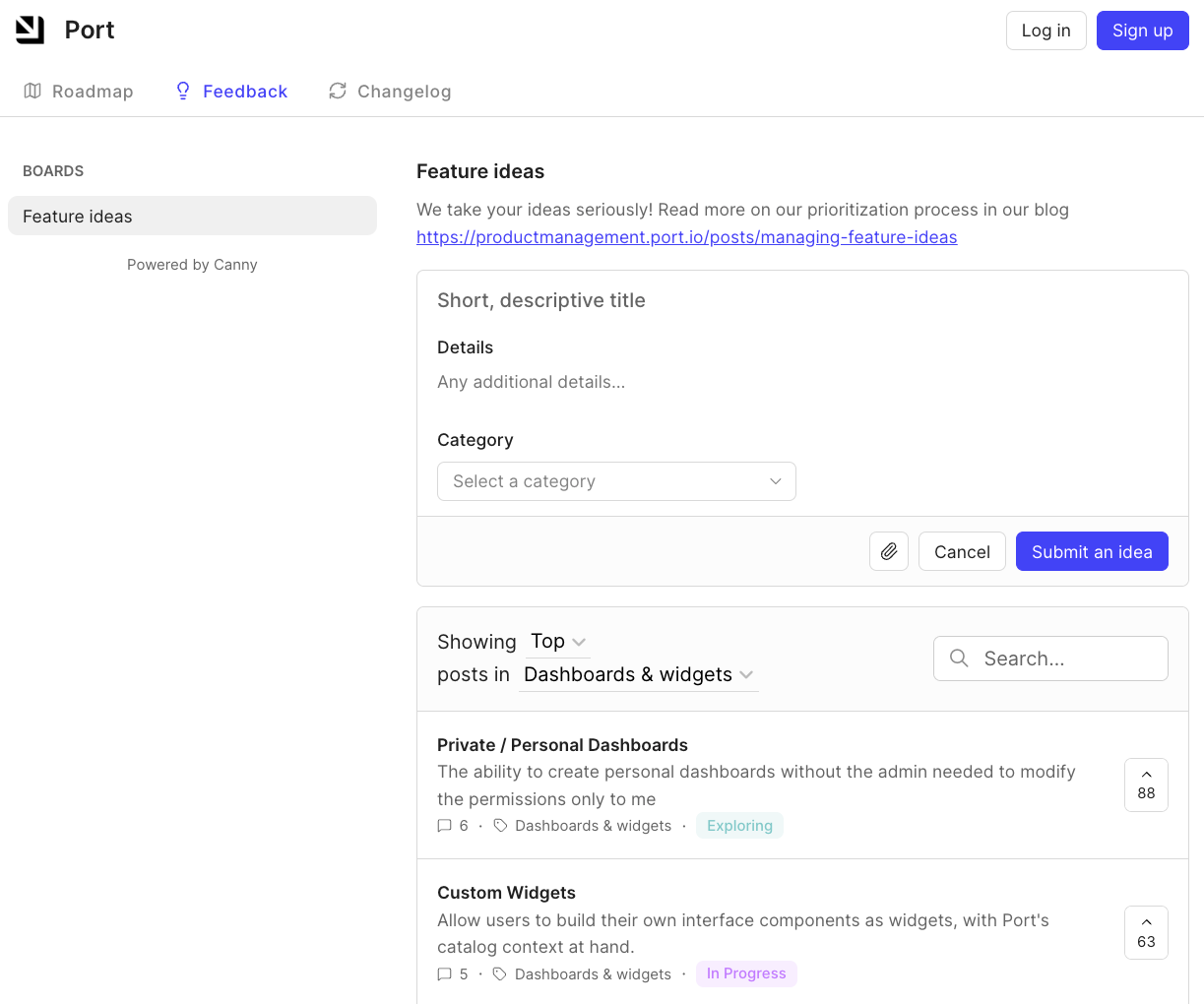
And we put our roadmap on Canny, where anyone can see what we're building, suggest features, upvote what matters to them, and tell us when we're wrong.
We believe that when we build this product, we should build it with the people who use it.
What it does for our customers
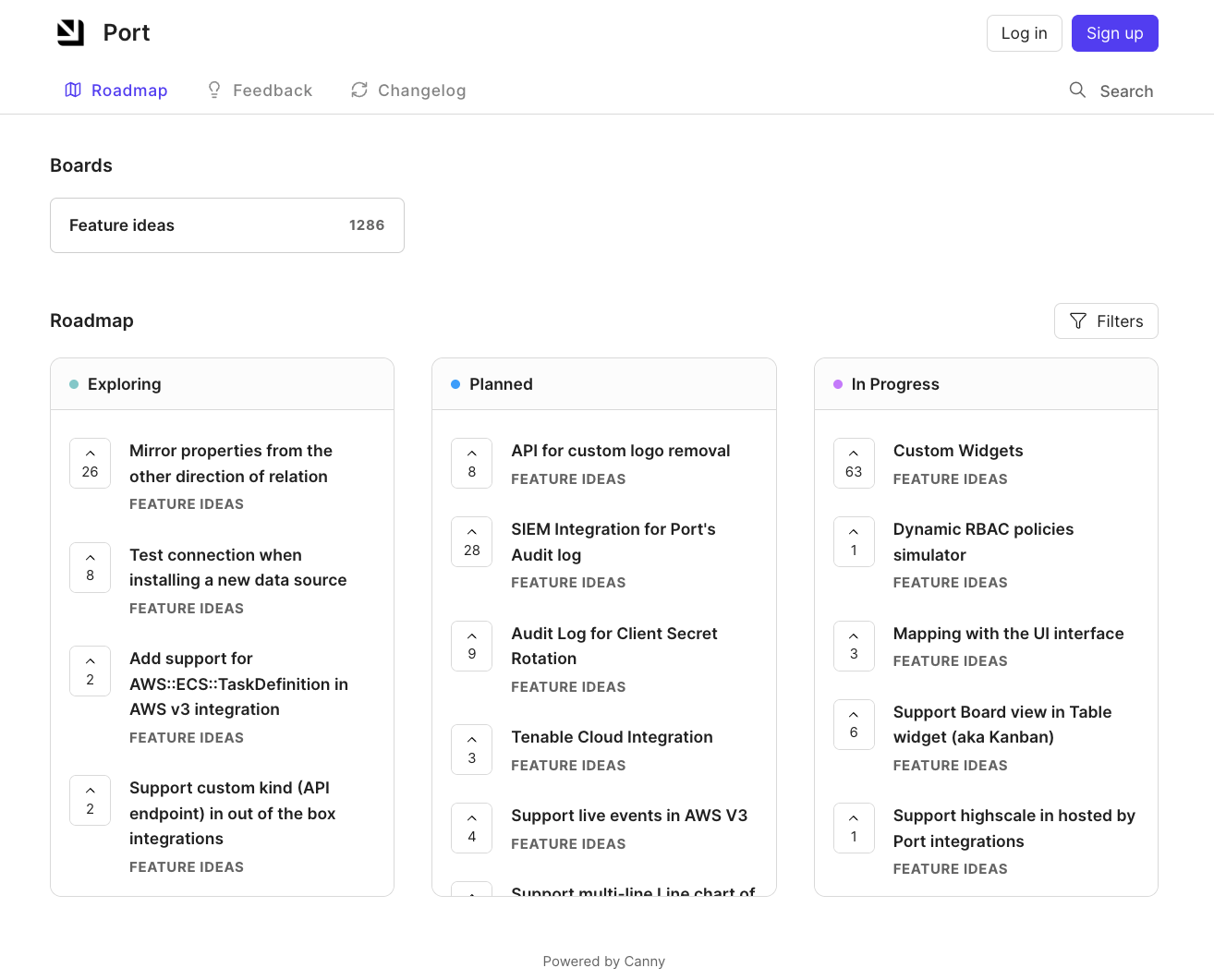
Today, our public roadmap has some impressive stats.
1,250+ feature ideas
10,450 votes
1,726 comments
43,200 users
In a given month, we get about 70-90 new feature ideas, 400-500 votes, and 80-100 comments.
Numbers aside, we've found some incredible feature ideas in the roadmap. They're not necessarily ideas we didn't know about, but we didn't realize how much our users wanted them until the upvote count started to rise.
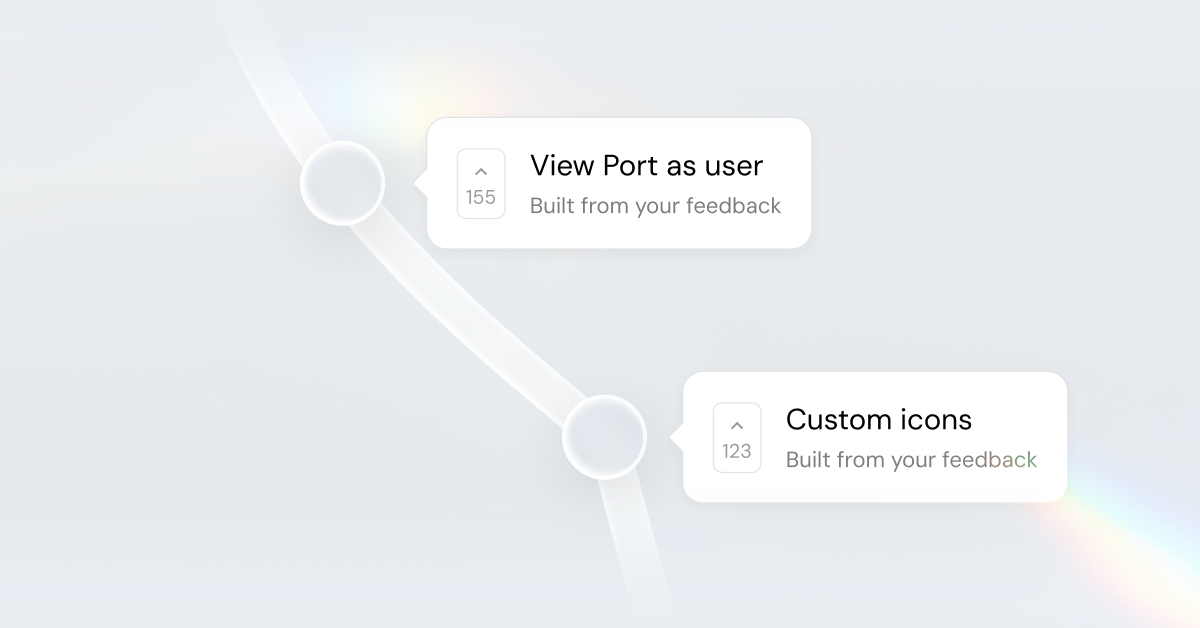
For example, we just shipped our most requested feature "View as". It completely changes the way our customers build in Port by letting builders see Port exactly how their users see it. It had over 150 votes.
Other requests like custom icons (123 votes) and dark mode (73 votes) seemed like small changes but it turned out people really cared about them and were thrilled when they were released.
Some customers even write requests that read like PRDs, with a target persona, the problem, and a proposed solution. The public nature of the roadmap pushes our customers to think a bit harder about how they express what they need, which helps us.
Instead of a request like 'add SCIM,' they explain their access control model and why it matters. That context is important for prioritization.
What it does for us
Publishing our plans creates accountability. When something goes on the roadmap, the timer starts. Our customers, the community, and yes, our competitors, they're all watching. We find that pressure useful.
Since we use Port heavily ourselves, our own engineers often request features right alongside our customers.
It also forced us to get better at communicating timelines. When customers can see everything, you can't be vague about what's next or when it's coming. High votes don't guarantee a feature will ship, but they push us to explain why they won't right now.
The community also surfaces things we may miss. We look at every item, even ones that seem minor. But if a lot of people vote for it, we pay more attention and start asking why. We know community requests can't be the entire roadmap, but they're a significant part of it.
Are we worried about copycats?
If other companies in our space see our plans and ship something similar, that's fine. It moves the whole category forward. Our Director of Product, Dudi, puts it this way: "You can copy features but you can't copy culture."
Because Port is a platform, everything connects. For example, custom widgets are built on top of dashboards, which are built on top of the catalog, which ties into automations, scorecards, and everything else. So our IP isn't a list of features. It's how everything connects and the approach we took to solve the problem. If a competitor finds itself building their roadmap based on what we publish, their whole strategy is reactive.
We believe that when vendors hide the roadmap, the customer pays the price. They negotiate for information instead of building with the product team. We'd rather everyone in this space be more open about what they're building. It's better for the people who use the products.
We'd do it again
People ask us all the time why we opened up the roadmap. By now, it's just how we work. It takes effort to manage and it requires honest communication about priorities. You also have to be willing to be held to what you say you'll build.
But it got us to the product we have today which we're very proud of.
You can see everything we're working on at our public roadmap. Upvote something, suggest a feature, tell us we're wrong. That's what it's there for.


Get your survey template today
%201.svg)


Download your survey template today


Free Roadmap planner for Platform Engineering teams
Set Clear Goals for Your Portal
Define Features and Milestones
Stay Aligned and Keep Moving Forward
Create your Roadmap


Free RFP template for Internal Developer Portal
Creating an RFP for an internal developer portal doesn’t have to be complex. Our template gives you a streamlined path to start strong and ensure you’re covering all the key details.
Get the RFP template


Leverage AI to generate optimized JQ commands
test them in real-time, and refine your approach instantly. This powerful tool lets you experiment, troubleshoot, and fine-tune your queries—taking your development workflow to the next level.
Explore now
Check out Port's pre-populated demo and see what it's all about.
No email required
LIVE WEBINAR, Aug 18, 2026:
Context-aware Vibe Coding for Platform Engineering
Thursday, October 22 12:00pm EDT⋅6:00pm CET
To learn more about the new capability and to see a live demo, join our upcoming community session with GitHub
Move fast while staying in control
Build governed agentic workflows on one central platform.
See it in action:
Watch this video on generating Terraform with Port, or explore our public demo.
.png)
Check out the 2025 State of Internal Developer Portals report
No email required
Minimize engineering chaos. Port serves as one central platform for all your needs.
Act on every part of your SDLC in Port.
Your team needs the right info at the right time. With Port's software catalog, they'll have it.
Learn more about Port's agentic engineering platform
Read the launch blog
Contact sales for a technical walkthrough of Port
Every team is different. Port lets you design a developer experience that truly fits your org.
As your org grows, so does complexity. Port scales your catalog, orchestration, and workflows seamlessly.
Port × n8n Boost AI Workflows with Context, Guardrails, and Control
Port Builders Session: A Single, Governed Interface for All MCP Servers
Book a demo right now to check out Port's developer portal yourself
Apply to join the Beta for Port's new Backstage plugin


n8n + Port templates you can use today
walkthrough of ready-to-use workflows you can clone
From manual to autonomous engineering
One platform to build, govern, and operate the Agentic SDLC.
Port is open for you to try it
build your first agentic workflow today