Practical AI in Platform Engineering: lessons from Port's latest meetup
We hosted a meetup with engineering leaders working on AI inside their orgs and ran an anonymous survey. Here's what came out of it.



While many teams are sharing demos of their new agents, what we keep hearing is the same thing: there aren't enough practical patterns to learn from - especially from the most advanced teams already doing this in production.
On June 10, Port hosted "Practical AI in Platform Engineering" in Tel Aviv. A room full of engineering leaders - team leads, platform leads, VPs of engineering - all working on the same hard problem: making AI useful inside their organizations without losing control. Four practitioners spoke: Mor Paz (Port) on lessons from building agentic workflows for bug triage and platform requests, Ido Stern (HiBob) on HiBob's journey from SDD to fully operational agentic workflows, Tomer Brook (monday.com) on how monday.com scaled AI across the SDLC using an agent marketplace, and Eliezer Steinbock (Cursor) on Loop Engineering.
We also ran a quick anonymous survey with everyone in the room.
This is what came out of it.
{{from_manual_to_autonomous_engineering}}
So, where do engineering teams actually stand today?
The goal of the survey was to get an honest read on where teams really are - not where they aspire to be. Six questions, multiple choice, covering the maturity curve, what's actually shipped in production, how teams evaluate agents, where they put humans in the loop, and their biggest concerns about giving agents more autonomy.
Where would you put your engineering org on the AI maturity curve?
Options: Not yet using AI · Coding assistants across teams · A few agents in the SDLC, not at scale · Fully autonomous AI-SDLC
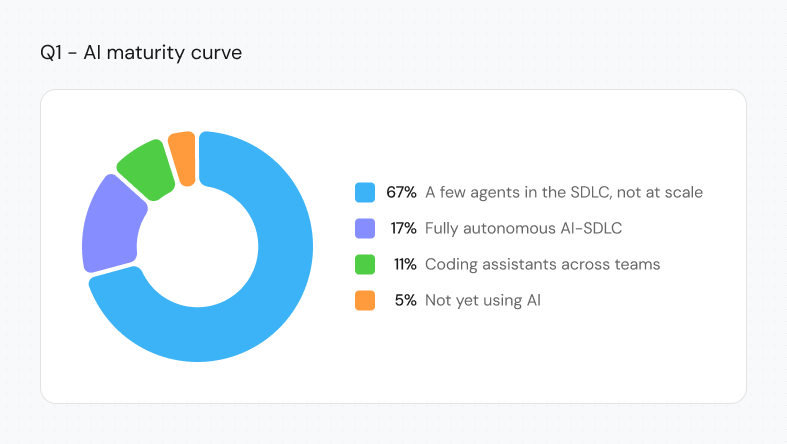
Two-thirds said the same thing: they have a few agents in the SDLC, but not at scale. Almost nobody said they aren't using AI at all. Almost nobody said they're fully autonomous. The industry isn't at either of the extremes the hype keeps pointing at. It's in the middle - with agents running, but not yet trusted enough to scale.
Where in the SDLC have you actually shipped AI to production?
Multi-select · Code generation · Code review · Testing and QA · Documentation and knowledge · Incident response / AI SRE · Infrastructure and IaC · Security and vulnerability remediation · Nothing in production yet
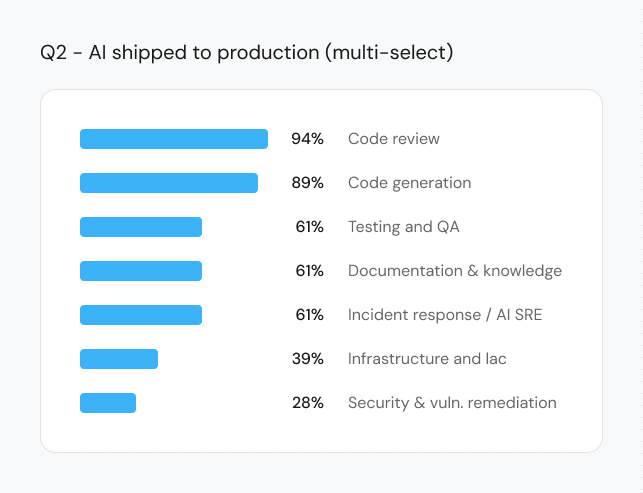
Code review came back at nearly 95%. Code generation at almost 90%. Security at less than a third. Infrastructure at under 40%. The story everyone is telling about the agentic SDLC is real - but for most teams, it's still happening in the IDE. The operational side of the SDLC is moving much slower.
How are you evaluating your agents before they touch production?
Options: We don't deploy agents yet · No formal process, we eyeball it · Test against a handful of known cases · Structured evals on a test dataset · Full automated evals in CI
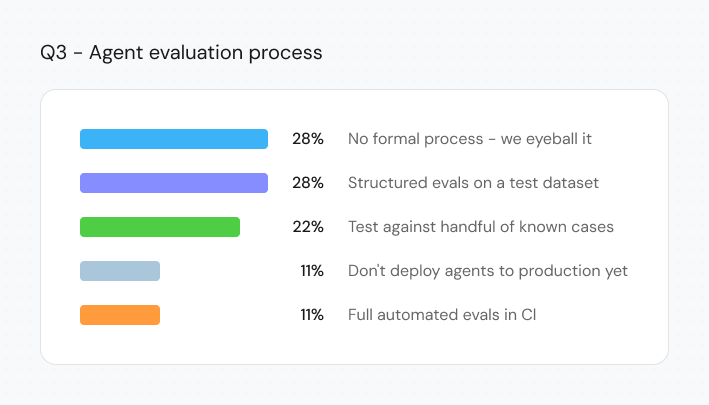
More than half answered with some version of "we eyeball it" or "we test a handful of cases manually." Only around 1 in 10 has automated evals running in CI. Most of the agents already shipped did not go through a process anyone would call rigorous. People in the room admitted this openly.
Where do you require a human in the loop today?
Options: Every agent action · Production-affecting changes only · Code merges and PRs only · Sample after the fact · No formal gates yet · Agents don't take production actions yet
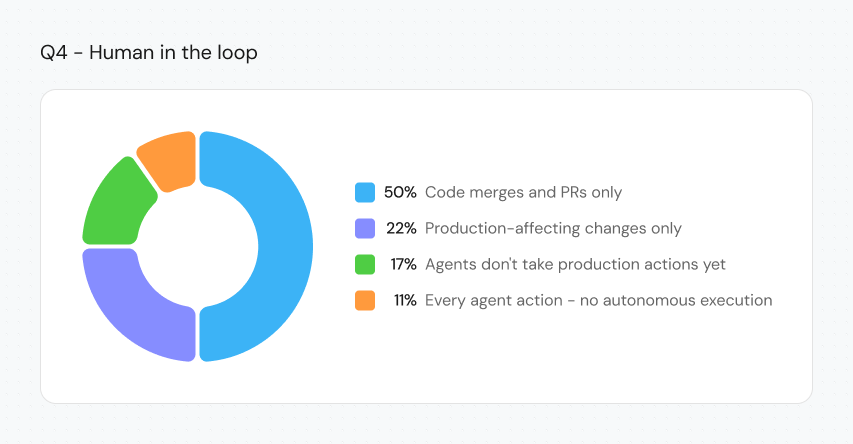
Half the room said code merges and PRs only. That's not a new layer. It's the same code review process they had before agents. It works for now, because most agents are still suggesting code. It breaks the moment agents are acting in production - deploying services, restarting workloads, resolving incidents. Most teams haven't built for that yet.
What's your company's biggest concern about giving agents more autonomy?
Options: Non-determinism · Governance, guardrails, and access control · Context quality · Cost and token consumption · Measuring real impact · Different teams doing it their own way · Developer adoption and pushback

Six in ten said governance, guardrails, and access control. Context quality was a distant second at around 20%. Non-determinism, cost, developer adoption - none of them came close. There's one bottleneck the room agreed on, and it isn't subtle.
Lessons from the room
Are evals here to stay - or are we overthinking them? Around half the room is shipping agents to production with informal evaluation - eyeballing it or testing a handful of cases manually. Only 1 in 10 has automated evals running in CI. Either teams are about to hit a wall and will need to catch up - or the eval discourse is moving slower than reality on the ground.
Coding is where everyone starts. Code review and code generation came back at nearly 95% and 90%. Security at less than a third. Infrastructure under 40%. The first wave of AI in engineering isn't really about the SDLC - it's about helping developers write and review code faster. The operational side is still waiting.
Since most agents are in the coding flow, the PR is the main human gate. Half the room places their human-in-the-loop at code merges and PRs only. That's the same gate they had before agents - and it works while agents are mostly suggesting code. It stops working the moment agents act in production: deploy services, restart workloads, resolve incidents.
Governance is the bottleneck the room agrees on. 6 in 10 pointed to governance, guardrails, and access control as their biggest concern about agent autonomy. Context quality was a distant second. Non-determinism, cost, developer adoption - all noise. The bottleneck isn't subtle.
CTA
If you recognized your team in the data above, this is worth reading next.
In "The Hidden Technical Debt of Agentic Engineering," Zohar Einy maps the seven infrastructure blocks that surround every agent in production - and why most teams only see them after something breaks.
→ The Hidden Technical Debt of Agentic Engineering
Ready to build the governance layer? Port's Agentic Engineering Platform gives your team the context, guardrails, and orchestration layer to run agents in production with confidence.


Get your survey template today
%201.svg)


Download your survey template today


Free Roadmap planner for Platform Engineering teams
Set Clear Goals for Your Portal
Define Features and Milestones
Stay Aligned and Keep Moving Forward
Create your Roadmap


Free RFP template for Internal Developer Portal
Creating an RFP for an internal developer portal doesn’t have to be complex. Our template gives you a streamlined path to start strong and ensure you’re covering all the key details.
Get the RFP template


Leverage AI to generate optimized JQ commands
test them in real-time, and refine your approach instantly. This powerful tool lets you experiment, troubleshoot, and fine-tune your queries—taking your development workflow to the next level.
Explore now
Check out Port's pre-populated demo and see what it's all about.
No email required
LIVE WEBINAR, Aug 18, 2026:
Context-aware Vibe Coding for Platform Engineering
Thursday, October 22 12:00pm EDT⋅6:00pm CET
To learn more about the new capability and to see a live demo, join our upcoming community session with GitHub
Move fast while staying in control
Build governed agentic workflows on one central platform.
See it in action:
Watch this video on generating Terraform with Port, or explore our public demo.
.png)
Check out the 2025 State of Internal Developer Portals report
No email required
Minimize engineering chaos. Port serves as one central platform for all your needs.
Act on every part of your SDLC in Port.
Your team needs the right info at the right time. With Port's software catalog, they'll have it.
Learn more about Port's agentic engineering platform
Read the launch blog
Contact sales for a technical walkthrough of Port
Every team is different. Port lets you design a developer experience that truly fits your org.
As your org grows, so does complexity. Port scales your catalog, orchestration, and workflows seamlessly.
Port × n8n Boost AI Workflows with Context, Guardrails, and Control
Port Builders Session: A Single, Governed Interface for All MCP Servers
Book a demo right now to check out Port's developer portal yourself
Apply to join the Beta for Port's new Backstage plugin


n8n + Port templates you can use today
walkthrough of ready-to-use workflows you can clone
From manual to autonomous engineering
One platform to build, govern, and operate the Agentic SDLC.
Port is open for you to try it
build your first agentic workflow today