Fine-grained permissions: control who builds what in Port
Let every team build their own resources and tools, without compromising security or governance.


.png)
A backend lead waits three days for a workflow only their team runs. The security team waits behind them just to change a single compliance rule. And the platform engineers spend the week reviewing changes they never wanted to own. Every team wants to automate its own slice of the SDLC. Everyone who builds inside Port stands in the same line, because until now one team built all of it.
That's no longer the case. Building is no longer only the platform engineer's job. Any member or team can now build and own its own piece of Port, scoped to exactly what it should touch. The platform team decides who can create, read, edit, or delete, who can run a workflow, who has to approve a change, and what each user or agent can reach, down to the data, MCP tools, and AI skills. Set the guardrails once, and every team builds its piece of the agentic SDLC.
The platform engineer became the bottleneck
A Port platform engineer carries the data model, integrations, scorecards, dashboards, workflows, and the RBAC on top of all of it. One role holds the whole platform. That worked when there was little to build; it breaks in three ways as it grows.
Over-privileged access. To change one thing, you get the keys to everything. A team that should own its scorecards ends up with edit rights on blueprints it shouldn't touch.
No separation of duties. Teams that want to own their piece of the platform file a request and wait for the one team that can make the change.
The scalability gap. Port keeps growing, the platform team doesn't, and every new domain, team, and workflow lands on the same desk.
This hits enterprises first, and customers say so: "We have multiple platform teams that manage different parts of Port." "We want teams like Security to own their rules without touching the Service blueprint."
More builders mean more risk to production
Letting every team build creates a second problem. When many teams build at once, every change could reach production. You already run Port across separate development, staging, and production environments, and promote changes between them through pull requests. One team's change can't break the platform for everyone else. Hand building to more people without controlling how their work ships, and you trade a bottleneck for a blast radius.
Two controls make it safe: access and rollout
Port handles both at once. Fine-grained permissions decide who can build what, so a team owns its piece without holding the keys to everything. Environment management decides how that work ships as code, reviewed like any other pull request. This is the pattern AWS and GCP already use for separation of duties: scoped roles for who can touch what, and decoupled Terraform and GitOps pipelines for how changes ship. Port brings both together in one place.
How Port scopes who builds what
Port resources are part of the catalog (everything is a blueprint)
Port has always described your software the same way. A blueprint defines a type, like Service or Deployment, and every real service is an entity of that type. That is what makes the catalog something you can search, own, and govern.
Now Port turns that same lens on itself. The tools you build with are blueprints and entities too, typed and owned like everything else. A workflow is a type, and a specific incident-response workflow is an entity that a team can own. Scorecards follow suit, and so does the AI registry, where your agents, skills, and MCP servers each land as first-class entities. Integrations work the same way: an API integration is the type, and your connected GitHub integration is an entity of it.
Once these resources live in the catalog as entities, the permissions that already govern your services govern them too.
Dynamic, context-aware permission policies
RBAC in Port gets specific. Grant create, read, edit, or delete per role, per user, or per team, at the entity level and down to a single property. The Security team owns the compliance rules on a workflow while the platform team keeps the Service blueprint, and neither one touches the other's fields.
Context makes the rule specific at runtime. Instead of listing who can touch what, you write a policy that compares the logged-in user against the data in front of them. An engineer can run the deploy workflow on the services their team owns, and is blocked on everyone else's. One rule covers every service in the catalog.
The property does not have to be a team. Allow edits to production services only for senior engineers, so a junior can change anything in development but not touch production. A policy can match any user attribute against any entity attribute you model.
Policies read state too, not just ownership. An on-call engineer gets edit access across every service while the pager is theirs, then drops back to their team's scope when the shift ends. No per-user setup, no cleanup afterward.
.png)
Trust every permission, and the reason that grants it
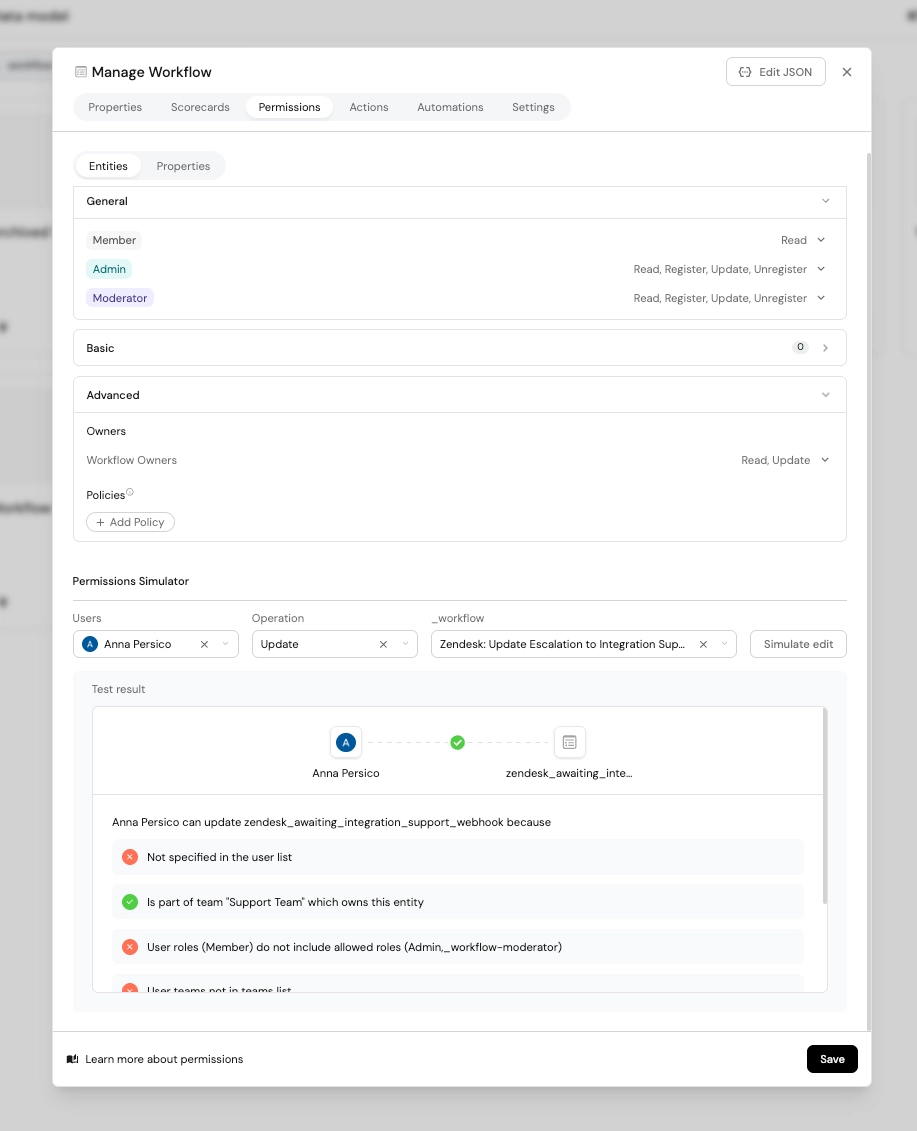
Permissions only earn trust if you can see them working. The permission simulator shows exactly that: pick a user, pick an operation, and Port shows exactly which entities they can reach and the specific rule that grants it. View-as lets you step into anyone's seat and experience Port as they do, the pages, workflows, and services they can reach, so you reproduce a permission issue instead of guessing at it.
Enforced everywhere, for humans and agents
Every answer comes with its reason, so no one takes the setup on faith. And the same model holds across UI, API, and MCP, so a developer in the IDE, or an agent acting through Port, gets the exact same scope as a user in the browser.
Roll out changes across environments
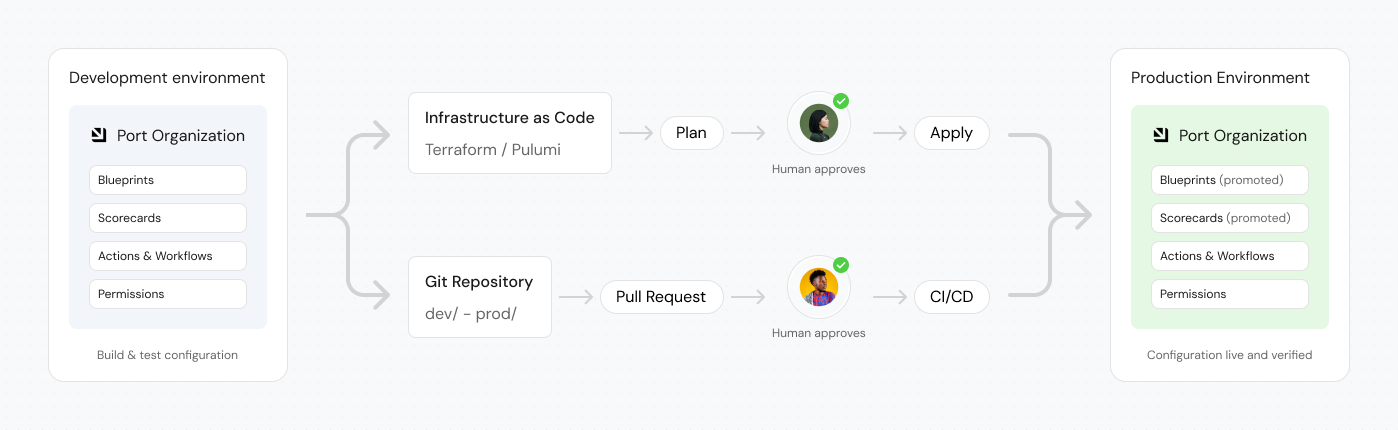
Building at scale means shipping at scale. Port's Terraform provider and a Pulumi provider manage every resource as code (IaC), and because Port is also API-first, you can run a pure GitOps flow with your existing CI/CD pipelines. Engineering and platform teams propose changes in their own environment. The central platform team reviews and approves each one, and only an approved change gets promoted toward production, with a full audit trail. Changes reach production the way application code does, not by editing the live environment.
Real-world examples
One workflow, four different scopes
Workflows are where this matters most, because a workflow doesn't just get read or edited. It runs, and when it runs, it acts on your systems.
Take a self-healing incident workflow that the SRE team owns. Two product domains, Payments and Identity, need to run it.
- The SRE team gets create, edit, and delete. They own the workflow.
- Payments and Identity get read and execute. They run it, they don't rewrite it.
- On-call engineers get dynamic edit while they hold the pager, then drop back to read when the shift ends.
- The team that owns the code has to approve the deploy. When a coding agent proposes a fix, the mitigation ships only after that team signs off.
The SRE team manages this workflow and its permissions in Terraform, so every change to who can run or edit it is versioned and reviewed like application code.
Scorecards owned by the teams they grade
Scorecards are how you hold teams to a standard, like production readiness, security, and cost hygiene. Sharing them works the same way as sharing a workflow.
Take an org running three sets of standards at once:
- The platform team owns the Production Readiness baseline. It sets the checks every service is graded on, and no other team can loosen it.
- Security owns a separate compliance scorecard and edits its own rules (a vulnerability scan passed, an owner set, on-call configured) without ever touching the Service blueprint.
- Each domain team adds the checks that matter to its own services, and grades only those.
- An AI or platform team owns a Skill Quality scorecard graded on every skill in the AI registry: has an owner, has an eval suite, last run passed.
The platform team keeps its baseline scorecard as JSON in a Git repo, validated in development and promoted to production through a pull request.
Set it up in one prompt
Blueprints, permissions, policies, you don't have to wire all of this by hand. With Port AI Builder, you describe what you want in plain language and it creates the blueprints, permissions, and policies for you, right in the UI or from a coding agent like Cursor or Claude over MCP. See Introducing Port AI Builder for how it works.
Let every team build, safely
The platform engineer was never supposed to build everything. The job was to make it safe for everyone else to build at scale, and until now the tools forced them into the bottleneck instead. Permissions and environment management change that: define the boundaries once, and every team, and every agent, works within them. The super admin who once held every key is finally scoped like everyone else.
For the full breakdown, team ownership, dynamic policies, and rolling changes out as code, see Scope building permissions across teams and users.
Set your boundaries once, and let every team build. Start free.
{{from_manual_to_autonomous_engineering}}


Get your survey template today
%201.svg)


Download your survey template today


Free Roadmap planner for Platform Engineering teams
Set Clear Goals for Your Portal
Define Features and Milestones
Stay Aligned and Keep Moving Forward
Create your Roadmap


Free RFP template for Internal Developer Portal
Creating an RFP for an internal developer portal doesn’t have to be complex. Our template gives you a streamlined path to start strong and ensure you’re covering all the key details.
Get the RFP template


Leverage AI to generate optimized JQ commands
test them in real-time, and refine your approach instantly. This powerful tool lets you experiment, troubleshoot, and fine-tune your queries—taking your development workflow to the next level.
Explore now
Check out Port's pre-populated demo and see what it's all about.
No email required
LIVE WEBINAR, Aug 18, 2026:
Context-aware Vibe Coding for Platform Engineering
Thursday, October 22 12:00pm EDT⋅6:00pm CET
To learn more about the new capability and to see a live demo, join our upcoming community session with GitHub
Move fast while staying in control
Build governed agentic workflows on one central platform.
See it in action:
Watch this video on generating Terraform with Port, or explore our public demo.
.png)
Check out the 2025 State of Internal Developer Portals report
No email required
Minimize engineering chaos. Port serves as one central platform for all your needs.
Act on every part of your SDLC in Port.
Your team needs the right info at the right time. With Port's software catalog, they'll have it.
Learn more about Port's agentic engineering platform
Read the launch blog
Contact sales for a technical walkthrough of Port
Every team is different. Port lets you design a developer experience that truly fits your org.
As your org grows, so does complexity. Port scales your catalog, orchestration, and workflows seamlessly.
Port × n8n Boost AI Workflows with Context, Guardrails, and Control
Port Builders Session: A Single, Governed Interface for All MCP Servers
Book a demo right now to check out Port's developer portal yourself
Apply to join the Beta for Port's new Backstage plugin


n8n + Port templates you can use today
walkthrough of ready-to-use workflows you can clone
From manual to autonomous engineering
One platform to build, govern, and operate the Agentic SDLC.
Port is open for you to try it
build your first agentic workflow today