Your agents are only as good as the foundation they run on
AI is changing how software gets built. An Agentic SDLC Platform is the foundation necessary to scale AI across the SDLC without losing control.


Your best engineers did everything right. They spotted the toil, built an agent to kill it, and shipped something that triages incidents in minutes instead of hours. It works. They’re proud of it. And you found out it existed three weeks after it went live.
That agent almost certainly doesn't: leave an audit trail, know your stack, or use scoped credentials to reach the data it reads. Nobody built it to your standards, because the team had a real problem and AI made it cheap to solve. Nobody opens a ticket for something they can build in an afternoon.
That one SRE agent isn’t the problem. The next forty are, and forty is where it starts – Gartner puts the average Global Fortune 500 enterprise at more than 150,000 agents in use by 2028, up from fewer than 15 in 2025. Every engineer is a builder now, each one wiring MCP servers into Cursor and stitching agents together, and the instinct is to treat the mess as a checklist: go find them, scope them, add approvals, turn on logging. But the list is never done – the day you close it out, ten more agents exist. Agent management isn’t a project you finish; it’s a property of the foundation your agents run on. Build that foundation for the job and the fortieth agent lands managed without anyone chasing it. That foundation is an agentic SDLC platform.
What an agentic SDLC platform actually is
An agentic SDLC platform is the shared layer where every agent gets its context, runs its actions, gets discovered, and stays governed. One place, so your standards live in the foundation instead of in fifty developers' heads.
Strip it down and it does four jobs: it creates the context agents read from, orchestrates the actions they take, keeps a registry of what exists, and governs what any of them is allowed to do.
You’ve solved a version of this before. Self-service handed developers a button that scaffolded a repo, a pipeline, and monitoring in one click. Velocity for them, your org’s standards baked in whether they thought about them or not. Agent management needs the same treatment: one place to build agents, with context and guardrails already inside.
Why can’t each team just manage its own agents?
On paper, they can. Hand every team the building blocks — a place to pull context, pre-cleared integrations, a set of approved actions, gates for the risky ones, and an audit trail – and in theory each team builds responsibly on its own. It falls apart because no two teams build it the same way.
Any one of those blocks is trivial for a single agent, and unmanageable across fifty.
One team hardcodes a Slack message for approvals, another skips them, a third writes its own logic, and because none of them share a model, the approval snaps the first time an agent has to work across two teams. Multiply that scenario by context stores, credential handling, and logging. You didn’t manage the sprawl, you gave it a template.
Anything every team has to solve and solve identically belongs in one place underneath them, not copied into forty repos.
Agent management is four jobs that only work as one
The four jobs hold together only when they’re the same system.
It hands every agent one shared context layer to read from, not fifty homegrown data stores. Who owns this service, what changed in the last deploy, what it depends on, who’s on call right now – pulled into one place, kept fresh. One MCP endpoint is how everything reaches it: the agents your teams build and the IDEs they build in, Cursor and Claude Code included, all query the same server instead of each team wiring its own path to Jira, GitHub, and PagerDuty to assemble the same picture. Share it and an agent resolves what it needs in one query instead of crawling five systems, which is where dLocal’s 80% cut in AI token cost came from.
It runs every action through one orchestration path, not per-team wiring. Agents don’t just read; they take action: trigger rollbacks, open PRs, and restart pods. Route those through the platform and the risky ones hit a real gate – staging auto-approves, production waits for a human outside business hours, and the rule either passes or it doesn’t. You can’t get that from a prompt that says “please ask before touching production,” because a gate is deterministic where a prompt is only a suggestion.
It keeps every agent, skill, and MCP server in one registry you can see. Auto-discover the agents, homegrown or third-party. Ingest skills from Git so teams reuse logic instead of rebuilding the same incident-triage skill five times. And scope MCP servers by job, not by vendor: a raw GitHub server can read a file or delete a repo, and an agent handed the whole thing will eventually call delete by misreading a task, so expose only the tools the job needs and grant the agent that, not the raw server.
It makes scoping, approval, and audit one governance layer, not per-team logic. Every action an agent takes lands on the record whether anyone thought to ask or not, so when an agent does something you didn’t expect you can reconstruct what it touched, what triggered it, and what came out. The same trace is what makes the agent sharper over time.
None of these is hard alone. Running all four for every engineer’s agent at the same time is what separates a managed fleet from sprawl.
How dLocal did it: the foundation came first
dLocal runs payments for companies like Google and Uber across 40-plus emerging markets, with 400 engineers holding a 99.99% uptime SLA. They run an internal agent called dCoder that handles 45% of their engineering tickets end to end: it reads the ticket, writes code against their own standards, runs security and QA checks, and opens a PR for a human to review. Teams using it perform more than 20% better, at a cost of zero added headcount.
dLocal built the foundation first with Port: context, guardrails, and reporting all in one place. dCoder became possible only once that existed. “Developers are still accountable. They just don’t need to do the grunt work. Port is the interface,” says CTO Alberto Almeida. The rest followed: deployment frequency up 60-70%, lead time and MTTR both cut in half through 2025.
Where Port fits
Everything above needs somewhere to run. Port is that layer: its Context Lake is the shared context every agent reads from, with one orchestration path, one registry holding every agent, skill, and MCP server, and one governance layer on top. It sits between your agents and the systems they touch, so every call – from a developer or an agent – routes through one place with RBAC and an audit record on each action. Platform engineers pick which tools a connector exposes and which of those an agent may call. That’s one system instead of four you stitch together yourself.
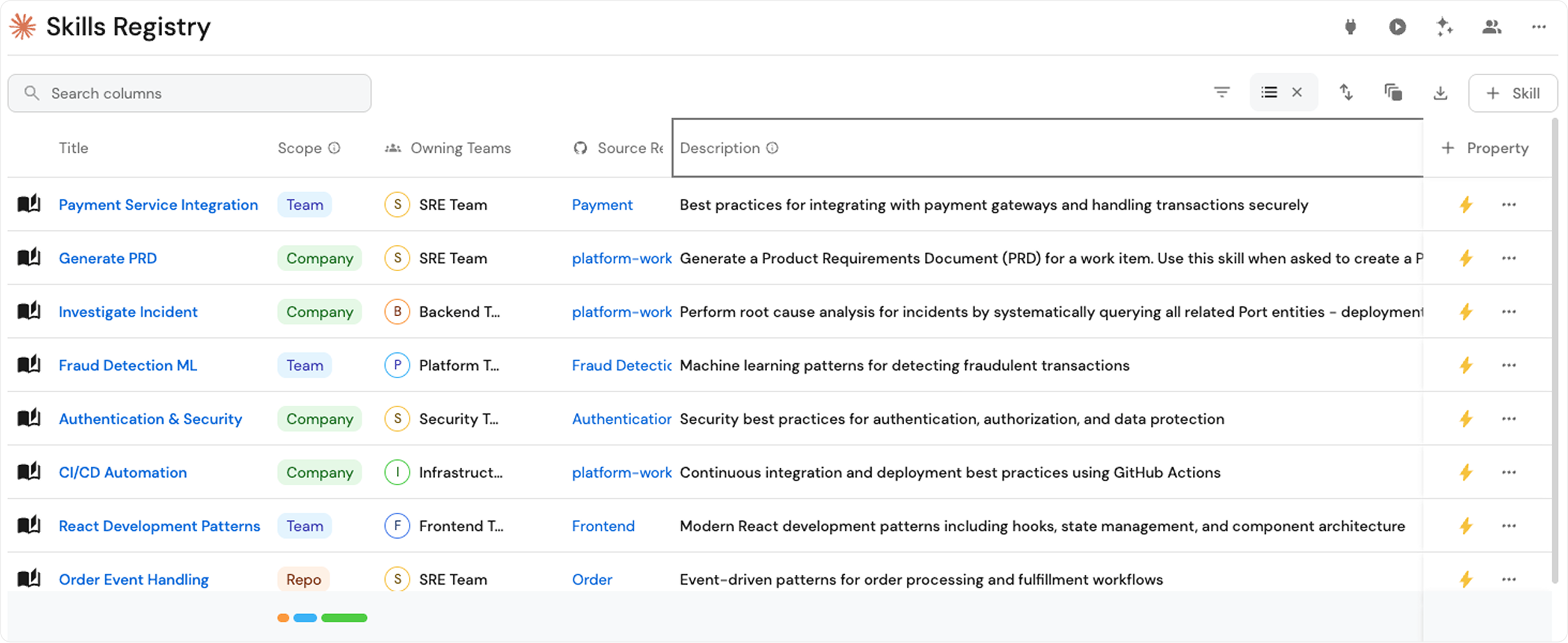
The mechanics matter less than order. You don’t bolt governance onto a fleet of agents that already shipped. You lay the foundation, and the fleet grows on top of it.
The teams that win won’t have the most agents
They’ll be the ones whose agents nobody has to worry about, because the platform underneath made discovered, scoped, grounded, and on-the-record the default instead of the afterthought.
Platform engineering isn’t going away. The catalog still needs maintaining, the golden paths still need updating, the CI/CD still breaks. Agents landed on top of all of it, reaching systems you provisioned and doing things you can’t fully see, and nothing fell off your plate to make room. The one advantage is you have time: the number of agents in your org is still small enough to get ahead of, and that window closes fast. Every engineer is a builder now. Give them the foundation to build on.
See what that foundation looks like before you have forty agents to catch up with. Book a demo or try Port, free.


Get your survey template today
%201.svg)


Download your survey template today


Free Roadmap planner for Platform Engineering teams
Set Clear Goals for Your Portal
Define Features and Milestones
Stay Aligned and Keep Moving Forward
Create your Roadmap


Free RFP template for Internal Developer Portal
Creating an RFP for an internal developer portal doesn’t have to be complex. Our template gives you a streamlined path to start strong and ensure you’re covering all the key details.
Get the RFP template


Leverage AI to generate optimized JQ commands
test them in real-time, and refine your approach instantly. This powerful tool lets you experiment, troubleshoot, and fine-tune your queries—taking your development workflow to the next level.
Explore now
Check out Port's pre-populated demo and see what it's all about.
No email required
LIVE WEBINAR, Aug 18, 2026:
Context-aware Vibe Coding for Platform Engineering
Thursday, October 22 12:00pm EDT⋅6:00pm CET
To learn more about the new capability and to see a live demo, join our upcoming community session with GitHub
Move fast while staying in control
Build governed agentic workflows on one central platform.
See it in action:
Watch this video on generating Terraform with Port, or explore our public demo.
.png)
Check out the 2025 State of Internal Developer Portals report
No email required
Minimize engineering chaos. Port serves as one central platform for all your needs.
Act on every part of your SDLC in Port.
Your team needs the right info at the right time. With Port's software catalog, they'll have it.
Learn more about Port's agentic engineering platform
Read the launch blog
Contact sales for a technical walkthrough of Port
Every team is different. Port lets you design a developer experience that truly fits your org.
As your org grows, so does complexity. Port scales your catalog, orchestration, and workflows seamlessly.
Port × n8n Boost AI Workflows with Context, Guardrails, and Control
Port Builders Session: A Single, Governed Interface for All MCP Servers
Book a demo right now to check out Port's developer portal yourself
Apply to join the Beta for Port's new Backstage plugin


n8n + Port templates you can use today
walkthrough of ready-to-use workflows you can clone
From manual to autonomous engineering
One platform to build, govern, and operate the Agentic SDLC.
Port is open for you to try it
build your first agentic workflow today