Port vs Warp.dev: Which AI Software Factory should you pick?
Warp Factories are one of the first managed AI software factories. Here’s how they work, what they do well, and how they compare with Port as you scale.


In August 2026, Warp, the company behind the Warp terminal and agentic development environment (ADE), released Warp Factories, one of the first managed services for AI software factories.
The idea is to move coding agents off each engineer’s laptop and into the cloud, where a team of agents handles a request from start to finish. Someone files a bug in Slack or Jira, one agent triages it, the next writes a plan, another writes the code, another reviews it, and a person approves the pull request at the end.
It’s an exciting, cutting-edge platform, and many organizations evaluating it are wondering the same thing:
Can Warp Factories keep up with the scale and complexity of an enterprise?
At enterprise scale, a factory has to answer questions like these:
- How does every agent know who owns a service and what depends on it, across hundreds of repos?
- What stops an agent from shipping during an open PagerDuty incident?
- When security updates a policy, how does every agent align with it automatically?
- What happens to deterministic pipelines your team already built? (e.g CI/CD)
- How do you keep human in the loop for risky operations without creating a bottleneck?
- How do you stop three teams from building the same skill three different ways?
In this article, we’ll compare Warp’s and Port’s AI software factories, and what each one means for you when you build one at enterprise scale.
{{from_manual_to_autonomous_engineering}}
What are Warp Factories?
Warp Factories is a cloud platform for running a team of agents that turns a request into a reviewed pull request. It replaces agents running on individual laptops, each with its own models and tools, with one shared factory where every run, permission, and cost is tracked in one place.
A work item process starts wherever the team already talks, whether that's a Slack mention, a Linear or Jira issue, or a GitHub PR.
How does it work?
Under the hood, a Warp factory has six components:
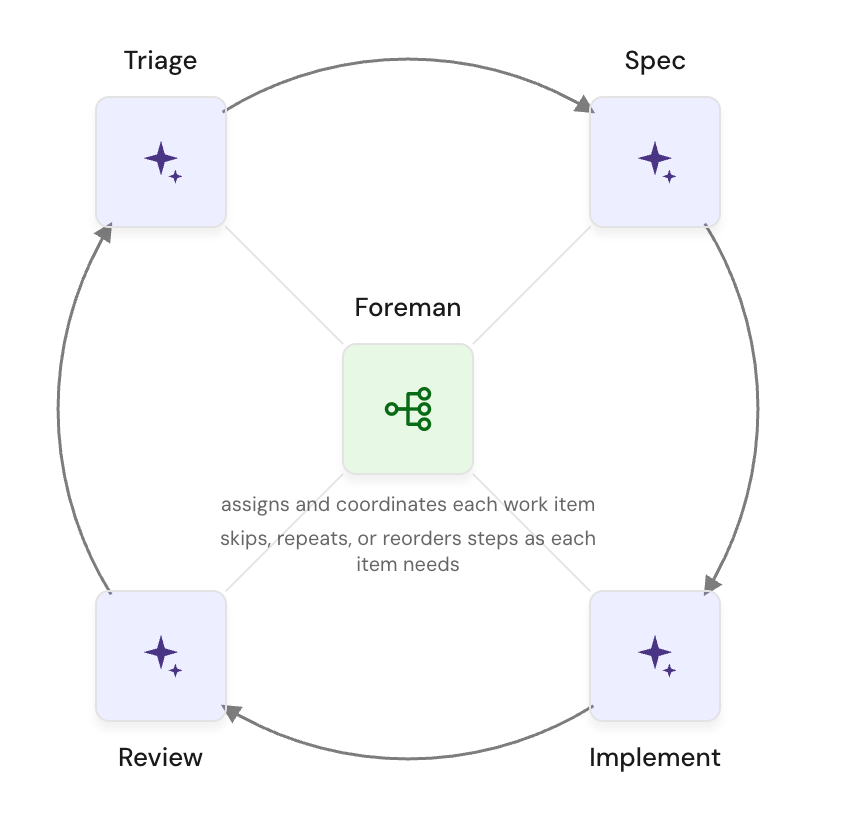
- The foreman is the orchestrator of the business process. For each work item it decides which stages it needs, by which AI agent. It might skip certain stages (for example triage or planning) when the work is already clear and revert to previous stages when revisions are needed.
- AI agents are the main actors in Warp. They get their own model, harness, skills, and MCP servers, running on Warp Agent Harness, Claude Code, or Codex.
- Automations route certain triggers like a Slack mention or a new issue to the right agent.
- The factory is an object representing the process itself. It lives as versioned code, and its definitions stored in GitHub go through PR review.
- Compute runs each agent in a sandbox, on Warp-hosted or self-hosted compute
- The quality loop scores runs against your rubric, benchmarks models on your tasks, and opens PRs to fix the factory when failures pile up.
Where does Warp stand out?
Warp makes the first factory setup easy. A setup wizard gives you a foreman and a ready team of triage, spec, implementation, and review agents in minutes, each running on the harness that fits it best, like Claude Code or Codex, and built-in scorers and benchmarks show how well the agents are doing. It’s a strong way to get one factory working well, and the harder questions show up when that factory has to serve the whole company.
What challenges might you face as an enterprise using Warp?
As your software factory becomes real, more teams, services, and agents mean more people who need to trust what the factory does, from security and compliance to the engineering teams that own each service.
These are the main challenges you might face, when using Warp at scale.
Factory context is based on repository files and agent memory
Warp builds context around the code, through AGENTS.md files and Agent Memory, and its native integrations, like Slack, GitHub, Linear, and Jira, are where people interact with the factory.
At enterprise scale, that means knowledge about ownership, dependencies, and incidents has to be written into md files repo by repo, then kept up to date as teams and services change. What we see in the market is that this knowledge already lives in tools like the service catalog, PagerDuty, Datadog, and Snyk, which brings a big opportunity - a unified context layer that pulls it straight from those systems gives every agent the same up-to-date picture from day one, and it’s something Warp will need to address to scale its factories.
Policies are limited to event filters and prompt instructions
In Warp, automation filters decide when work starts by matching fields only from the incoming event, like a repo or a label, and the foreman’s instructions decide which steps to run and when to stop for a human. Enterprises need dynamic policies, rules that read live data from their tools at each decision point in the factory, here are a few scenarios you’ll need to address:
- Approvals: a tier-1 change should go to its owning team, and anything touching customer data to security, but Warp asks the person who kicked off the work, since the factory has no record of who owns each service or which ones handle customer data.
- Factory branches: a product launch should always run design and security review, but a bug should go to PR immediately. In Warp the foreman decides which steps to skip, so a required step runs only if the agent follows its instructions.
- Guardrails: “no agent changes to a service with an open PagerDuty incident” needs incident data before the agent acts, but Warp’s filters only see the incoming event, so the rule lives in a prompt or depends on a person catching it in review.
Separation between company and team policies
In most companies, policies need to be enforced at two levels:
- Platform rules - approved models, required reviews, allowed data access, allowed tools.
- Team rules - service level policies, team-level skills
In Warp, every factory has its own rules and policies, and there’s no way to enforce standards at the company level without setting them up manually in every factory, and keeping them in sync each time there’s a new standard update.
Including deterministic steps in the factory
In Warp, every stage in the factory runs as an agent, which fits work like triage, specs, code, and review. But enterprise processes also include steps that have to run the same way every time, like a deployment through an approved pipeline, opening a change ticket in ServiceNow, or recording compliance evidence. Those steps either sit outside the factory in CI or rely on an agent following its instructions, which makes the most sensitive parts of the process the hardest to keep predictable and splits one business process across two systems that don’t share context or audit.
Bringing your own managed cloud agents
Every factory agent runs as a Warp cloud agent, with the Warp Agent, Claude Code, or Codex as its harness, so agents your teams already run on Claude managed agents, Bedrock AgentCore, or Azure AI Foundry can't join as they are. A triage agent your SRE team built on Claude managed agents has to be rebuilt and go back through security review, or keep running on a second platform with its own permissions, audit trail, and bill.
No enterprise-level agent certification
In Warp, quality is measured after the fact: scorers grade finished runs, benchmarks compare models on your tasks, and each factory’s agents change through PR review. What enterprises also need is a way to certify an agent or skill before it reaches production, with evals, an owner, and an approved model, and then reuse it across teams. Without that, the same skill gets rebuilt in different factories with different quality, and there’s no single list of which agents are approved to run.
How does Port approach those challenges?
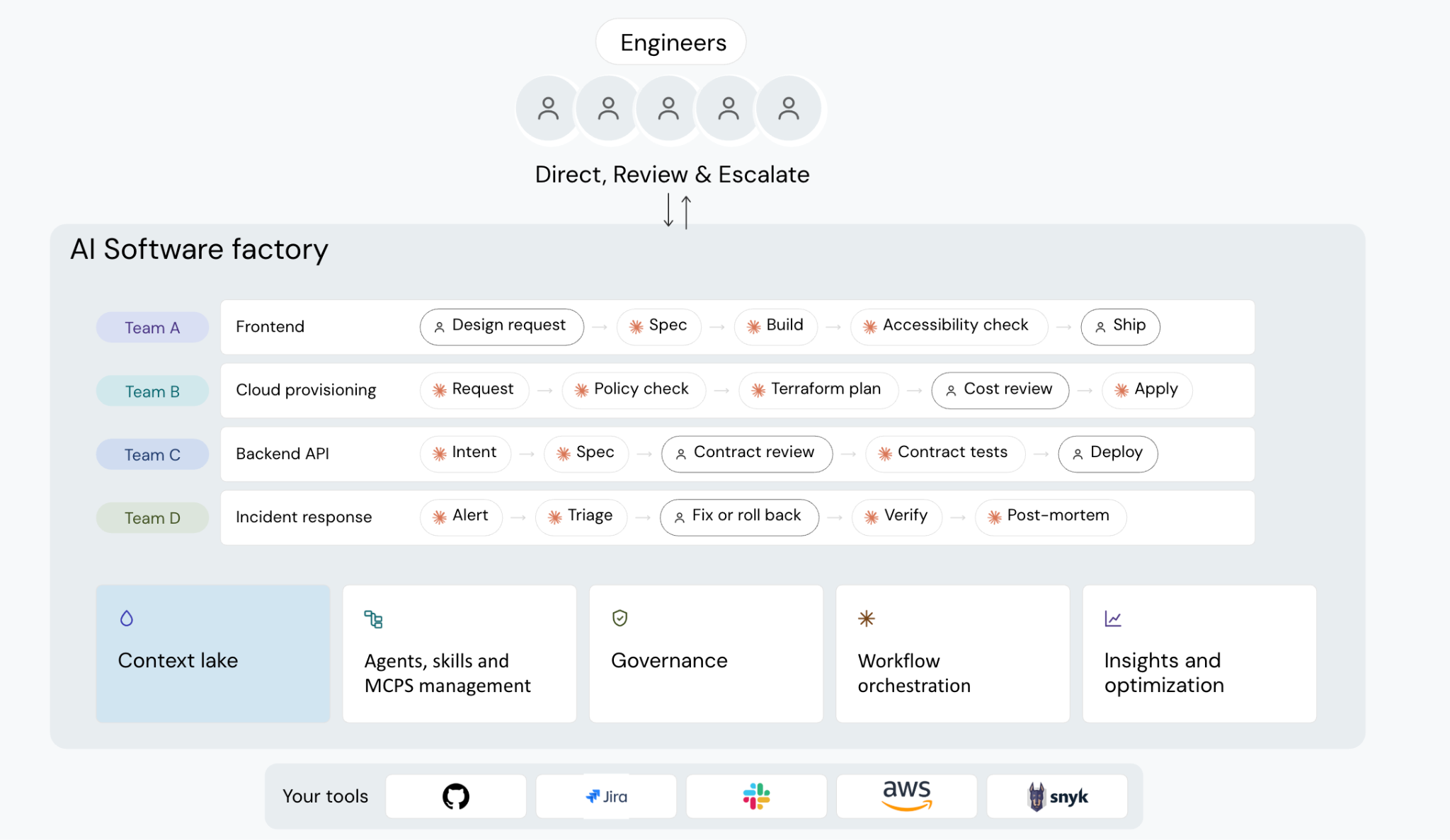
Port is an AI software factory built for enterprise scale, with a scalable engine behind each of its main pillars.
A unified Context Lake, fed by the tools you already use
Port’s Context Lake is a flexible data model shaped to your organization, with services, owners, dependencies, deployments, incidents, and any other tool data your teams rely on. It’s filled automatically through 200+ integrations with the tools that already hold that knowledge, like your repos, PagerDuty, Datadog, and Snyk, so nobody has to rewrite it into md files repo by repo or keep those files in sync.
Every agent queries the same up-to-date knowledge graph, which can cut token use by up to 80% compared with calling MCP servers directly, and a permissions layer decides what each agent can read based on its scope and role.
Dynamic policies based on live data
In Port, policies are conditions on each step of the factory, checked against live Context Lake data at the moment an agent tries to act. For example, a rule like “no agent changes to a service with an open incident” runs every time, using the latest incident, workload, and service data instead of what the agent was told in a prompt or an md file.
Human review is based on risk, so a small UI bug fix that passes every policy moves ahead without waiting on anyone, while a change to a payments service goes to the right approver based on service ownership and data sensitivity (in Slack, Claude, or Jira).
Each persona, from service owners to security to the platform team, gets its own view to monitor the factory, and every decision is stored in the factory audit log.
Company and team policies are layered in each factory flow
In Port, the platform team defines company-wide policies once, like approved models, allowed tools, required reviews, and data access, and every team’s flows inherit them automatically. Teams add their own rules on top for their services and skills, but they can’t override what the platform set.
When a standard changes, the platform team updates it in one place and it applies to every flow across the company, so security gets one answer to “are all our factories following the rules?”
Bring your own agents, and make them production ready
In most enterprises, the agents a factory needs already exist, built by different teams, Claude managed agents, Bedrock, Azure AI Foundry, or home-built runtimes. The challenge is putting them to work in the factory without losing track of which ones exist, who owns them, or what they’re allowed to touch.
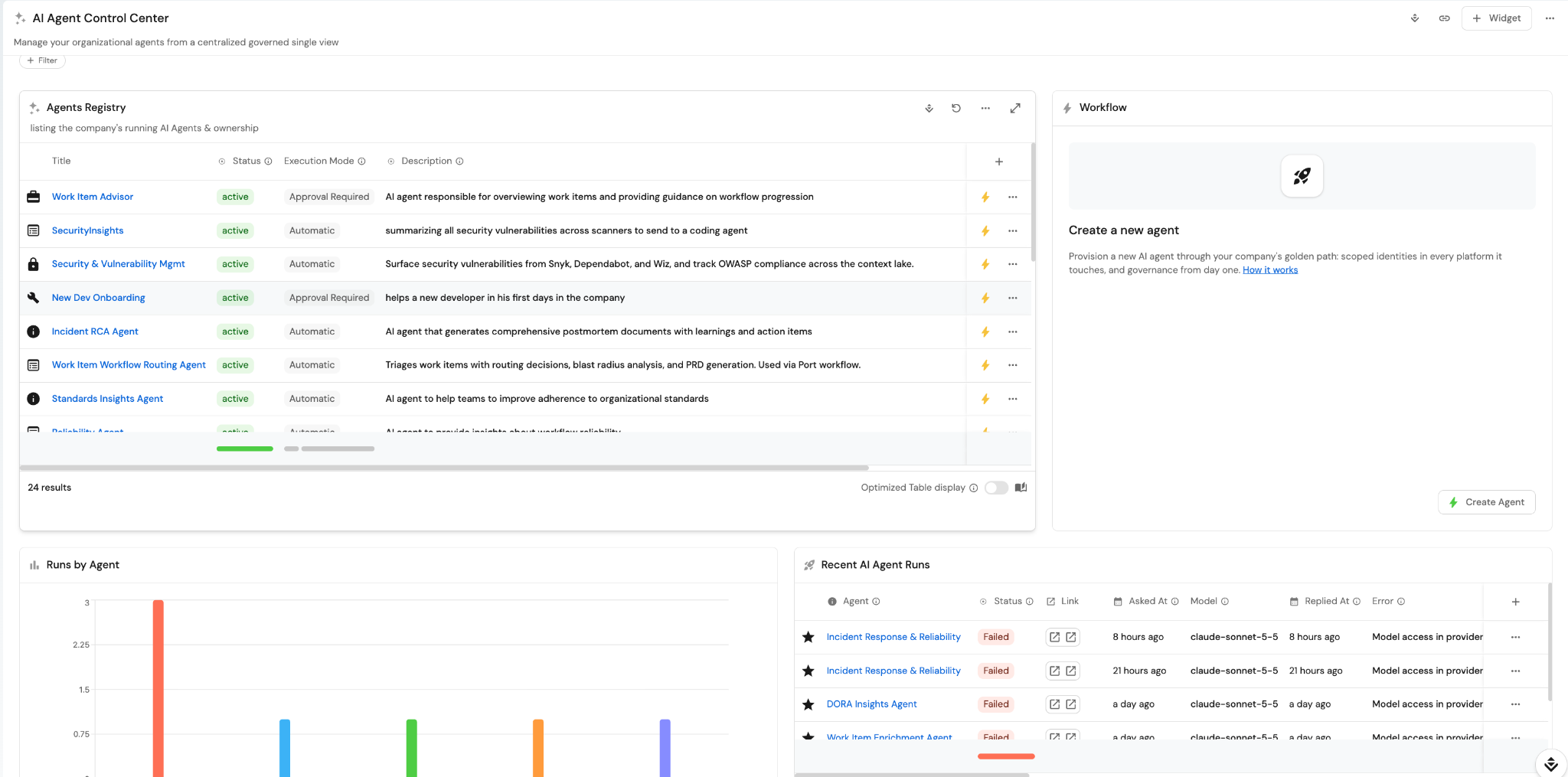
Port’s agent registry finds those agents automatically through GitHub, AWS, Claude, and Azure and makes them available as steps in any factory flow, while they keep running on the runtime security already approved. New agents join the factory through golden paths with your standards built in, and production readiness scorecards keep any agent that falls short out of the flow.
Every agent in the factory has an owner you can reach and a full audit trail, so teams reuse what already works and any incident traces back to the exact agent and step.
Deterministic steps in every flow
In Port, a factory flow can mix agent steps with deterministic ones. Agents handle the work that benefits from judgment, like triage, specs, and code, while steps that have to be exact run as fixed workflows inside the same factory, like a deploy through your approved pipeline, a change ticket in ServiceNow, or recording compliance evidence.
AI ROI across the factory
Warp’s dashboard comes with a fixed set of factory metrics, like cost per PR and run volume. In Port, you build dashboards around the business metrics each persona look for, so engineering leaders can track cost and delivery per team, platform teams can watch change failure rate and rejected steps, and security can follow policy decisions across every flow. When a flow underperforms, you can trace the root cause, whether it’s missing context, a weak skill, or a step that keeps getting rejected, and both engineers and agents can share feedback on what would help them do better work.
Which AI software factory should you pick?
If you’re starting a greenfield project from scratch, like a new product or an internal tool, and one team wants agents shipping PRs fast, Warp Factories will give you a smooth, fast factory experience.
But as the factory grows, it has to scale in two directions at once: more factory lines, like bug fixes, migrations, and launches, and more teams running each of them. Every combination brings its own details, like a regulated payments team that needs its own approval path, a company-wide rule that has to reach every line at once, or an agent your SRE team already runs that needs to join the flow.
With one scalable platform as the foundation, every new factory line and every new team builds on the context, agents, and policies already in place. The more lines and teams you add, the bigger the ROI and the faster each one goes live, so you improve velocity while staying in control. That’s why, for the long run, Port should be your platform of choice.
{{port_is_open_for_you_to_try_it}}
FAQ
What does Warp Factories do?
Warp Factories is one of the AI developer tools built to run a team of coding agents in the cloud. A foreman agent takes work from Slack, Linear, Jira, or GitHub and routes it through triage, spec, implementation, and review agents as each item needs them, with scorers and benchmarks that track quality and cost per PR.
How is Port's AI software factory different from Warp Factories?
Warp Factories focuses on getting agents to turn a request into a reviewed PR. Port focuses on what the factory needs to run across a whole company: a Context Lake that models your services and owners, 200+ integrations, dynamic policies on live data, approvals routed to the right team, and one registry for every agent you run, which is how we approach agentic engineering.
Does Warp.dev replace the need for a developer portal?
No, because Warp has no catalog of services and owners, no scorecards, and no developer self-service for work beyond coding, so teams that need developer workflow automation across the SDLC still need a platform layer. Port covers both, with the portal and the factory built on the same Context Lake.
Can I bring agents I've already built into an AI software factory?
In Port, yes: the agentic registry brings in agents from Claude managed agents, Bedrock, Azure AI Foundry, or your own custom agents, with owners and certification. In Warp Factories, factory agents run as Warp cloud agents on the Warp Agent, Claude Code, or Codex harness.
{{from_manual_to_autonomous_engineering}}


Get your survey template today
%201.svg)


Download your survey template today


Free Roadmap planner for Platform Engineering teams
Set Clear Goals for Your Portal
Define Features and Milestones
Stay Aligned and Keep Moving Forward
Create your Roadmap


Free RFP template for Internal Developer Portal
Creating an RFP for an internal developer portal doesn’t have to be complex. Our template gives you a streamlined path to start strong and ensure you’re covering all the key details.
Get the RFP template


Leverage AI to generate optimized JQ commands
test them in real-time, and refine your approach instantly. This powerful tool lets you experiment, troubleshoot, and fine-tune your queries—taking your development workflow to the next level.
Explore now
Check out Port's pre-populated demo and see what it's all about.
No email required
LIVE WEBINAR, Aug 18, 2026:
Context-aware Vibe Coding for Platform Engineering
Thursday, October 22 12:00pm EDT⋅6:00pm CET
To learn more about the new capability and to see a live demo, join our upcoming community session with GitHub
Move fast while staying in control
Build governed agentic workflows on one central platform.
See it in action:
Watch this video on generating Terraform with Port, or explore our public demo.
.png)
Check out the 2025 State of Internal Developer Portals report
No email required
Minimize engineering chaos. Port serves as one central platform for all your needs.
Act on every part of your SDLC in Port.
Your team needs the right info at the right time. With Port's software catalog, they'll have it.
Learn more about Port's agentic engineering platform
Read the launch blog
Contact sales for a technical walkthrough of Port
Every team is different. Port lets you design a developer experience that truly fits your org.
As your org grows, so does complexity. Port scales your catalog, orchestration, and workflows seamlessly.
Port × n8n Boost AI Workflows with Context, Guardrails, and Control
Port Builders Session: A Single, Governed Interface for All MCP Servers
Book a demo right now to check out Port's developer portal yourself
Apply to join the Beta for Port's new Backstage plugin


n8n + Port templates you can use today
walkthrough of ready-to-use workflows you can clone
From manual to autonomous engineering
One platform to build, govern, and operate the Agentic SDLC.
Port is open for you to try it
build your first agentic workflow today