AI Software Factory
An AI software factory runs your SDLC as a production line with agents at each stage. What it is, what it needs, and how it works.

Whether you're a CTO or a platform lead, giving all engineering access to Claude / Codex is easy to start and hard to make pay off. Almost every team has coding assistants now, yet few are shipping faster for it. The teams we work with keep asking how to speed up the whole delivery line, not just the coding stage. That is what an AI software factory does.
Key Takeaways
- A software factory is your software development lifecycle run as a production line, where AI agents do the work at each stage and engineers design, direct, and operate the line.
- Four things make it work: orchestration, shared context, governance, and measurement, all sitting on top of the tools you already run.
- A coding assistant speeds up one stage, so the bottleneck just moves downstream. A factory runs the whole line, which is what actually makes delivery faster.
- Platform engineering builds and governs it, engineers operate it, DevOps owns the machines underneath, and the VP of R&D sets how far autonomy can go.
What Is an AI Software Factory? A Definition for Engineering Leaders
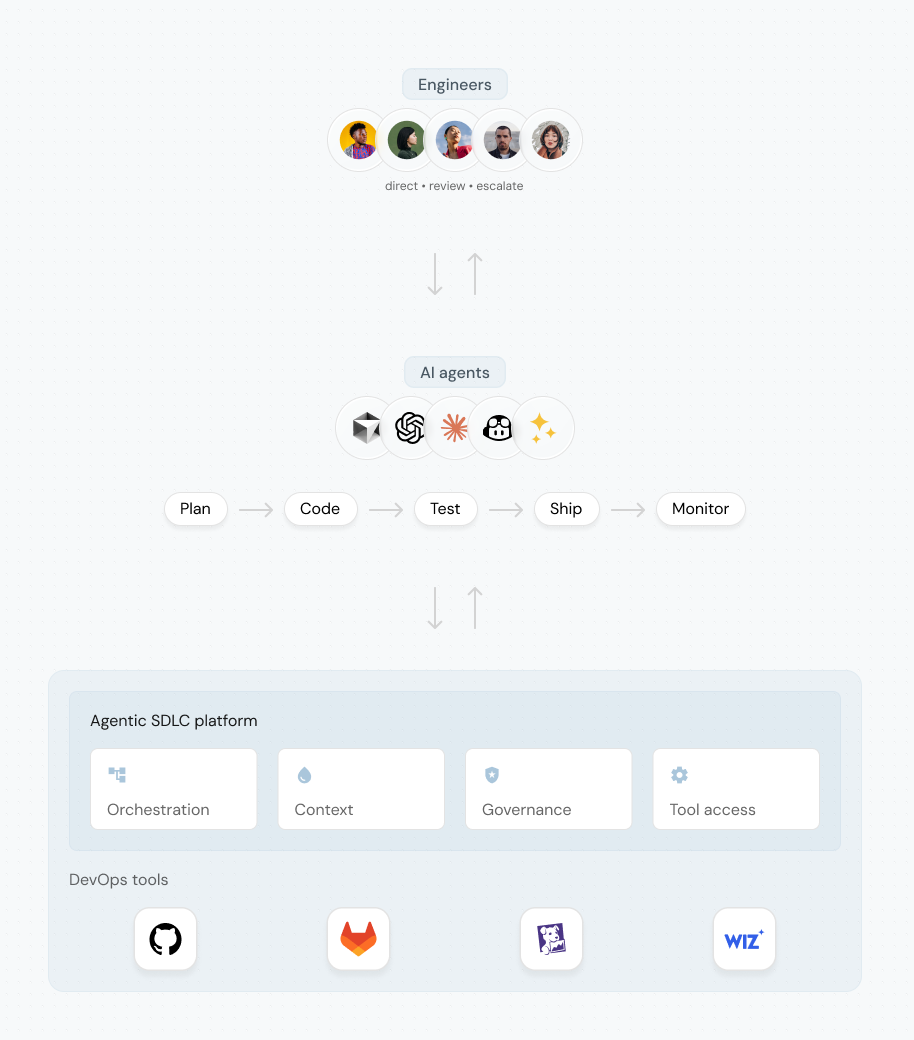
An AI software factory is an operating model where your software development lifecycle runs as a production line, with agents doing the work at each stage and engineers designing and running the line.
The stages are the ones you already know. You plan the work, agents write code while engineers direct and review it, CI runs the tests, CI/CD ships it, and on-call keeps it healthy. What changes is who works each station: agents now stand beside your engineers, who move from writing every line to directing and approving it. You keep the same tools, and what changes is how the work moves through them.
AI Software Factory vs AI Factory vs Traditional Software Factory
Three different things get called a "factory" in AI, and they are easy to mix up. Here is how they differ.
An AI factory, in the sense NVIDIA popularized, is a data center that produces AI. It takes in data and uses compute to produce tokens and trained models. This is a hardware and infrastructure idea, not a way of building software.
A traditional software factory is an older concept that traces back to Bob Bemer's 1968 paper "The Economics of Program Production." It applies manufacturing discipline to software: standardized processes, reuse, and repeatable delivery, often through offshore delivery centers. People still write every line, so the factory here is the process around them.
An AI software factory is that same production line, except agents now do the work at each station, under orchestration, shared context, governance, and measurement. There is another term called Dark Software Factory. You can think of a factory as having two “modes”: lights on and lights off. A “lights on” factory needs lights on because humans need to see what they are doing. A “lights off” or dark software factory doesn’t need lights because machines are doing all the work and don’t need lights to function
What an AI Software Factory Is Made Of
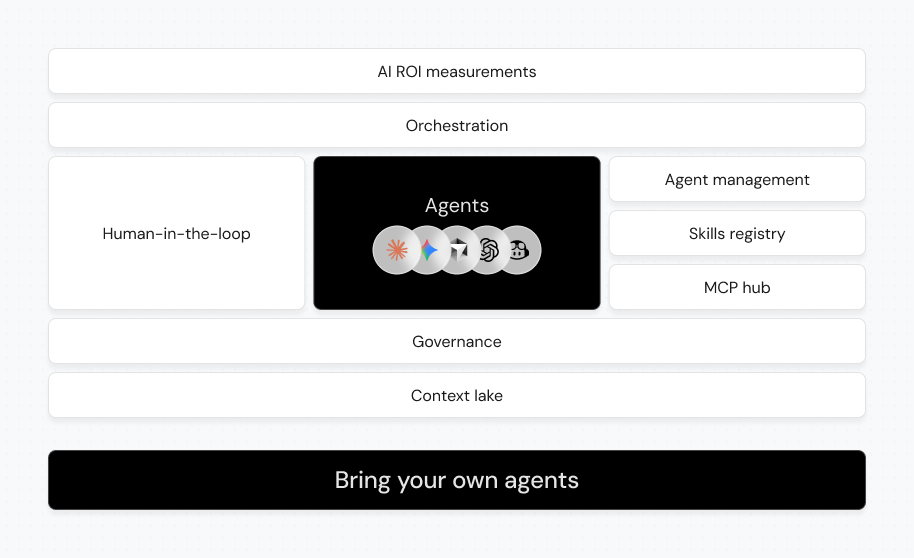
You already have most of the pieces: your engineers, the tools they run on, and your agents, whether they run on Bedrock, a third-party platform, or in-house. The factory is the layer that connects them and keeps them coordinated.
- Context Lake is the system of record and action: the shared source of truth agents and engineers read context from and act through, including services, owners, dependencies, and the actions each is cleared to run.
- Workflow engine is the orchestrator, where you define the lines: what happens on an incident, a release, or a new ticket from product.
- MCP Hub connects agents to the tools and actions they are allowed to use, so access stays scoped.
- Agent registry is one place to see and manage every agent you run.
- Skills registry holds reusable, certified skills, so teams build on shared building blocks instead of reinventing each one.
- Human-in-the-loop gates decisions by risk, routing the ones that need judgment to a person.
- Governance sets permissions, audit, and guardrails across the whole line.
- Measurement tracks speed, quality, and cost, and shows whether the agents actually pay off.
How an AI Software Factory Runs
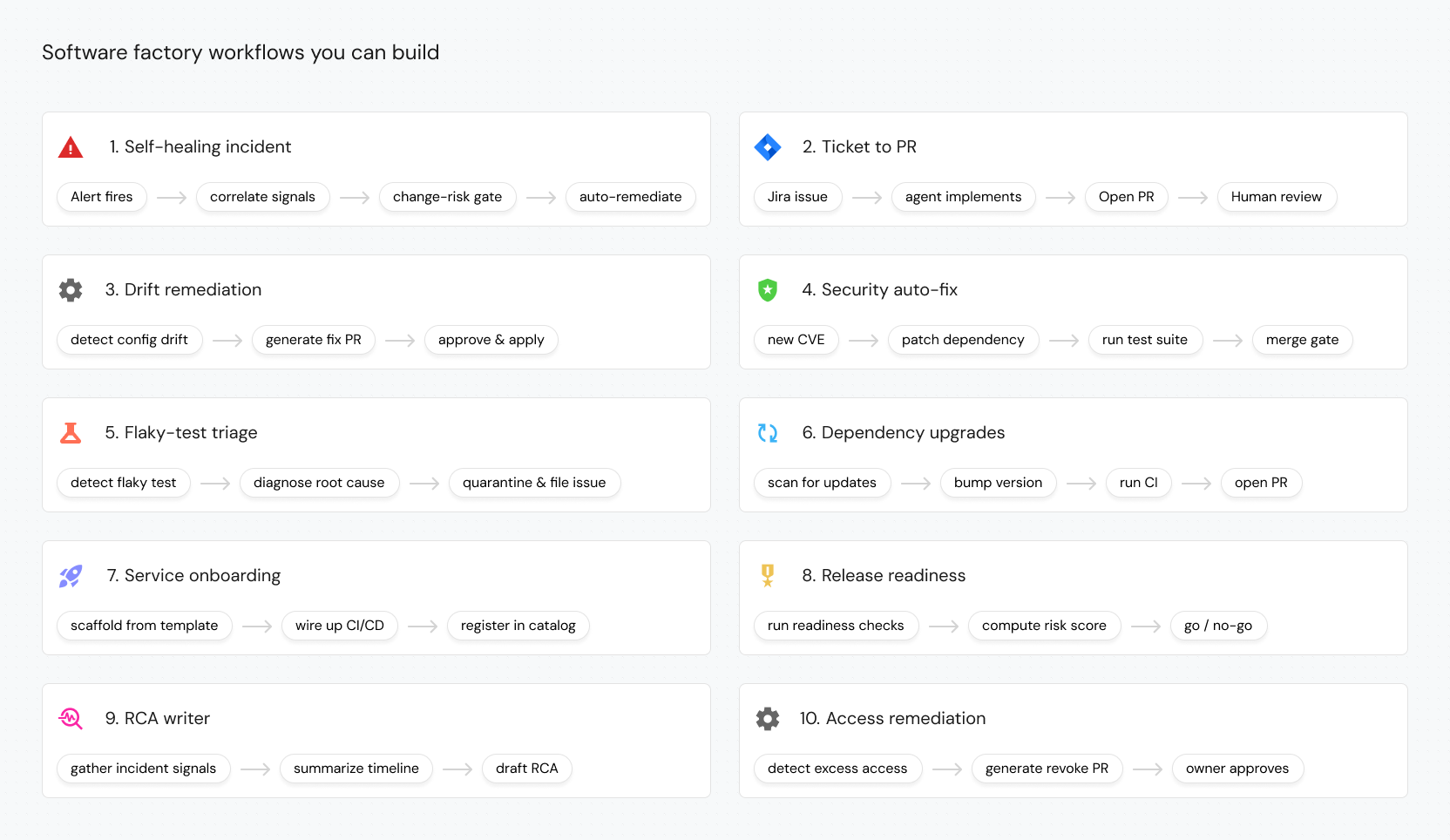
The fastest way to make this concrete is to follow one ticket from intake to production. A well-scoped bug lands from product. The workflow hands it to an agent, which reads the affected service, its owner, and dependencies from the Context Lake, writes the fix, and opens a pull request in GitHub. A second agent reviews the diff, the CI suite runs the tests, and the line scores the risk: is the change confined to one service, covered by tests, and clear of payments, auth, and data paths? If it is low-risk, it merges and deploys on its own. If not, it routes to an engineer, who sees the diff, the reasoning, and the blast radius in Slack and approves or rejects before it ships. Incidents run the same way: a PagerDuty alert comes in, an agent proposes a root cause, and anything risky waits for the on-call engineer.
A common question is software factory vs DevOps: which one does what? A factory does not replace DevOps, it runs on top of what DevOps builds. DevOps owns the machines, the CI/CD, observability, on-call, and security, and agents can only run the line as far as that pipeline is automated and trustworthy. Platform engineering builds and governs the factory, giving teams the Context Lake, workflow engine, and scoped tools to build their own lines. Engineers operate and extend it, and the VP of R&D or CTO sets how far autonomy can go.
In our own research, giving agents one shared context layer instead of wiring each to a pile of MCP servers cut token use by about 80%, because the agents no longer waste effort hunting for context. For the full playbook, the three workflows to start with, and how to measure ROI, see our guide to building a software factory.
How to Tell Whether You Are Running One
This is the question we get asked most, so here is a short checklist to hold your own org against.
- Work moves through review, test, and deploy without a person at every step, and you can name the stages that run agent-first.
- One registry lists every agent and what each is cleared to touch, instead of agents scattered across CI jobs, Slack bots, and Cursor automations no one is tracking.
- Agents read from a shared source of truth about your systems, not from whatever someone pasted into a prompt.
- You measure the line by lead time, deployment frequency, change failure rate, and the share of work an agent resolves end to end, not by tokens spent or percent of code written by AI.
- Permissions and audit live in one place, so an agent can open a pull request in one service while anything touching payments or auth is blocked and logged.
If most of these are true, you are running one. If your agents are live but ungoverned and hard to track, you have agents without a system around them, and that sprawl is the problem a factory is meant to fix.
FAQ
Who owns the AI software factory inside an engineering organization?
Platform engineering builds and governs it, setting the shared context layer, the workflows, and the guardrails. Engineers operate and extend it alongside agents. DevOps owns the machines underneath, meaning CI/CD, observability, security, and on-call. The VP of R&D or CTO funds it and sets how far autonomy can go.
Is an AI software factory the same thing as the SDLC?
No. The SDLC is the set of stages: plan, code, review, test, ship, and operate. A software factory is how you run those stages, as a production line where agents do the work and engineers direct it. Same stages, different operating model.
Does an AI software factory replace engineers?
No. It reshapes the work and expands how much a team can build. Engineers move from writing every line to designing the line, directing agents, approving risky changes, and building the workflows specific to their domain. The judgment stays with people.
What is a dark software factory?
A dark, or lights-out, software factory writes, reviews, tests, and ships without a human reading the code. Google engineer Addy Osmani describes it as code that ships that no one has read. Treat it as a direction to move toward, and keep a human in the loop for anything touching money, data, or safety.
Do you need to replace your existing tools to build one?
No. An agentic SDLC platform sits on top of your current stack, your cloud, Git, CI/CD, and observability, plus your own agents, which keep doing their jobs. It adds the orchestration, shared context, governance, and measurement that turn those tools into one coordinated line.


Get your survey template today
%201.svg)


Download your survey template today


Free Roadmap planner for Platform Engineering teams
Set Clear Goals for Your Portal
Define Features and Milestones
Stay Aligned and Keep Moving Forward
Create your Roadmap


Free RFP template for Internal Developer Portal
Creating an RFP for an internal developer portal doesn’t have to be complex. Our template gives you a streamlined path to start strong and ensure you’re covering all the key details.
Get the RFP template


Leverage AI to generate optimized JQ commands
test them in real-time, and refine your approach instantly. This powerful tool lets you experiment, troubleshoot, and fine-tune your queries—taking your development workflow to the next level.
Explore now
Check out Port's pre-populated demo and see what it's all about.
No email required
LIVE WEBINAR, Aug 18, 2026:
Context-aware Vibe Coding for Platform Engineering
Thursday, October 22 12:00pm EDT⋅6:00pm CET
To learn more about the new capability and to see a live demo, join our upcoming community session with GitHub
Move fast while staying in control
Build governed agentic workflows on one central platform.
See it in action:
Watch this video on generating Terraform with Port, or explore our public demo.
.png)
Check out the 2025 State of Internal Developer Portals report
No email required
Minimize engineering chaos. Port serves as one central platform for all your needs.
Act on every part of your SDLC in Port.
Your team needs the right info at the right time. With Port's software catalog, they'll have it.
Learn more about Port's agentic engineering platform
Read the launch blog
Contact sales for a technical walkthrough of Port
Every team is different. Port lets you design a developer experience that truly fits your org.
As your org grows, so does complexity. Port scales your catalog, orchestration, and workflows seamlessly.
Port × n8n Boost AI Workflows with Context, Guardrails, and Control
Port Builders Session: A Single, Governed Interface for All MCP Servers
Book a demo right now to check out Port's developer portal yourself
Apply to join the Beta for Port's new Backstage plugin


n8n + Port templates you can use today
walkthrough of ready-to-use workflows you can clone
From manual to autonomous engineering
One platform to build, govern, and operate the Agentic SDLC.
Port is open for you to try it
build your first agentic workflow today