Your Engineering Intelligence Tool Told you what’s broken. Now what?
Your Engineering Intelligence tool has metrics. What it's missing is the action that makes those metrics useful.


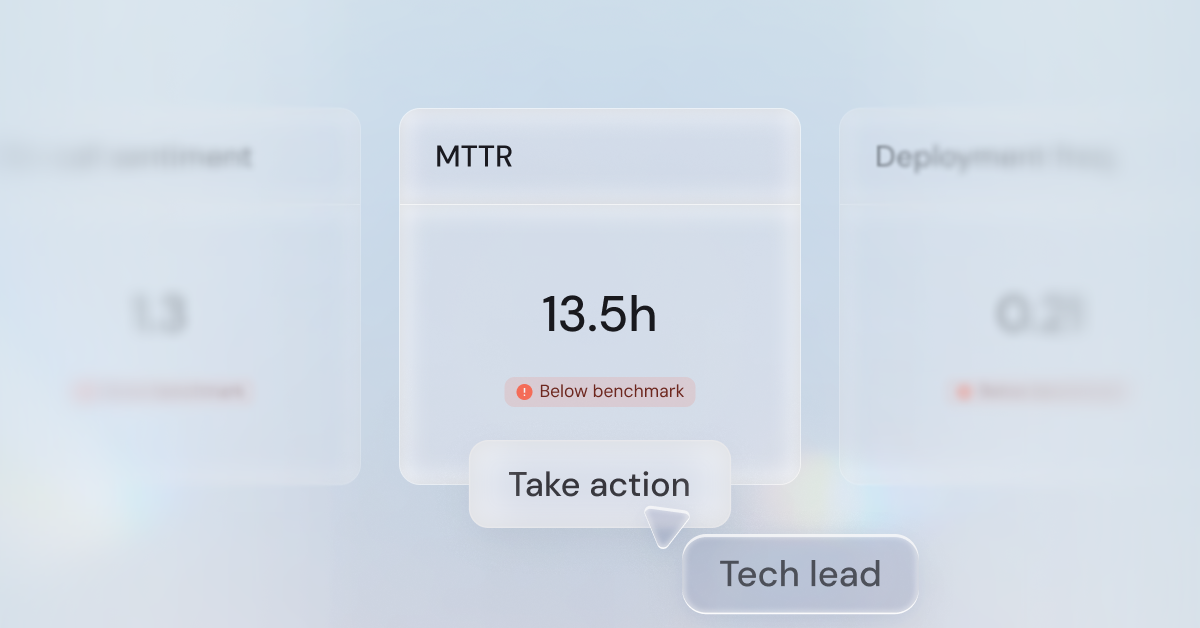
You’ve invested in engineering intelligence. The dashboards are live. You can see exactly where your teams lose time. Slow code reviews, flaky tests, endless context switching between tools. And then nothing changes. The data sits in dashboards. The bottlenecks remain. Your developers are still frustrated, and you’re explaining to leadership why shipping takes so long.
Measurement without action is expensive wallpaper.
Engineering intelligence tools tell you what’s wrong. But knowing your CI/CD pipeline takes 47 minutes doesn’t shorten it. Seeing that developers spend 30% of their week on manual tasks doesn’t eliminate those tasks. Surfacing that Team A has a 3-day code review cycle doesn’t speed up their reviews.
The question isn’t “what’s broken?” It’s “how do we turn this insight into something developers can act on, without it becoming another ticket in our backlog?”
The measurement trap
A generation of engineering intelligence tools emerged from academic research. They brought rigor to a space that had been driven by gut feel. Frameworks like DORA, SPACE, and Core 4 gave leaders real metrics to work with.
This was valuable. For the first time, your engineering organization could see what was actually happening: How long does it take to merge code? Where do developers report the most friction? Which teams are burning out?
These tools were built to measure, not fix. They connect your GitHub, your Jira, your CI system. They pull data. They generate reports. They surface insights. And then they stop.
What happens after the dashboards show a problem? In most organizations, it looks like this:
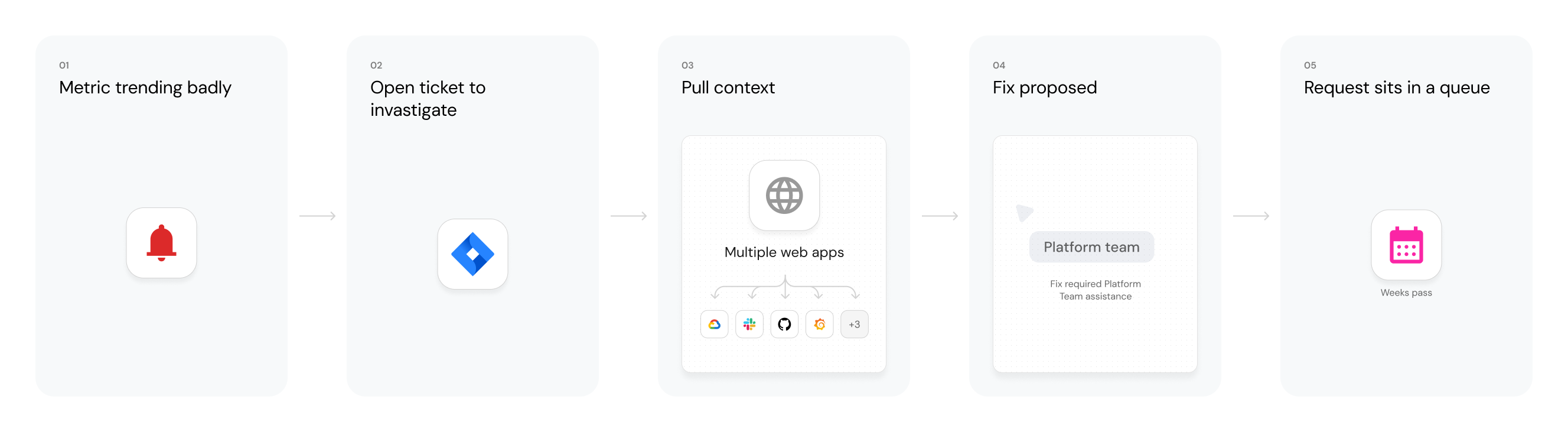
The intelligence tool did its job; It surfaced the problem. But without a mechanism to act on that intelligence, you’ve just added another dashboard to the pile.
Intelligence needs infrastructure
Real improvement requires two things working together:
- Measurement: Seeing where time goes, where quality suffers, and where your developers get stuck.
- Action: Fixing what you’ve observed. Spinning up an environment. Triggering a rollback. Paging the right team. All without filing a ticket and waiting for someone else to do the work.
Standalone engineering intelligence tools give you measurement. They show you the “what” and sometimes the “why.” But they fail to deliver on the “how.” They can’t spin up an environment. They can’t trigger a pipeline. They can’t page your on-call engineer or kick off a remediation workflow. Your engineering leaders become professional report-readers.
Port gives you both sides: measurement to see what’s broken and the platform to fix it, without switching tools. Every insight connects to an action: rollback a failed deployment, page an owner when there’s an SLO breach, provision an environment, all from within the platform.
The IDP foundation changes everything
Port’s Service Catalog shows you who owns Service X, what it depends on, when it was last deployed, and which runbook applies. That context powers your portal every day. So when a metric spikes or an SLO fails, you’re not hunting for information. You already know who owns it, what changed, and what to do next.
Without an IDP foundation: Your intelligence tool shows that Service X has been failing its SLO for two weeks. You know what’s broken. Now you need to figure out who owns it, what dependencies it has, what deployment history looks like, and who can actually fix it. That information lives in five different places. A tough challenge.
With Port: The same SLO failure surfaces in your portal. But now you’re one click away from seeing the owning team, the service’s dependencies, recent deployments, related incidents, and the runbook for remediation. The owning team can rollback or trigger a fix themselves. No ticket required.
Same intelligence. Radically different outcome.
The Agentic future belongs to platforms
You’re probably already seeing AI assistants in your org. They help your developers write code faster, platform teams generate Terraform configs, SREs triage alerts or draft runbooks. But what would happen if an agent had access to the right systems, and could resolve an incident, enforce a standard, or close a ticket? That’s where the IDP foundation matters: it gives automation something to act on.
Port’s Agentic Engineering Platform means your team isn’t waiting for this future. You’re building on a foundation that’s ready for it today. The catalog, the actions, the workflows you set up now become the infrastructure for your AI agents.
An agent can’t fix a deployment if it has no access to your deployment system. It can’t remediate a security vulnerability, if it doesn’t know your service dependencies. It can’t enforce standards, if there’s no catalog to enforce them against.
Measurement-only tools and traditional IDPs will struggle to participate in this shift. They can tell an agent what’s wrong, but they can’t give the agent hands to fix it.
Port embodies your environment - the software catalog, self-service actions, automation workflows, and governance guardrails - gives AI agents the operational layer they need. Not another alerting system, but automation that handles the routine so your team can focus on complex, human-centric tasks.
The point of Engineering Intelligence is improvement
Engineering intelligence gave you insights. Now you need outcomes. When a deployment frequency drop on Monday leads to a pipeline fix by Friday. When a code review bottleneck surfaces Tuesday and the team has a new review rotation by Thursday.
That requires more than visibility. It requires a platform where every insight connects to an action: a rollback, a page, a provisioned environment, an enforced standard.
Port closes the loop between knowing and doing. Your dashboards stop being wallpaper and start being the place where problems actually get solved.
See how you can connect engineering intelligence to the actions that move the needle.


Get your survey template today
%201.svg)


Download your survey template today


Free Roadmap planner for Platform Engineering teams
Set Clear Goals for Your Portal
Define Features and Milestones
Stay Aligned and Keep Moving Forward
Create your Roadmap


Free RFP template for Internal Developer Portal
Creating an RFP for an internal developer portal doesn’t have to be complex. Our template gives you a streamlined path to start strong and ensure you’re covering all the key details.
Get the RFP template


Leverage AI to generate optimized JQ commands
test them in real-time, and refine your approach instantly. This powerful tool lets you experiment, troubleshoot, and fine-tune your queries—taking your development workflow to the next level.
Explore now
Check out Port's pre-populated demo and see what it's all about.
No email required
LIVE WEBINAR, Aug 18, 2026:
Context-aware Vibe Coding for Platform Engineering
Thursday, October 22 12:00pm EDT⋅6:00pm CET
To learn more about the new capability and to see a live demo, join our upcoming community session with GitHub
Move fast while staying in control
Build governed agentic workflows on one central platform.
See it in action:
Watch this video on generating Terraform with Port, or explore our public demo.
.png)
Check out the 2025 State of Internal Developer Portals report
No email required
Minimize engineering chaos. Port serves as one central platform for all your needs.
Act on every part of your SDLC in Port.
Your team needs the right info at the right time. With Port's software catalog, they'll have it.
Learn more about Port's agentic engineering platform
Read the launch blog
Contact sales for a technical walkthrough of Port
Every team is different. Port lets you design a developer experience that truly fits your org.
As your org grows, so does complexity. Port scales your catalog, orchestration, and workflows seamlessly.
Port × n8n Boost AI Workflows with Context, Guardrails, and Control
Port Builders Session: A Single, Governed Interface for All MCP Servers
Book a demo right now to check out Port's developer portal yourself
Apply to join the Beta for Port's new Backstage plugin


n8n + Port templates you can use today
walkthrough of ready-to-use workflows you can clone
From manual to autonomous engineering
One platform to build, govern, and operate the Agentic SDLC.
Port is open for you to try it
build your first agentic workflow today
.png)
.png)