The Official Guide to Measuring Your AI Software Factory
Learn how to measure an AI software factory across speed, quality, autonomy, efficiency and governance, from a baseline to ROI.




An agent opens a pull request in minutes. Another writes a specification. A third fixes a failing pipeline. Each produces useful activity. To understand whether that activity improves business outcomes, you need a broader view.
Work can move quickly through development and still spend days waiting for review. An inexpensive agent run can require hours of human correction. A merged pull request can sit unreleased for days or weeks.
An AI software factory connects people, processes, agents, tools, and workflows to carry work from intent to a completed outcome. As more teams run different factory lines, measurement needs to show which approaches work, where delivery gets stuck, and what the organization should improve next.
Key Takeaways
- Define what each factory line needs to deliver. A feature in production, a restored service, and a resolved vulnerability require different measures.
- Look at speed, quality, autonomy, efficiency, and governance together to understand whether a workflow is improving.
- Establish a baseline and compare similar work before deciding which models or workflows to use more widely.
- Connect each finding to an action, then measure what changed and whether the improvement justified the investment.
Agree what a completed outcome looks like
A feature-delivery agent opens a PR and reports success. The agent has finished its task, but the feature still needs review, testing, and deployment. For this factory line, completion means the feature is live in production.
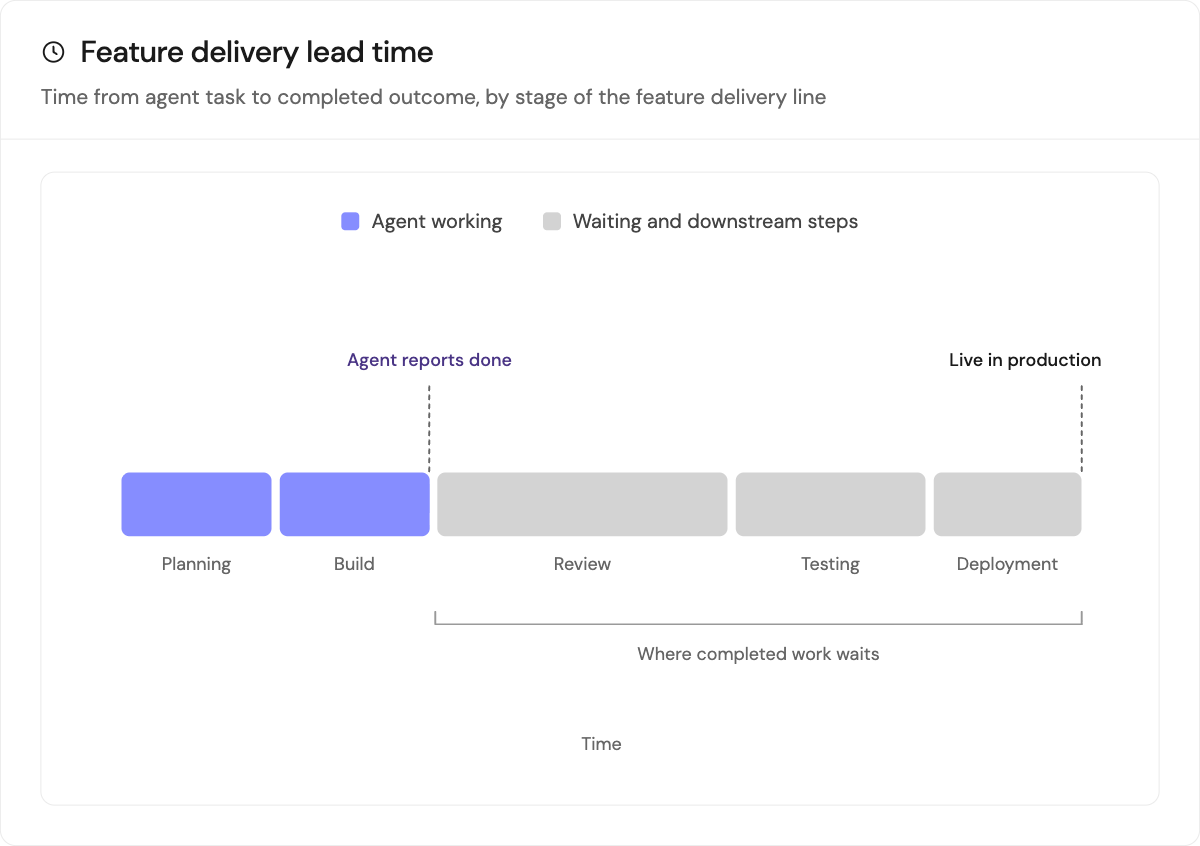
The distinction matters. Counting agent tasks as completed outcomes can make the factory appear productive while work accumulates further down the line.
Agree on what a completed outcome means with the teams operating each line and the people who depend on its result. The outcome should reflect what the line is intended to achieve. Examples might include:
Keep that understanding consistent across teams doing comparable work. Their agents, tools, and workflows may differ, but leaders need to know that completion means the same thing across them.
Keep the quality of those outcomes visible too. A feature can reach production and introduce a defect; a service can be restored and fail again. Those consequences help explain whether higher completion volume is creating more rework elsewhere in the organization.
Connect agent activity to completed outcomes
Connect agent runs to the factory line, workflow stage, intended outcome, responsible team, and affected services. Keep model and tool usage visible alongside human correction and unsuccessful attempts.
More runs, tokens, or PRs could indicate more completed outcomes, greater effort, or repeated corrections. Look at delivery time, quality, and human effort to understand what that activity achieves.
For example, higher spend in vulnerability patching might accompany faster remediation or repeated failures on one service. A workflow delivering better results at an acceptable cost may be worth testing with other teams.
Identify shared bottlenecks across factory lines
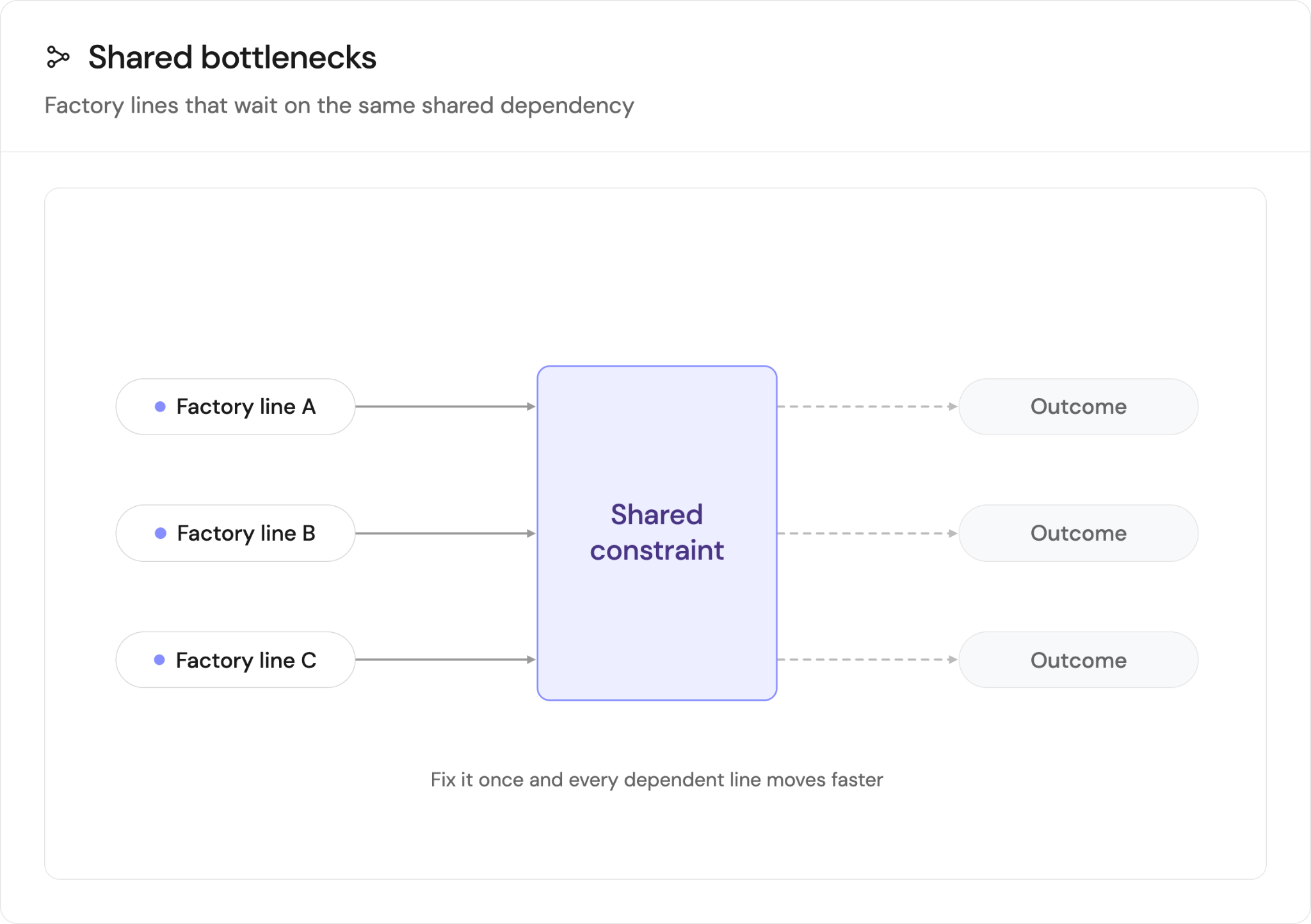
A security patch may wait for a product team's review. Several factory lines may depend on the same test environment or platform team.
Keep these dependencies visible so leaders can distinguish a problem within a single workflow from a constraint affecting several lines. Teams can then see which improvements they own and where they need support from others.
Measure software factory across five dimensions
Engineering metrics should help leaders see which factory lines are improving, where work gets stuck, and what teams should change. A shorter delivery time alone leaves questions about quality, human correction, cost, and compliance unanswered.
Assess performance across five dimensions: speed, quality, autonomy, efficiency, and governance. Choose measures within each dimension that reflect the factory line’s purpose and operating context. Read the results together to understand whether a change improves delivery overall or shifts effort and problems elsewhere.
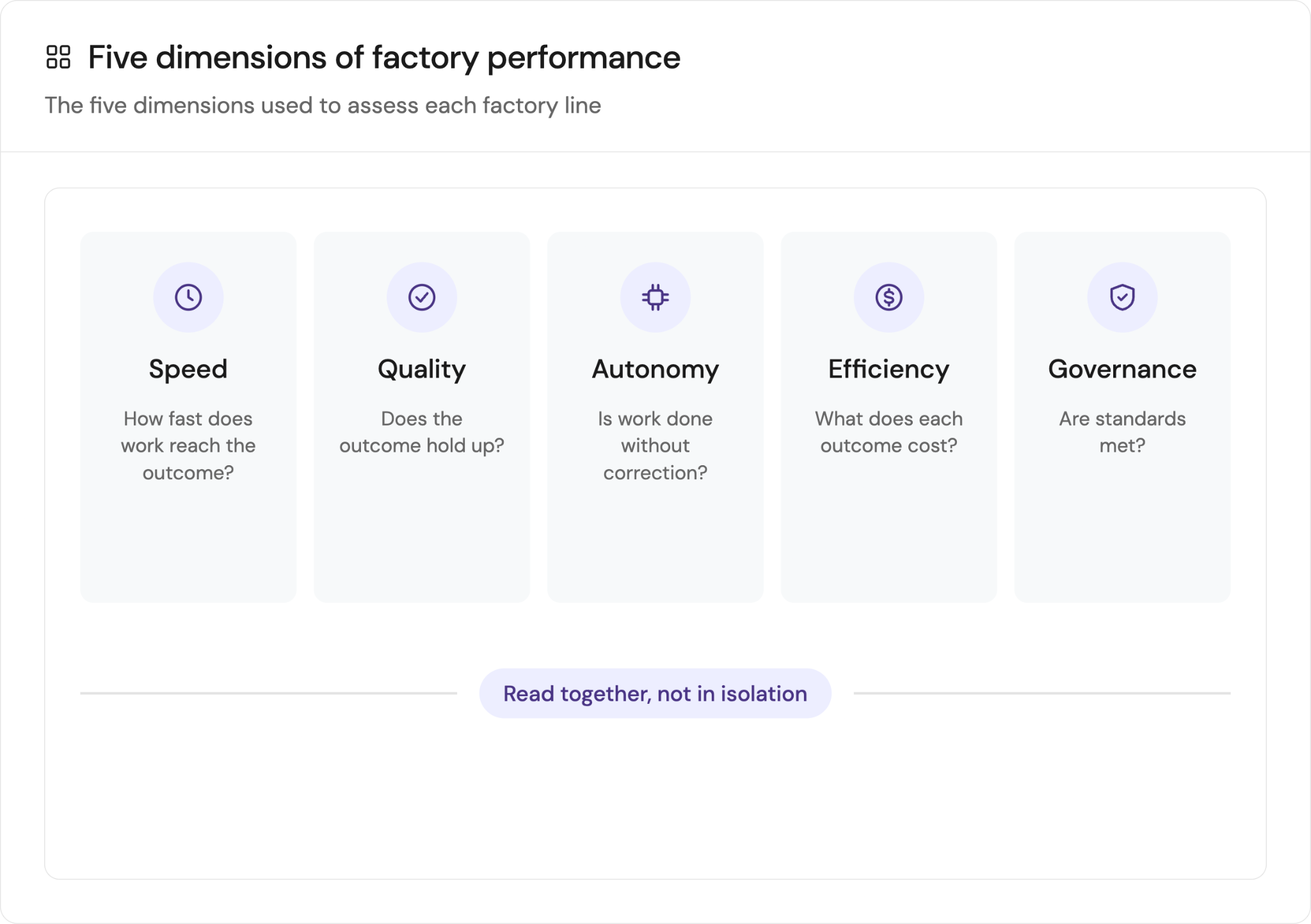
An agent may write code faster, while engineers spend more time reviewing and correcting it. Assess the effect on time to production, quality, human effort, and cost to understand whether the workflow has improved overall.
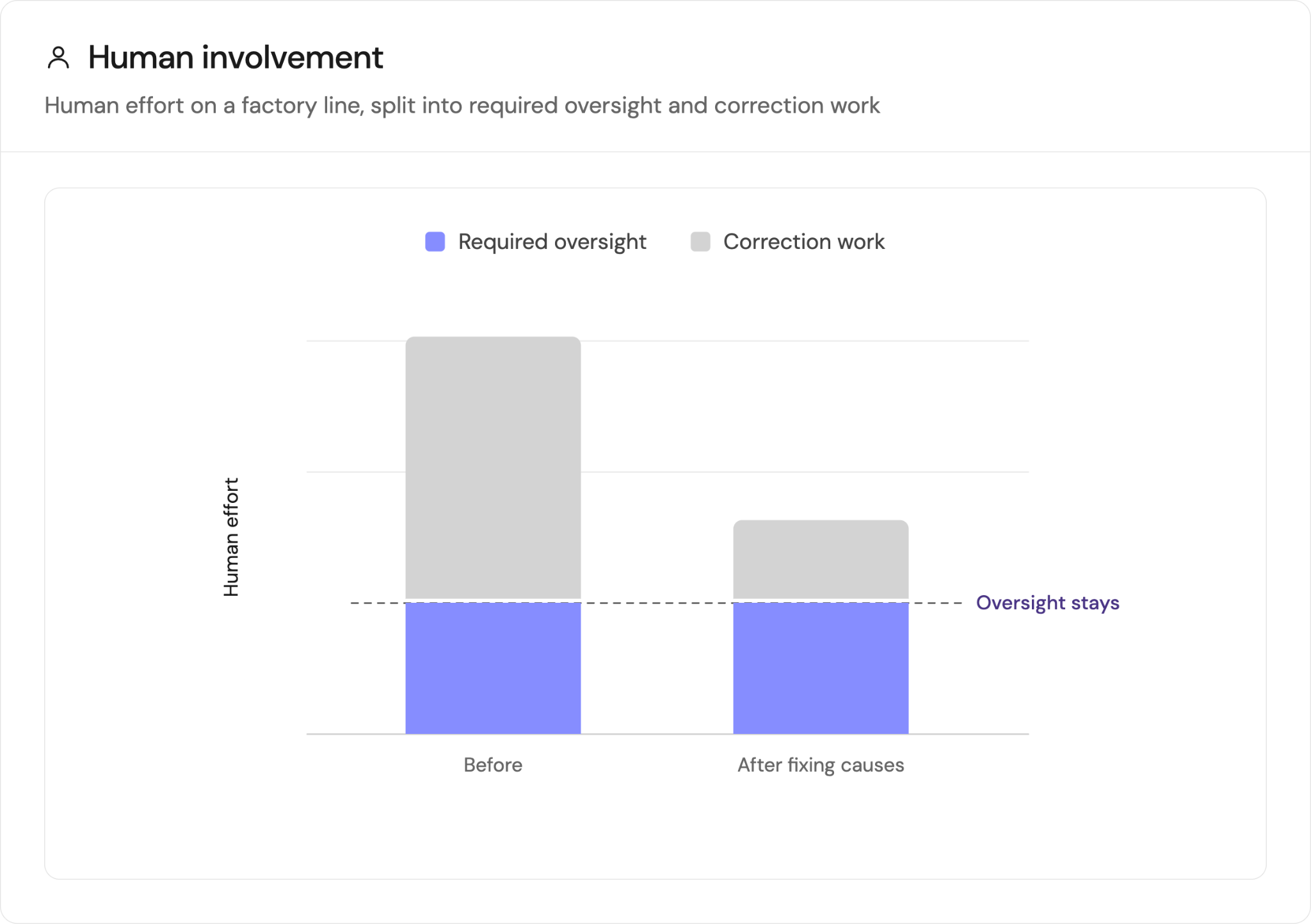
Gartner’s October 2026 research summary recommends measuring human and agent contributions separately across the SDLC to identify constraints. When interpreting those measures, distinguish required oversight from correction: approving a sensitive production change and repeatedly rewriting an agent’s output represent different kinds of human effort.
A workflow may also finish quickly and cheaply while missing required checks or relying on repeated policy exceptions. Keep those gaps visible alongside delivery results so that speed and cost do not hide weaknesses in governance.
Example of a factory line
Consider a feature-delivery line where agents implement changes and open pull requests, while engineers review them before testing and deployment. Work is complete when the feature is available to its intended users in production.
PRs are opened quickly, but changes spend days in review. Looking at speed across the stages locates the delay, while quality signals help explain it: review comments, test failures, and defects found after release. If the same mistakes keep recurring, investigate what causes them before assuming that more reviewers will solve the problem.
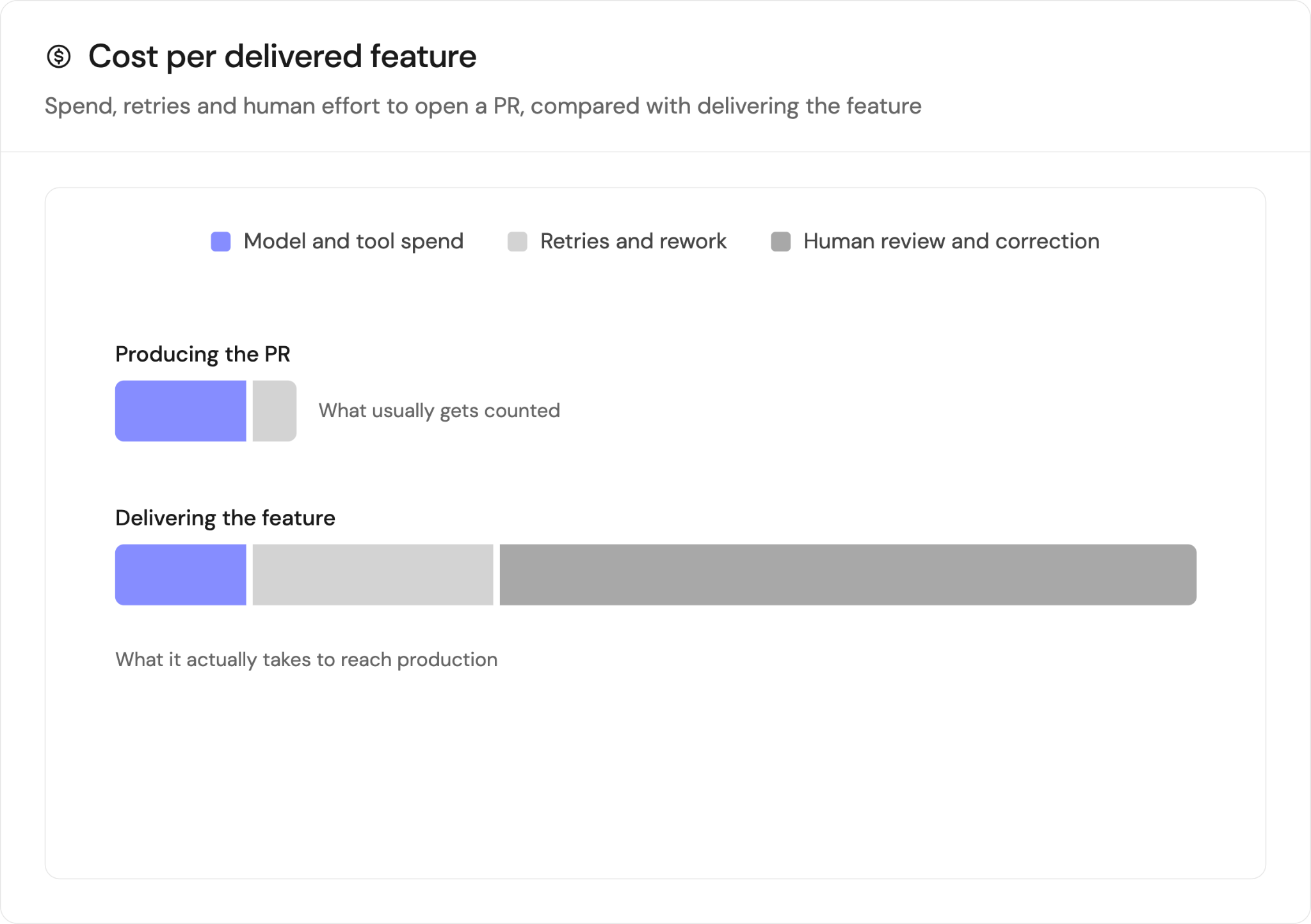
The corrections also affect autonomy. A change that merges after an engineer rewrites the code was completed with human help. Looking across all resolved agent assignments, including failures and abandoned work, shows how often agents finish without correction. For efficiency, connect those outcomes to model and tool spend, retries, and human effort. The cost of producing a PR may be a small part of what it takes to deliver the feature.
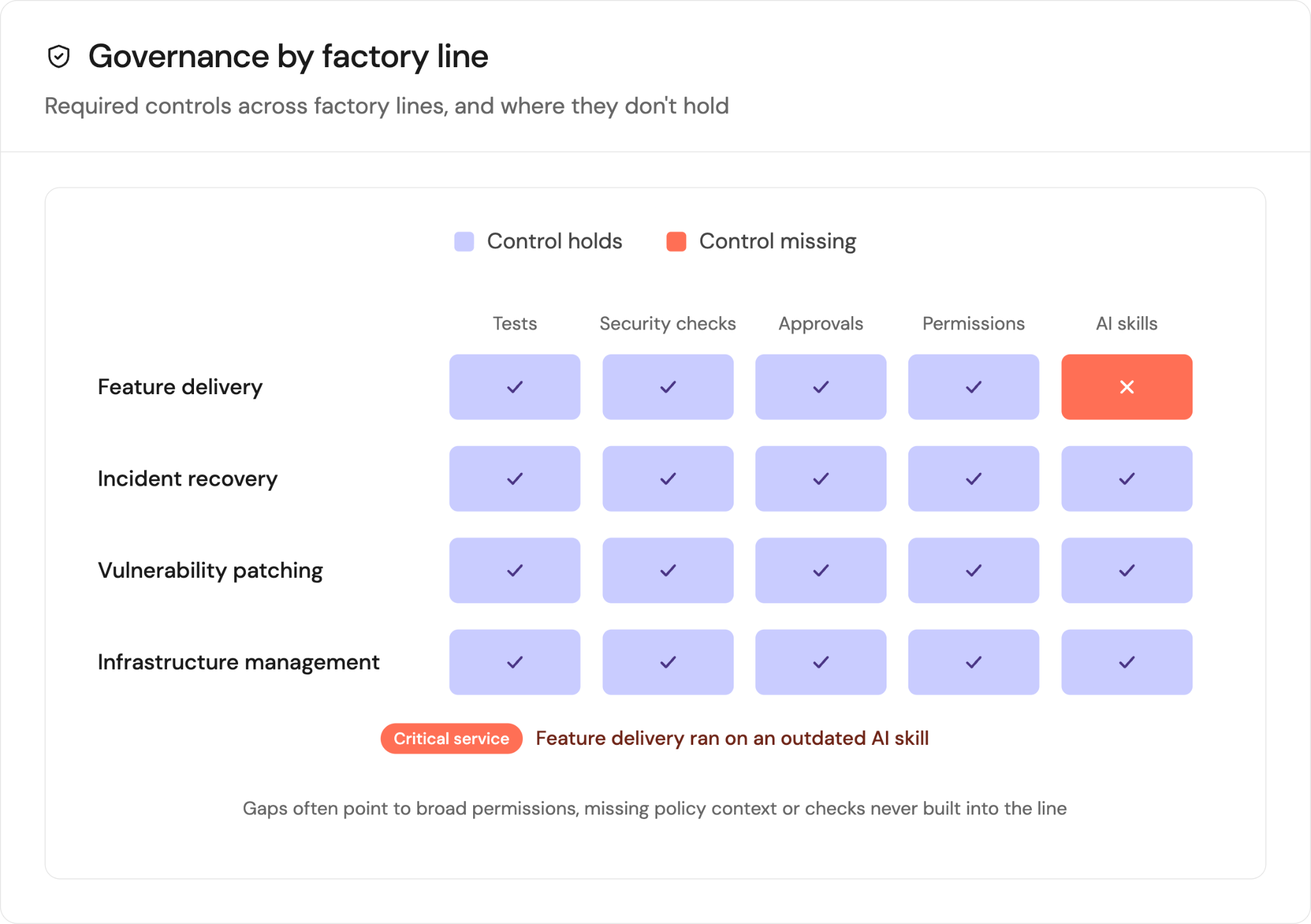
For this feature-delivery line, verify that required tests, security checks, and approvals were completed, and flag missing evidence for investigation. Record approval separately from correction: an engineer signing off a sensitive change is providing oversight, while rewriting the agent’s code is correction work.
Why governance matters
These controls need to hold as more teams build workflows with different agents and tools. A provisioned resource may still have excessive permissions, or a feature may reach production without a required expert review. Leaders need to understand which standards apply, what agents can access and change, and where the workflow enforces the required checks.
An overall compliance rate can hide a serious violation on a critical service, so examine severity, affected services, and how long issues remain unresolved. Repeated exceptions may indicate permissions that are too broad, a missing policy context, or checks that were never built into the workflow.
Use these findings to improve how the line operates: build validation into the workflow, provide the policy context agents need, scope permissions appropriately, and route approvals to the right people. Governance measurement should help teams identify and address recurring gaps as the factory scales.
Establish a baseline and compare similar work
Before changing a model, adding an agent, or redesigning a workflow, establish how the factory line performs across the five dimensions. Use a period that reflects its normal workload, including waiting, failed attempts, and human correction, and keep outcome definitions and measurement rules consistent after the change.
Compare work of similar type, complexity, and risk. A month of routine fixes may show faster delivery than a month of complex features without any improvement in the workflow. Comparisons between teams also need to account for service dependencies, test quality, and the context and support available to agents.
Record other changes that could explain the results. If a team adopts a new model while improving tests and deployment, the comparison shows how the new setup performs; it cannot isolate the model’s contribution.
For model comparisons, consider the cost and human effort required to complete similar assignments, including retries and corrections. A higher-priced model may need fewer attempts, while a cheaper model may be sufficient for routine work. Confirm that the gains persist and that quality and required standards are maintained before expanding the change.
Understand what is working and what needs attention
Review performance by factory line, team, and service to see where the factory delivers good results and where work repeatedly falls short.
Gartner’s September 2026 research summary on AI software factories highlights how slow coordination across the SDLC can constrain what agents deliver. This supports examining the workflow around the agent, including handoffs, dependencies, validation, and human involvement, to understand differences in factory line performance.
Look for improvements in completed outcomes. A feature-delivery line may reach production faster without increasing defects or review effort. An incident-recovery line may restore services sooner with fewer repeated interventions. These patterns help identify workflows and practices worth investigating for broader use.
Also examine where increased activity fails to improve outcomes. More agent runs may produce little additional delivery. Higher spending may accompany repeated attempts on the same service. Faster implementation may leave more work waiting for review.
Use the surrounding context to explain those results. Examine the agents, models, tools, service information, validation, and human support involved. A workflow that succeeds in one team may depend on conditions another team does not yet have.
Bring these findings together across the organization. Identify which practices other teams could reuse, which workflows need investigation, and which shared dependencies affect several factory lines. This helps leaders direct investment towards demonstrated strengths and recurring problems.
Act on findings
Connect each finding to the affected factory line, services, responsible team, and supporting evidence. Use that context to decide what should change and which human or agent workflow should carry out the work.
For example, measurement may reveal that resource provisioning repeatedly waits for manual validation. The platform team could introduce a workflow that gathers the required context, runs validation, and provisions the resource, with approval where required.
Keep the finding, decision, and workflow execution connected. Teams can then see which actions address an identified problem and whether those actions have been completed.
Connect actions to measurable impact
After the change, use the same measures and engineering context to assess its effect. In the provisioning example, check whether the time to provision and hands-on effort decrease, while resource quality and required standards hold.
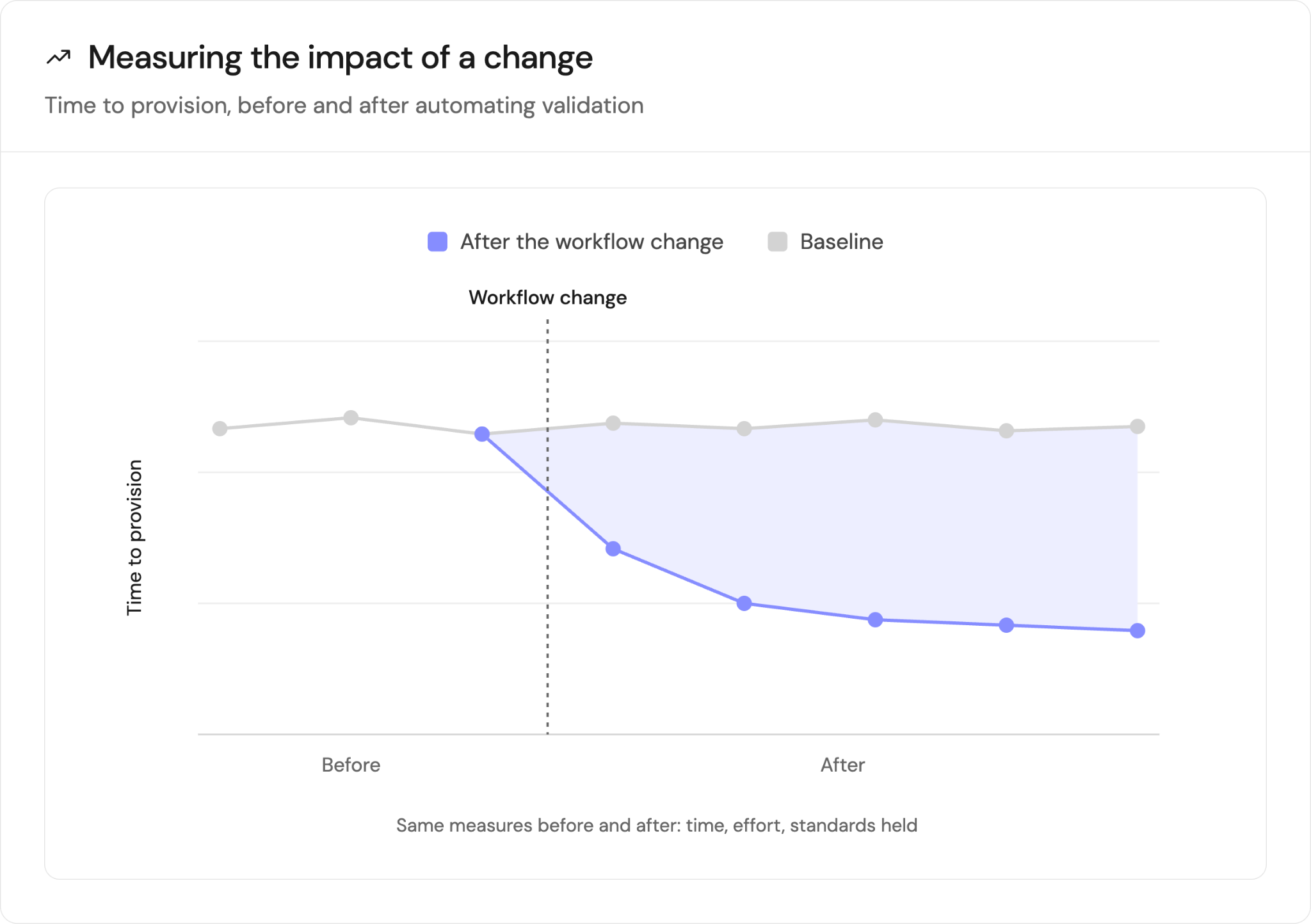
Evaluate ROI using the evidenced benefits and the cost of implementing and operating the improvement.
Keeping engineering insights, agentic actions, and measured outcomes connected in one platform helps teams trace an improvement from the original finding through execution to the result. Leaders can see which investments delivered value, which need adjustment, and which could benefit other teams and factory lines.
Build and measure your AI software factory in Port
Build your factory lines and measure their performance on the same platform. Port connects agents and governed workflows with engineering data and service ownership, so teams can understand what needs attention, act on the findings, and measure the result.
Try Port for free and start with one factory line.
FAQ
How do you compare factory lines that produce different outcomes?
Use the same questions about speed, quality, autonomy, efficiency, and governance, while keeping each line's outcomes and operating context visible. Feature delivery and incident recovery serve different purposes, so their raw completion times should not determine a ranking. Look at improvement within each line, the resources it needs, and its contribution to organizational priorities. Make direct comparisons between teams or workflows handling work of similar type, complexity, and risk.
How do you know whether a bottleneck comes from an agent or the wider workflow?
Follow where work waits and where people correct it. Repeated technical mistakes may point to an agent, model, context, or validation problem. Long waits after acceptable work is produced may involve review capacity, approvals, or another team's dependency. Investigate examples with the people operating the line, then change the suspected cause and observe whether the completed outcome improves.
Does human involvement mean a factory line is underperforming?
Human involvement can provide judgment, required approval, or expertise appropriate to the work's risk. The useful distinction is between that contribution and repeated correction that the workflow could avoid. Examine why people intervene, how much effort it requires, and whether the same problems recur. A line with deliberate oversight can perform well while still offering clear opportunities for greater autonomy.
What is the difference between measuring AI adoption and measuring an AI software factory?
Adoption shows where AI is being used, by whom, and how consistently. Factory measurement connects that activity to completed outcomes across teams and workflows. It examines delivery speed, quality, human involvement, cost, and standards, including what happens between agent tasks. Adoption provides useful context, but more usage alone cannot tell you whether the organization is delivering better results.
Download the RFP guide


Get your survey template today


Download your survey template today


Free Roadmap planner for Platform Engineering teams
Set Clear Goals for Your Portal
Define Features and Milestones
Stay Aligned and Keep Moving Forward
Create your Roadmap


Free RFP template for Internal Developer Portal
Creating an RFP for an internal developer portal doesn’t have to be complex. Our template gives you a streamlined path to start strong and ensure you’re covering all the key details.
Get the RFP template


Leverage AI to generate optimized JQ commands
test them in real-time, and refine your approach instantly. This powerful tool lets you experiment, troubleshoot, and fine-tune your queries—taking your development workflow to the next level.
Explore now
Check out Port's pre-populated demo and see what it's all about.
No email required
LIVE WEBINAR, Aug 18, 2026:
Context-aware Vibe Coding for Platform Engineering
Thursday, October 22 12:00pm EDT⋅6:00pm CET
To learn more about the new capability and to see a live demo, join our upcoming community session with GitHub
Move fast while staying in control
Build governed agentic workflows on one central platform.
See it in action:
Watch this video on generating Terraform with Port, or explore our public demo.

Check out the 2025 State of Internal Developer Portals report
No email required
Minimize engineering chaos. Port serves as one central platform for all your needs.
Act on every part of your SDLC in Port.
Your team needs the right info at the right time. With Port's software catalog, they'll have it.
Learn more about Port's agentic engineering platform
Read the launch blog
Contact sales for a technical walkthrough of Port
Every team is different. Port lets you design a developer experience that truly fits your org.
As your org grows, so does complexity. Port scales your catalog, orchestration, and workflows seamlessly.
Port × n8n Boost AI Workflows with Context, Guardrails, and Control
Port Builders Session: A Single, Governed Interface for All MCP Servers
Book a demo right now to check out Port's developer portal yourself
Apply to join the Beta for Port's new Backstage plugin


n8n + Port templates you can use today
walkthrough of ready-to-use workflows you can clone
From manual to autonomous engineering
One platform to build, govern, and operate the Agentic SDLC.
Port is open for you to try it
build your first agentic workflow today