AI Skills are easy to create. Understanding their value is harder.
AI Skills adoption is only the starting point. See how consistency, reuse, and engineering context reveal which Skills matter.



AI Skills are becoming a practical way to package instructions, workflows, and domain knowledge for AI. An engineer might create one to review a certain type of change, investigate an incident, work with an internal service, or automate a repetitive task.
That can be valuable even if the Skill is only used by one person.
The harder problem starts as Skills spread across an organization. Which ones do people keep coming back to? Which solve repeatable problems? Where is useful knowledge becoming reusable? And does engineering work look different where those Skills are being used?
A list of available Skills cannot answer those questions. You need visibility into what happens after a Skill is created.
Value can start with one person
Many useful Skills begin with someone solving their own problem.
An engineer creates a better way to review a pull request. Someone captures a repeatable incident investigation process. Another person packages the right instructions for working with an internal platform.
If the Skill makes that person more effective, there is already value.
The broader opportunity appears when that knowledge becomes useful beyond its original creator. A personal Skill may become useful to a project, a team, or eventually a much larger part of the organization.
That makes the important questions less about how many Skills exist and more about what happens after they are created. Do people return to them? Do they support repeatable work? Could the same knowledge help others?
Start with adoption, then look at consistency and reuse
Adoption is the starting point, but it should not be the end goal.
First, establish whether Skills are actually being used. Then look at consistency. Are people returning to the same Skills over time, or is usage mostly experimentation?
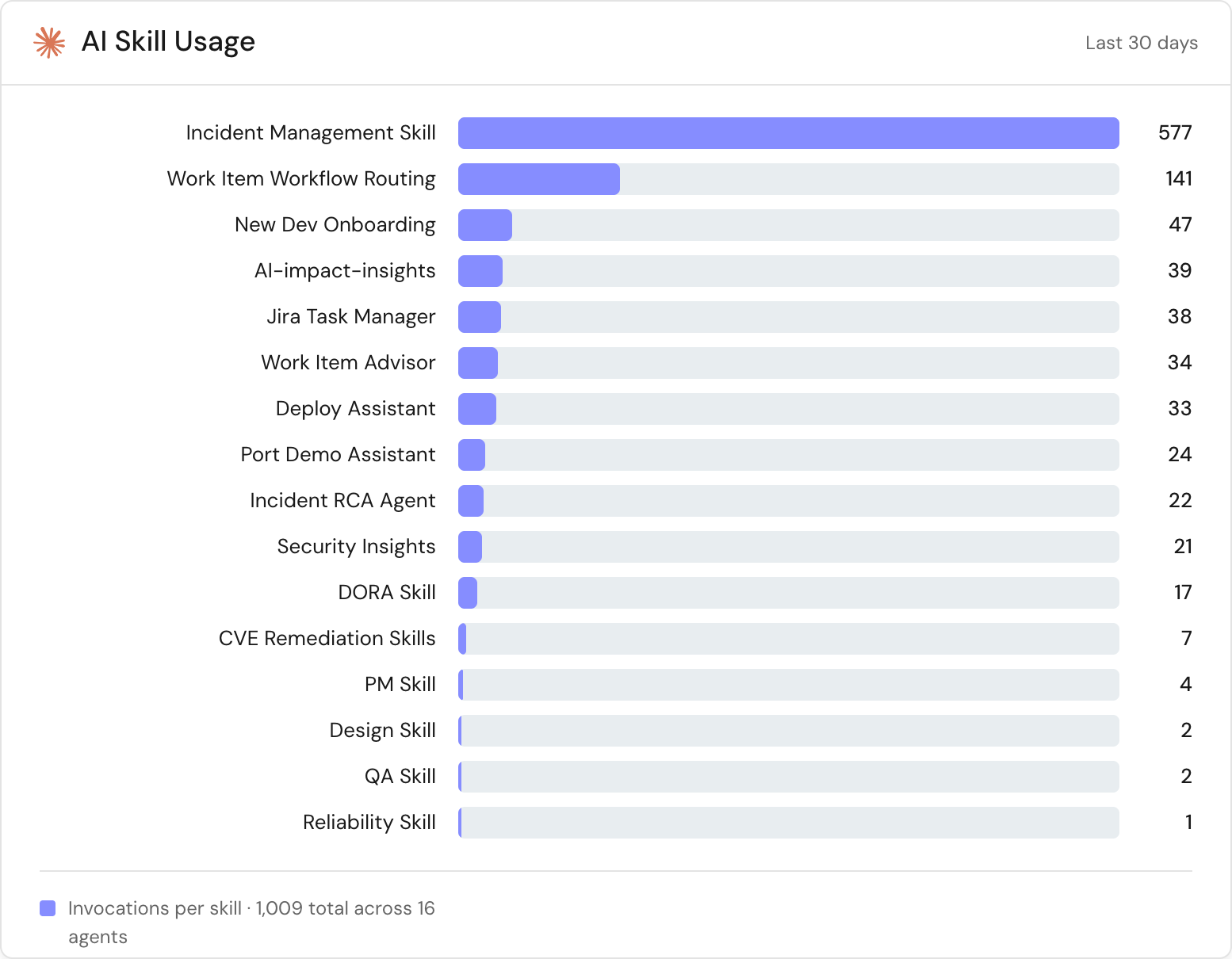
That distinction matters. A Skill might be invoked hundreds of times during a one-off migration and then disappear. Another might be used only a few times each week, but consistently for months because it supports an ongoing workflow.
Total usage can make those patterns look similar. They are not.
Then look at reuse. Is useful knowledge staying with individuals, or is it being applied across projects and teams?
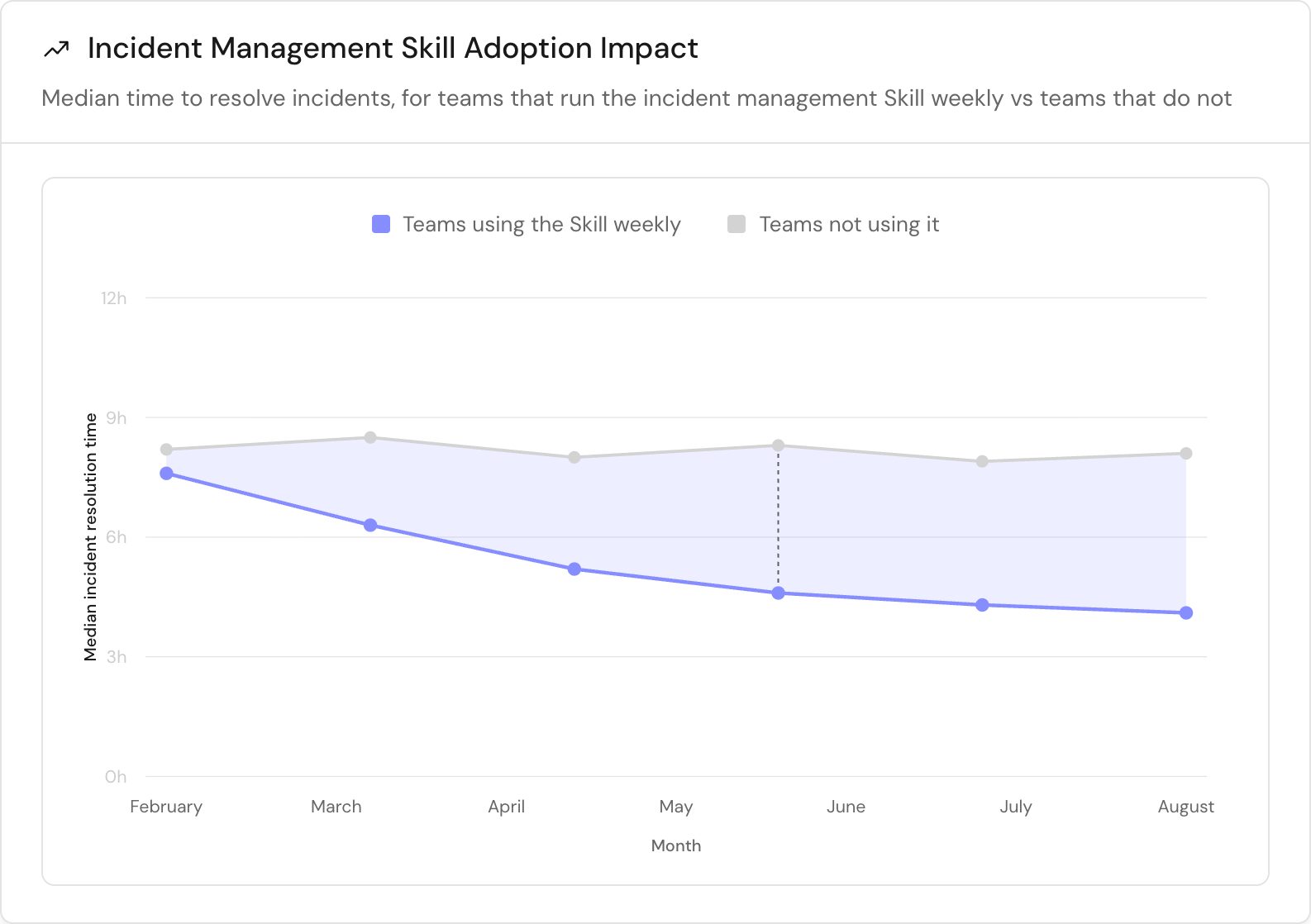
Together, adoption, consistency, and reuse help show which Skills are becoming part of how engineering work gets done.
But they still do not tell you whether the work itself is improving.
Measure Skills in the context of the work they are meant to improve
Skill usage data can tell you what people are doing with Skills. On its own, it cannot tell you whether those Skills are improving engineering workflows.
That requires a broader engineering context.
Once Skill data sits alongside information about teams, repositories, services, pull requests, deployments, incidents, and engineering metrics like lead time, deployment frequency, and change failure rate, you can start asking more meaningful questions.
Take an incident investigation Skill. If the teams that run it every week resolve incidents faster than the teams that don’t, and the gap holds for months, the Skill is doing real work. If resolution times look the same either way, it’s a habit, not a lever.
It moves the conversation beyond:
This Skill was invoked 500 times.
to a much more useful question:
Does engineering work actually look different where people use it?
That is the shift from measuring AI activity to understanding how Skill usage relates to engineering work.
When everyone can create Skills, visibility matters more
As Skills become easier to create, the challenge shifts from creation to visibility.
You need to know which Skills engineers rely on, what useful knowledge already exists, and where teams may be solving the same problems independently.
Without that visibility, useful Skills can stay buried, similar workflows can evolve in parallel, and valuable domain knowledge can remain tied to the people who first captured it.
You’re not trying to standardize everything. You want to see what’s proving useful first, then decide what deserves broader reuse, investment, or standardization.
Understand how Claude Skills are being used
Port brings usage data for Skills used in Claude into the same engineering context as teams, repositories, services, pull requests, incidents, and engineering metrics.
With that context, you can tell which Skills are worth reusing across teams, which are worth investing in, and which were experiments that never went anywhere.
See how to visualize Claude Skills adoption in Port. Try Port for free and see which Claude Skills are changing how your teams work.
{{from_manual_to_autonomous_engineering}}


Get your survey template today
%201.svg)


Download your survey template today


Free Roadmap planner for Platform Engineering teams
Set Clear Goals for Your Portal
Define Features and Milestones
Stay Aligned and Keep Moving Forward
Create your Roadmap


Free RFP template for Internal Developer Portal
Creating an RFP for an internal developer portal doesn’t have to be complex. Our template gives you a streamlined path to start strong and ensure you’re covering all the key details.
Get the RFP template


Leverage AI to generate optimized JQ commands
test them in real-time, and refine your approach instantly. This powerful tool lets you experiment, troubleshoot, and fine-tune your queries—taking your development workflow to the next level.
Explore now
Check out Port's pre-populated demo and see what it's all about.
No email required
LIVE WEBINAR, Aug 18, 2026:
Context-aware Vibe Coding for Platform Engineering
Thursday, October 22 12:00pm EDT⋅6:00pm CET
To learn more about the new capability and to see a live demo, join our upcoming community session with GitHub
Move fast while staying in control
Build governed agentic workflows on one central platform.
See it in action:
Watch this video on generating Terraform with Port, or explore our public demo.
.png)
Check out the 2025 State of Internal Developer Portals report
No email required
Minimize engineering chaos. Port serves as one central platform for all your needs.
Act on every part of your SDLC in Port.
Your team needs the right info at the right time. With Port's software catalog, they'll have it.
Learn more about Port's agentic engineering platform
Read the launch blog
Contact sales for a technical walkthrough of Port
Every team is different. Port lets you design a developer experience that truly fits your org.
As your org grows, so does complexity. Port scales your catalog, orchestration, and workflows seamlessly.
Port × n8n Boost AI Workflows with Context, Guardrails, and Control
Port Builders Session: A Single, Governed Interface for All MCP Servers
Book a demo right now to check out Port's developer portal yourself
Apply to join the Beta for Port's new Backstage plugin


n8n + Port templates you can use today
walkthrough of ready-to-use workflows you can clone
From manual to autonomous engineering
One platform to build, govern, and operate the Agentic SDLC.
Port is open for you to try it
build your first agentic workflow today