Implementing the Anthropic AI-Native SDLC Playbook: What do you need to get there?
Implement Anthropic's AI-native SDLC playbook. Learn the key requirements and foundation needed to run agentic SDLC at scale.



Anthropic just published an excellent Agentic SDLC playbook for the AI-native SDLC, guiding the community on the pattern to build agents for different SDLC stages, and the evolution of delivery processes to support agents as the main contributors.
The AI SDLC playbook is specific about the agent’s job: the artifacts produced at each stage (intent.md → spec.md → plan.md → PR → production), governance built in as code (hooks, skills, evals), with HITL for judgment, while agents do the rest.
To put the Anthropic playbook to work at scale, agents would need to operate reliably at scale - as engineering organizations look to scale across many agents and supported use cases. This article discusses the Agentic SDLC platform foundation and critical capabilities required to operationalize AI-Native SDLC playbook by Anthropic.
Scaling the AI Native SDLC
The Anthropic playbook is more validation that AI has forever changed the way we build and ship software, and that the role of developers is changing from coding to intent and governing. With code generation no longer a bottleneck, bottlenecks moved to other stages of the SDLC still running at human speed. For organizations to accelerate the full lifecycle and maximize AI ROI, agents must be rolled out across every stage of the SDLC.
When you need to scale agents across all teams and use cases, orchestrate, govern and monitor them – you've hit the limits of process. You need a platform.
How do you build consistently, orchestrate, govern, and operate an AI-native SDLC at scale?
Key requirements for implementing AI-native SDLC playbook at scale
Anthropic calls out that platform engineering owns this transformation. This isn’t a tooling rollout or a process every team figures out alone. Alongside building agents you also need to operate them at scale - which requires a platform.
Let’s consider what Platform Engineers will need to succeed with AI-SDLC across the org.
The Platform Harness
Anthropic provides the agent harness- used for building the agent. This harness includes the LLMK selection, framework (LangGraph, etc.), model fine-tuning and training, and core agent logic and capabilities - like the ability to iterate on feedback, reason about risk, and so on. That’s half the problem.
The platform harness defines the layer around the model that specializes agent behavior for domain-specific work in your specific organization. It controls what the agent sees, what it can do, when it can act, how outputs are interpreted, how errors are handled, and how humans supervise. The same Claude agent produces different behavior across organizations because each platform harness has its own context layer (engineering & SDLC knowledge), governance & policies (credentials and permissions, standards, spend limits, approvals, policies and audit), configurations, and orchestration.
An Agentic SDLC Platform is the platform harness for the software engineering domain - the context, governance, and orchestration layer that works with any agent. This harness, not the agent, is how you realize the full potential of AI across engineering.. It makes your organizational standards, patterns, and domain context into operational constraints that ensures agents do good work.
The Anthropic playbook gives you the process for AI-SDLC. The Agentic SDLC Platform scales it.
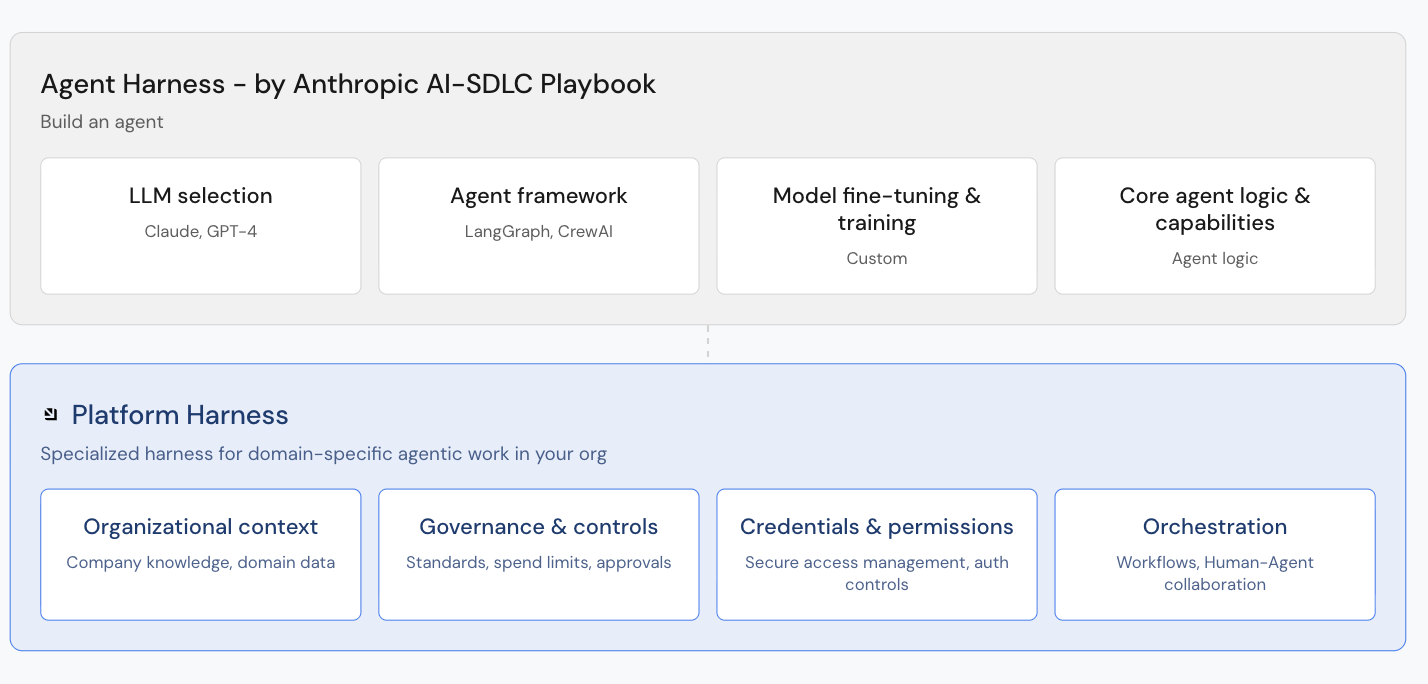
How the platform harness scales Anthropic’s AI-Native SDLC pattern:
Let's walk through each stage of the Anthropic SDLC playbook and show how the platform harness comes in.
Stage 1: Plan
Anthropic AI-Native SDLC Playbook: Before code, someone writes down what the work is and why in a file called intent.md. It can start from an idea, a support ticket, or an alert.
What to consider to scale this step? How that file actually gets created from any of those signals. The AI Native playbook by Anthropic playbook assumes intent exists. It doesn't describe the mechanism.
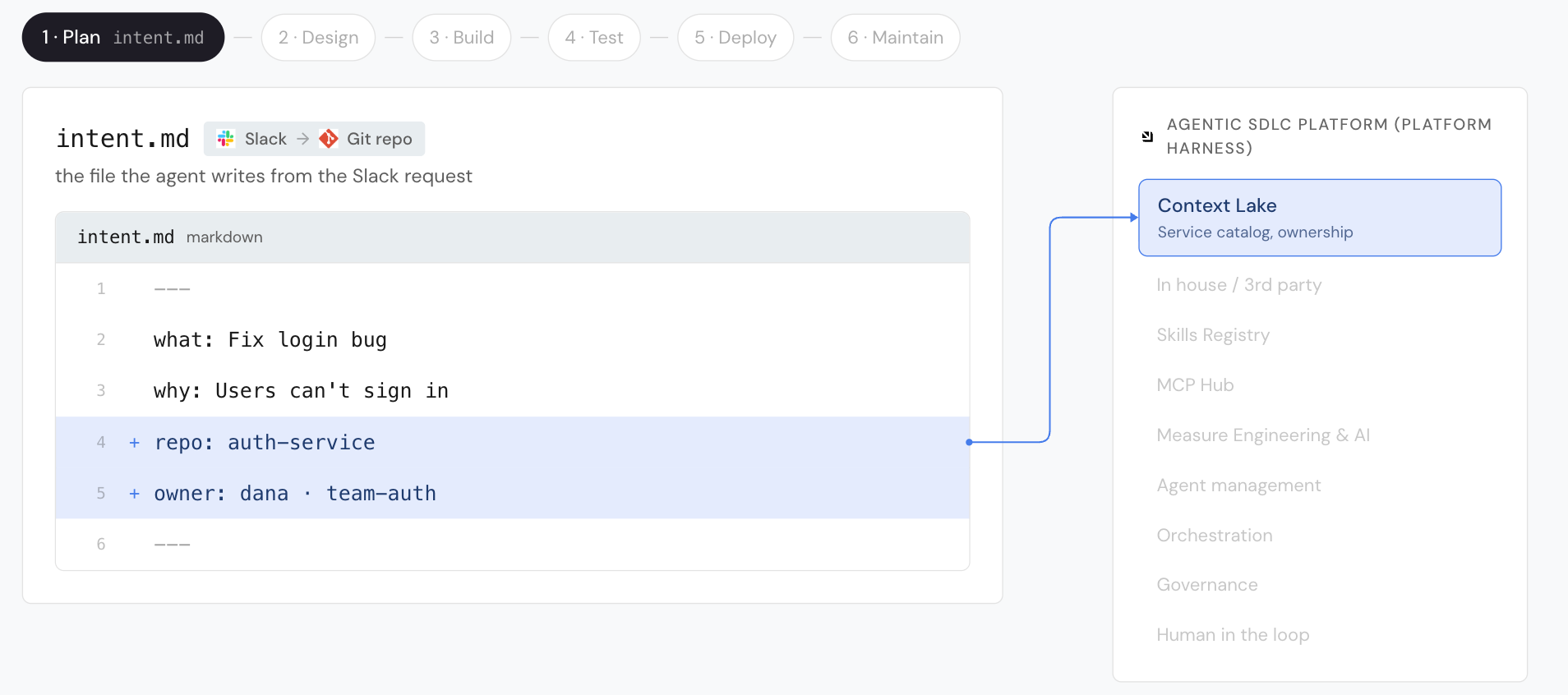
How the platform harness comes in: Turns any signal into an intent.md in the right repo. A Slack request, a Zendesk ticket, a Sentry error, a PagerDuty incident—one mechanism for all of them. But a signal like "Fix login bug" doesn't say which service it affects, so nothing can pick the repo. The platform resolves the affected service and its owner on the way in, enriching the signal so the agent starts with context, not a guess.
Stage 2: Design
Anthropic AI-Native SDLC Playbook: The intent becomes a spec, shaped by company policies for security, compliance, brand, and UX. If something looks risky, the product owner sends it to "the named policy owner."
What to consider to scale this step? Who that owner is, how they find out about the change, and how anyone decided the change was risky in the first place.
How the platform harness comes in: Three critical things.
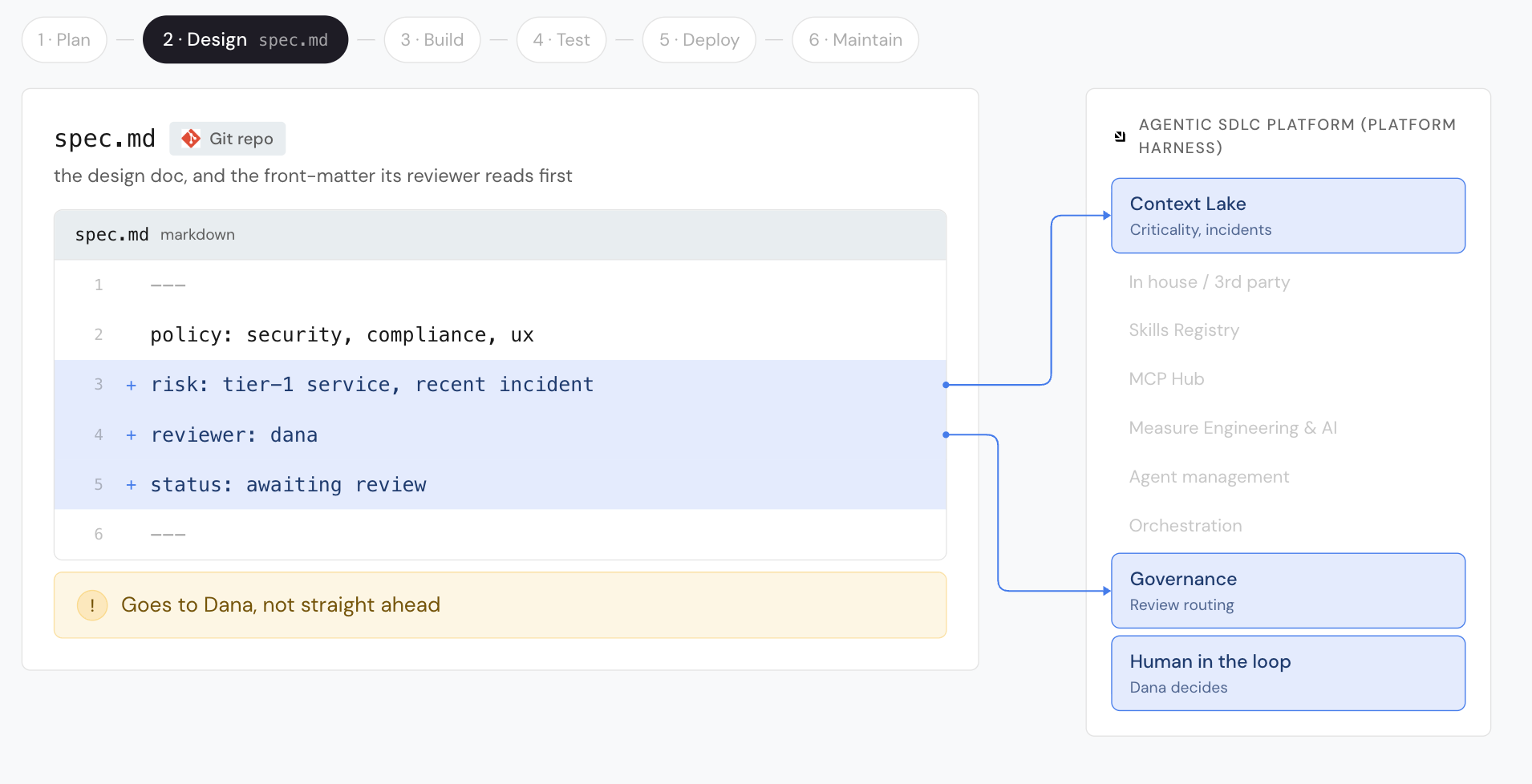
First, it gives the spec real context. Without a platform, whoever writes the spec starts from "fix login bug" and has to work out who owns the service, what depends on it, and what broke there recently. The platform already holds all of that—service ownership, dependencies, incident history.
Second, it decides whether it's safe to hand off using rules the platform team writes down, not the model's judgment that day. For example: not a top-tier service, blast radius is calculated and not high, no open incidents, priority not critical. All must pass. One failure escalates to a human. The AI explains the decision in plain language, but the rules make it.
Third, it works out the right reviewer from ownership data instead of someone's memory, and gives them a real approval step where they already work—with buttons to approve, send back, or take it themselves. Their answer is written back to the record.
Stage 3: Build
Anthropic AI-Native SDLC Playbook: The engineer approves a plan before code gets written. Skills guide the agent while it works. Hooks block what must never happen. Risky changes go to a tech lead.
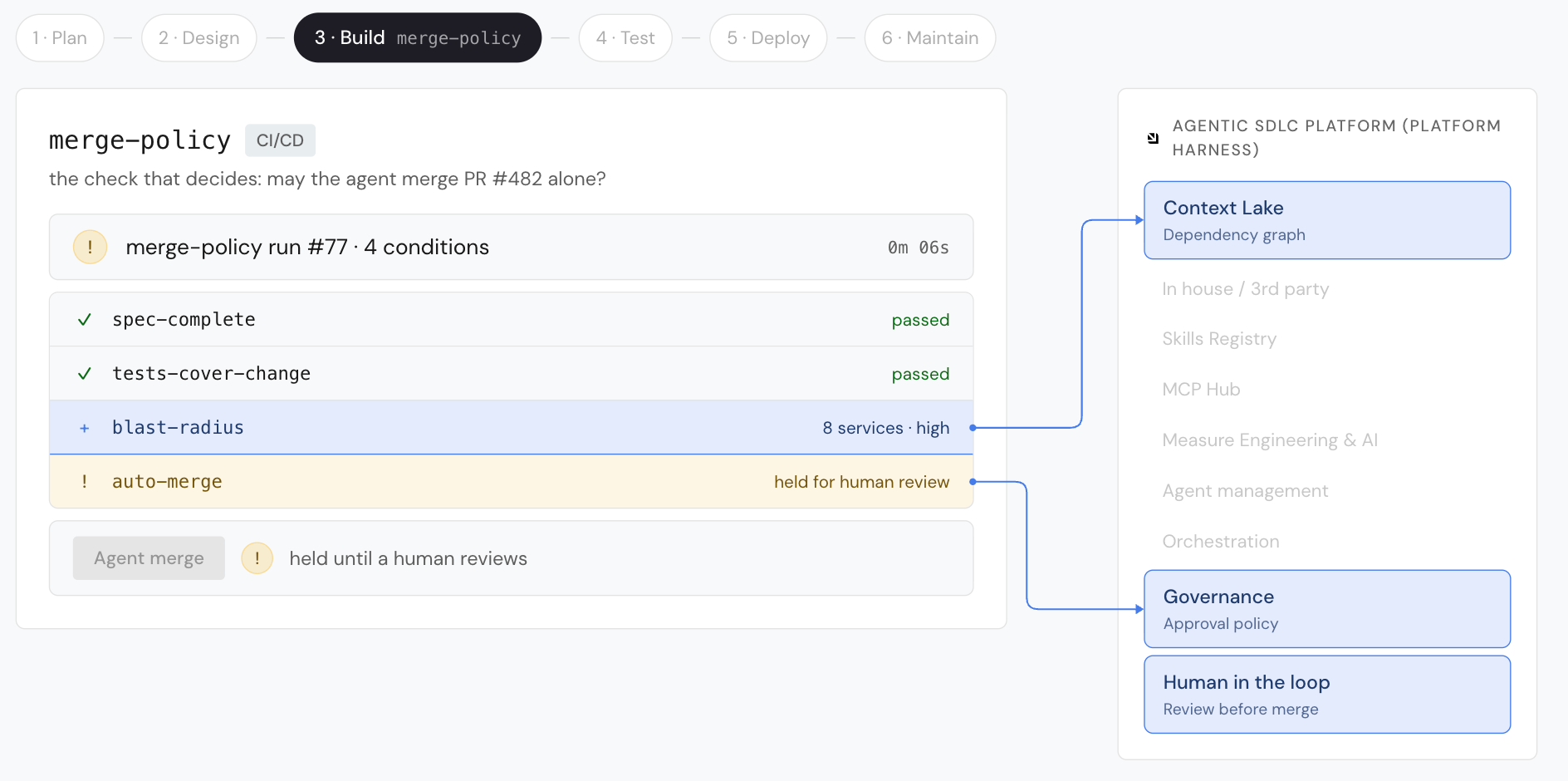
What to consider to scale this step? How you calculate blast radius. The article says a change is safe to run with less supervision when the spec is tight, tests cover the code, and the blast radius is small. The first two you can check inside the repo. Blast radius you cannot—not without knowing the infrastructure.
How the platform harness comes in: Calculates the real blast radius from service dependencies: which services are affected, who owns them, and a risk score. That's the missing third condition, and it's the same score the handoff decision uses.
It also governs the agent layer with a registry of approved skills and approved MCP servers instead of people installing whatever they want. And when a policy changes, the platform routes it to the right owner for approval. If an engineer edits the skill holding the security policy, it goes to the CISO and holds the new version until they approve. The files stay in git. Who can use what, and holding a change until the right person signs off, happens in the platform, not in git.
Stage 4: Test
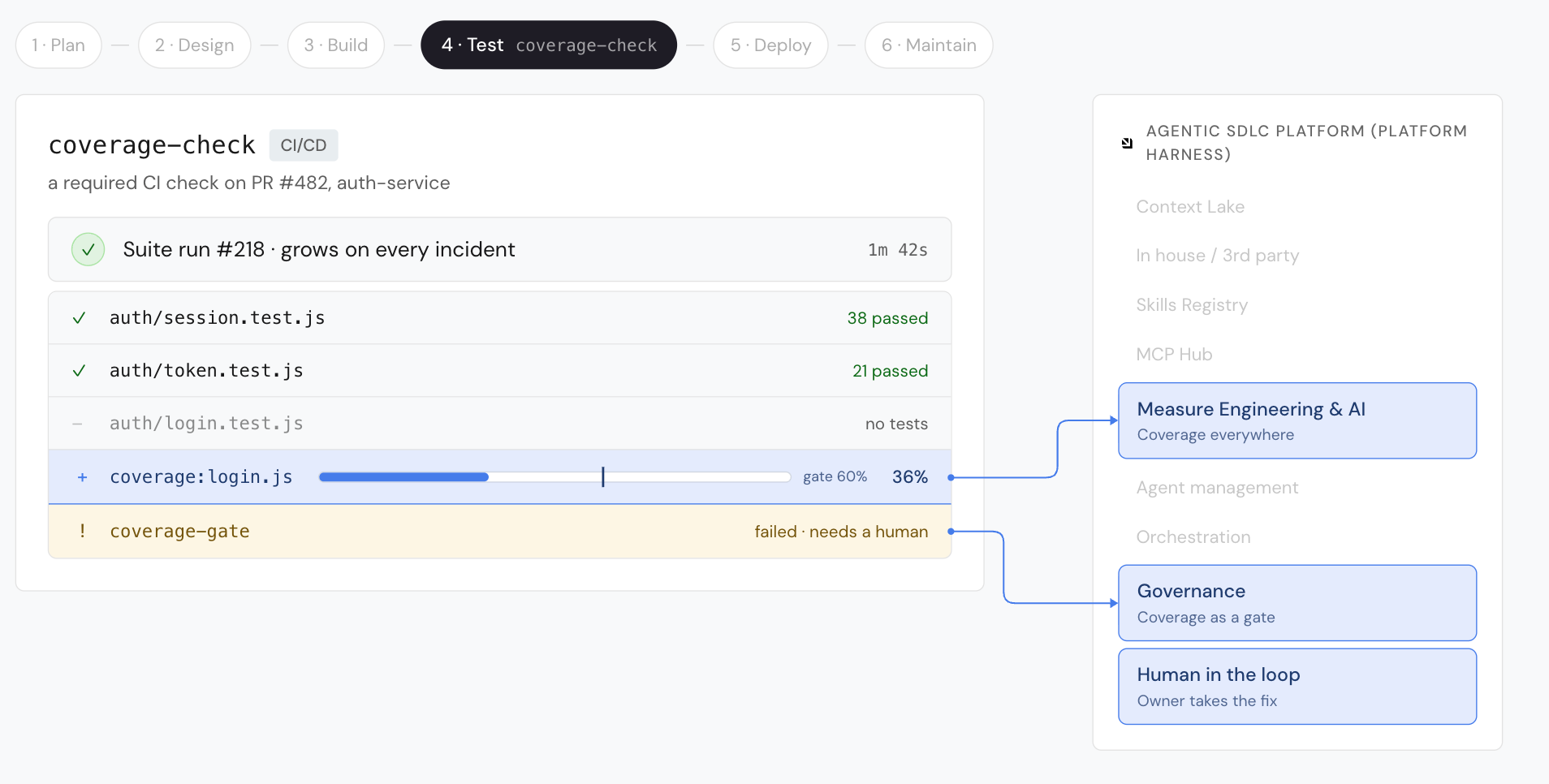
Anthropic AI-Native SDLC Playbook: Build twenty to fifty test cases from real past work. Re-run them whenever the context file, a skill, or a hook changes. Every incident adds one, permanently.
What to consider to scale this step? How you know any of it happened, or which services have a test suite at all.
How the platform harness comes in: Test coverage becomes a gate, not just a number. The platform watches test coverage—one of the playbook's own conditions for working with less supervision. A change touching code with no coverage is rated higher risk automatically, so it doesn't get approved without a human. Coverage thresholds from your existing scanners become rules applied to every service.
When an incident closes, the platform opens a tracked item for the regression test and keeps it visible until someone writes it, so tests grow when they matter most.
Stage 5: Deploy
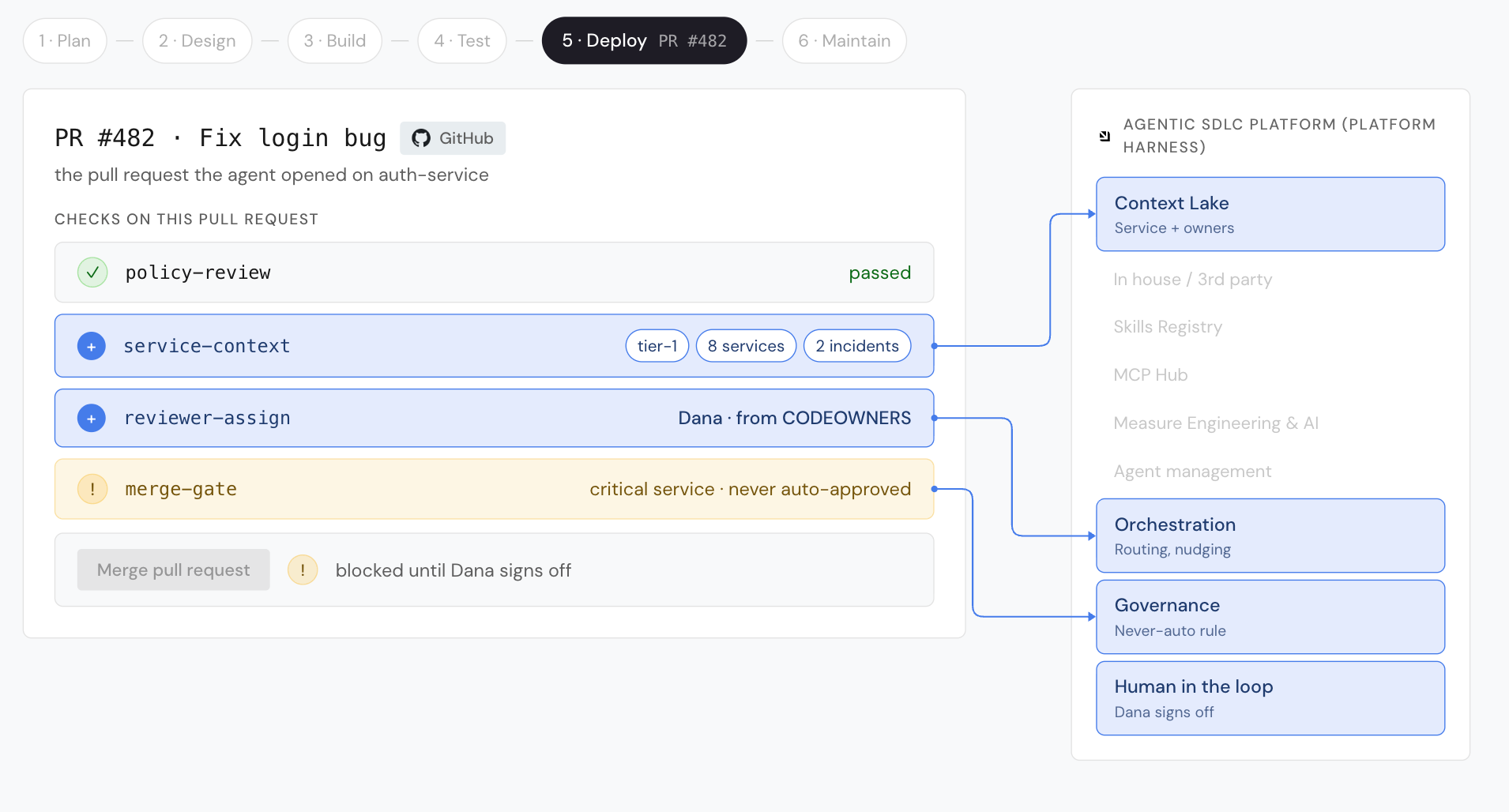
Anthropic AI-Native SDLC Playbook: Every pull request is reviewed against a written policy. Findings and approvals live in the PR as the record. A human approves, and the agent that wrote the code cannot. Routine changes go to the engineer, riskier ones to a tech lead.
What to consider to scale this step? How you decide which is which, who the right reviewer is, and how this survives once agents open most of the PRs.
How the platform harness comes in: Comments on the PR before a human opens it with what the service does, how critical it is, the blast radius, and recent incidents. It picks the reviewers using CODEOWNERS data, who has actually been committing to those files, and who isn't already sitting on three reviews. It nudges them in Slack when a PR goes stale.
It handles the routine-versus-risky split the article describes. Documentation and formatting can be approved automatically. Anything touching authentication, payments, migrations, or infrastructure is rated high risk. A change to a critical service is never auto-approved however small it looks, because the platform knows the criticality.
Stage 6: Maintain
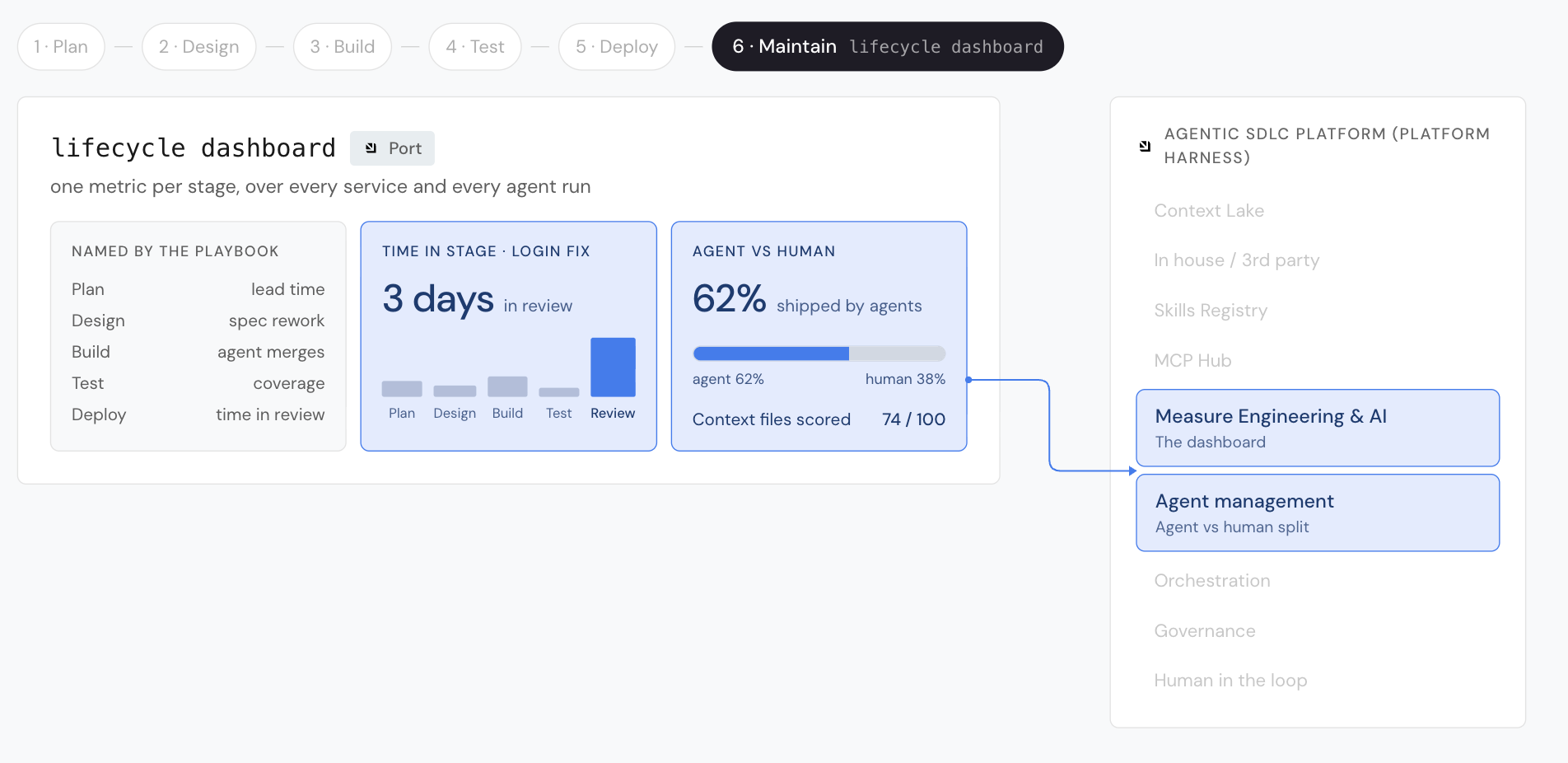
Anthropic AI-Native SDLC Playbook: Something detects a problem, an agent diagnoses it and writes up what it found as a new intent, and that re-enters the normal process. The article also names a metric per stage.
What to consider to scale this step? Naming metrics is the easy part. Nobody gives you the dashboard. And nothing tells you which teams actually adopted this and which just said yes in a meeting.
How the platform harness comes in: This is where the story completes. The article's whole argument is that coding got fast and the human steps around it didn't. The platform shows you where the slow part is.
Because every decision is written back, the platform can show how much work went to agents versus humans, which stage each item sits in, and where things stop moving. If items pile up after the agent opens a PR, review is the bottleneck, not coding. You can see which of your own gate rules blocks the most work, which tells you whether the rule is wrong or the data behind it is stale.
The platform also shows whether the skills you wrote are used at all, and by how many people. The Agentic SDLC playbook's own measure is that policy-related review comments should fall to almost zero once a skill is working. If they aren't falling, either the skill isn't firing or its wording has drifted from the real policy.
And the part that brings it full circle: adoption itself becomes a scorecard. The Agentic playbook says every repo needs a context file, kept short and corrected whenever the agent repeats a mistake. The platform reads those files out of every repo and scores them: does it exist, is it under the size limit, has it been touched recently. Across a few repos you can eyeball that. Across hundreds you cannot.
Then the fix. A failing rule already knows which services are missing something, so that list becomes a to-do list. The platform writes an intent.md for every service on it from one instruction, and each one enters the same pipeline as any other piece of work: its own tracked run, its own pull request, and a stricter gate for more critical services. Same mechanism as Stage 1, just fanned out. Finding out that a dozen services are missing something is easy. Turning that into a dozen pull requests without losing a day is the work.
Through all of this, you keep your .md files or code in git. The agent reads them at startup. The platform operates around that structure: it doesn't create the artifacts, but it ensures the right context reaches the right people with the right approvals and visibility.
That's the platform's job.
The platform foundation for implementing the AI-Native SDLC Playbook
Anthropic gave us the destination and the map. They said "here's where you want to get to: agentic SDLC. The Anthropic AI SDLC playbook is the route- the process to get there. What the agentic SDLC playbook didn't give us is the vehicle - the Agentic SDLC platform that operationalizes that process at scale.
You need something that catches signals from all your tools, knows your architecture, enforces your policies at runtime, measures whether it's working, and closes the loop when things break. Not as side tools cobbled together, not as a patch on Claude, but as a unified, agnostic platform harness.
That platform connects all your tools into one operating model. Across teams, repos, services, and the full lifecycle.
Moving forward
To implement Anthropic's SDLC playbook, start with their guidance. Then ask your platform team: what do we need underneath to make the agentic SDLC real?
{{stay_tuned}}
Frequently asked questions
What is the Anthropic AI-native SDLC playbook?
The Anthropic AI-native SDLC playbook is a published guide for building agents across each stage of the software development lifecycle. It defines the artifacts an agent produces at each stage (intent.md, spec.md, plan.md, PR, production), the governance that ships as code through hooks, skills, and evals, and the points where humans stay in the loop for judgment. It describes the process to follow, not the platform that runs it at scale.
What is an agentic SDLC platform?
An agentic SDLC platform is the platform harness for software engineering: the context, governance, and orchestration layer that wraps any agent and specializes its behavior for your organization. It holds service ownership, dependencies, and incident history, enforces your policies at runtime, and shows you where work actually slows down. The Anthropic playbook gives you the process, and the agentic SDLC platform is what scales it across the whole organization.
How is the agentic SDLC playbook different from an agentic SDLC platform?
The agentic SDLC playbook is the route, and the platform is the vehicle. Anthropic's playbook tells you what good looks like at each stage and which artifacts and governance to put in place, but it assumes intent already exists, the right reviewer is known, and blast radius can be judged. A platform supplies those missing mechanisms. It turns any signal into an intent.md, resolves the affected service and its owner, calculates blast radius from real dependencies, and enforces the gates. You need both to run agentic SDLC in practice.
Do you need Claude Code to implement the Anthropic playbook?
Claude Code is the agent harness Anthropic provides, and it handles model selection, skills, hooks, and the core agent logic. That is one half of the problem. The other half is the platform harness around it, the context, policies, and orchestration that make the same Claude Code agent behave correctly in your specific organization. The playbook works with Claude Code as the agent, and an agentic SDLC platform is what operates it across every team and repo.
Who owns AI-native SDLC in an organization?
Platform engineering owns it. Anthropic is explicit that this is not a tooling rollout that every team figures out alone. Building the agents is one job, and operating them reliably across all teams and use cases is the platform team's job, which is what requires a platform rather than a process.
What does agentic development change for developers?
Agentic development moves the developer's work from writing code to expressing intent and governing outcomes. Once code generation stops being the bottleneck, the slow parts move to the human steps around it: design decisions, reviews, approvals, and testing. The role shifts toward stating what the work is, setting the guardrails, and making the calls the agent cannot make on its own.
How do you scale the Anthropic playbook across many agents and teams?
You scale it with a platform harness that catches signals from every tool, knows your architecture, enforces your policies at runtime, measures whether the process is working, and closes the loop when things break. Rolling agents out across every SDLC stage with consistent context, governance, and visibility is what turns the SDLC playbook from a single-team practice into an operating model across hundreds of repos and services.
{{from_manual_to_autonomous_engineering}}


Get your survey template today
%201.svg)


Download your survey template today


Free Roadmap planner for Platform Engineering teams
Set Clear Goals for Your Portal
Define Features and Milestones
Stay Aligned and Keep Moving Forward
Create your Roadmap


Free RFP template for Internal Developer Portal
Creating an RFP for an internal developer portal doesn’t have to be complex. Our template gives you a streamlined path to start strong and ensure you’re covering all the key details.
Get the RFP template


Leverage AI to generate optimized JQ commands
test them in real-time, and refine your approach instantly. This powerful tool lets you experiment, troubleshoot, and fine-tune your queries—taking your development workflow to the next level.
Explore now
Check out Port's pre-populated demo and see what it's all about.
No email required
LIVE WEBINAR, Aug 18, 2026:
Context-aware Vibe Coding for Platform Engineering
Thursday, October 22 12:00pm EDT⋅6:00pm CET
To learn more about the new capability and to see a live demo, join our upcoming community session with GitHub
Move fast while staying in control
Build governed agentic workflows on one central platform.
See it in action:
Watch this video on generating Terraform with Port, or explore our public demo.
.png)
Check out the 2025 State of Internal Developer Portals report
No email required
Minimize engineering chaos. Port serves as one central platform for all your needs.
Act on every part of your SDLC in Port.
Your team needs the right info at the right time. With Port's software catalog, they'll have it.
Learn more about Port's agentic engineering platform
Read the launch blog
Contact sales for a technical walkthrough of Port
Every team is different. Port lets you design a developer experience that truly fits your org.
As your org grows, so does complexity. Port scales your catalog, orchestration, and workflows seamlessly.
Port × n8n Boost AI Workflows with Context, Guardrails, and Control
Port Builders Session: A Single, Governed Interface for All MCP Servers
Book a demo right now to check out Port's developer portal yourself
Apply to join the Beta for Port's new Backstage plugin


n8n + Port templates you can use today
walkthrough of ready-to-use workflows you can clone
From manual to autonomous engineering
One platform to build, govern, and operate the Agentic SDLC.
Port is open for you to try it
build your first agentic workflow today