From Agentic Chaos to an AI-Native SDLC
A practical playbook for engineering leaders who want to move from their first agents to a fully AI-native engineering organization.
Engineering organizations are already building their first agents. The hard part is what comes next: scaling to dozens, hopefully hundreds. Each agent acts across your repos, tickets, incidents, and deploy paths. This playbook will help you build the platform that closes that gap, before it becomes chaos.
What will you learn from reading this eBook?
- Why scaling AI agents is harder than building them, and where teams lose control
- A practical 6-step playbook for building the platform that runs agents at scale
- What the teams already scaling agents do differently
- How to build an AI-native engineering culture that proves its ROI
Cool AI agent demos only get you so far
Managing AI agents at scale is a different problem than building one.
If your company is interested in becoming AI-native, you’ve probably been in an impressive agentic demo run by a senior engineer lately. For example, an agent that triages an incident in seconds, drafts a fix, closes a ticket, writes the test. It works in the demo, the room is impressed, and someone says the obvious thing: how are we taking it to production?
Scale is where things get difficult. One agent built by one team, monitored by one engineer, is a demo. Hundreds of agents built by dozens of teams, acting across your repos, tickets, incidents, and deploy paths, is an operating model. The gap between those two is not a better model or a more clever prompt. It's whether you can run agents at scale without losing track of what’s their intent, what they can touch, and what they've done.
This gap is where most organizations are right now. AI adoption is racing ahead, and existing controls can’t keep up. According to Gartner, about 27% of engineering organizations already apply agentic AI somewhere in the SDLC, but adoption is outpacing the ability to manage it. More than half of developers point to tool sprawl, the difficulty of tracking all the AI tooling choices, as a top adoption barrier.
“It worked in the demo”, right?
This playbook is about closing that gap before it becomes chaos. It's written for the engineering leader who sees AI as critical to core software delivery, and wants to accelerate their journey towards AI-native engineering and reliably scale agentic SDLC across the organization. This is in contrast to trial and error cycles, “it worked on my machine”, or patching it together one team at a time after something breaks.
What is agentic chaos, and when does it hit?
Think about Agent Sprawl as the new Shadow IT, but this one also takes action on your engineering systems. At scale.
Agentic chaos is what we want to avoid, if we can. It's the point where agents and skills are multiplying faster than our control (the inventory, ownership, access rules, and audit trail around them). Of course, losing control is not a decision you make. It happens slowly, one useful agent at a time, until no one can answer the basic questions: which agents exist? who owns them? what they can access? and what did they do last week?
It usually begins when an experiment starts working. The success is what triggers the sprawl. Every team that saw a working demo wants their own agent, so they build one, wire up their own context, borrow whatever credentials are handy, and ship it. One 2026 survey of over 900 practitioners found 80.9% of teams had already pushed agents into testing or production, while only 14.4% went live with full security and IT approval (Gravitee, State of AI Agent Security 2026).
We tried comparing it to shadow IT but with a slight difference. A forgotten SaaS tool sits there and creates cost and data risk. An agent as well, but, and that's the change - an ungoverned agent can also act. It can open a ticket, trigger a workflow, draft a remediation PR, call an internal API, or pull data from a system nobody expected it to reach. The failure mode isn't a bad spreadsheet, it's an action taken before a human sees it. In one 2025 incident, an AI coding agent deleted a software company's production database during an active code freeze, ignoring explicit instructions not to make changes, and wiped records for more than 1,200 companies (Fortune, July 2025).
If it happens to you, your instinct at this point will probably be to slow down. But it's not necessarily the right lesson. The teams that win don't stop building agents, they build the platform layer that lets agents run safely at scale, and this playbook will show you how.
The 6 steps to take you from chaos to autonomy
A practical framework for AI agent governance across the engineering SDLC.
We will suggest a clear path from agentic chaos to an AI-native SDLC. It climbs in six steps. They might feel intuitive, as they map to existing platform engineering concepts teams already use for services: a catalog, a source of truth, scoped access, golden paths, guardrails, and metrics. Agents are just a new kind of actor in your SDLC, and this is how you manage that actor at scale.
How to read this playbook
The six layers depend on each other. You can't skip to the top.
Read this as a climb, because the order matters. Each layer stands on the one below it, and we recommend starting from step 1.
The value everyone wants lives at the top, in the last two steps: agents running production work on their own, returning measurable time. But you can't start there. An autonomous agent with no registry, no governed context, and no boundary isn't a strategy, it's the incident waiting to happen. The top of the climb is only as trustworthy as the layers under it.
So find where your gaps start and build from there. Most organizations are already partway up without realizing it. Each step below ends with what you'll have once it's in place, so you can track the climb as you go.
Step 1: Turn on the lights on Agents, Skills, and MCPs
Build an AI registry so you can see every agent you run.
You can't govern what you can't see, and right now you almost certainly can't see it. Agents are running in your organization that you didn't authorize, built by teams you didn't ask, touching systems you didn't map. So the first move isn't a policy or a framework. It's a light switch.
An AI agent registry is the system of record for every agent you have: its owner, purpose, access details, and status, in one place. It's the foundation the rest of this playbook builds on, because none of the layers above it work until the fleet is visible. You can't scope an agent you don't know exists, audit one you can't name, or retire one you can't find.
The registry should populate itself with an auto-discovery engine. Agents, skills, MCPs get discovered automatically across the platforms they already run on and tracked as they change, so the registry reflects what's actually running rather than what someone remembered to write down.
If you don’t take care of this detail - a registry you maintain by hand is stale the day after you build it, while an auto-discovered one stays current on its own.
An agent registry does two jobs at once. It gives you and your security / Platform team a single, current view of what's running, who owns it, and what it can reach. It also lets your engineers find and reuse approved agents instead of quietly building the fifth copy of the same thing.
Engineers call it a marketplace, IT calls it a registry, you get both governance and enablement. (We go deeper on why discovery and reuse belong in one system in “Agent Registry vs Agent Hub: You Need Both”.)
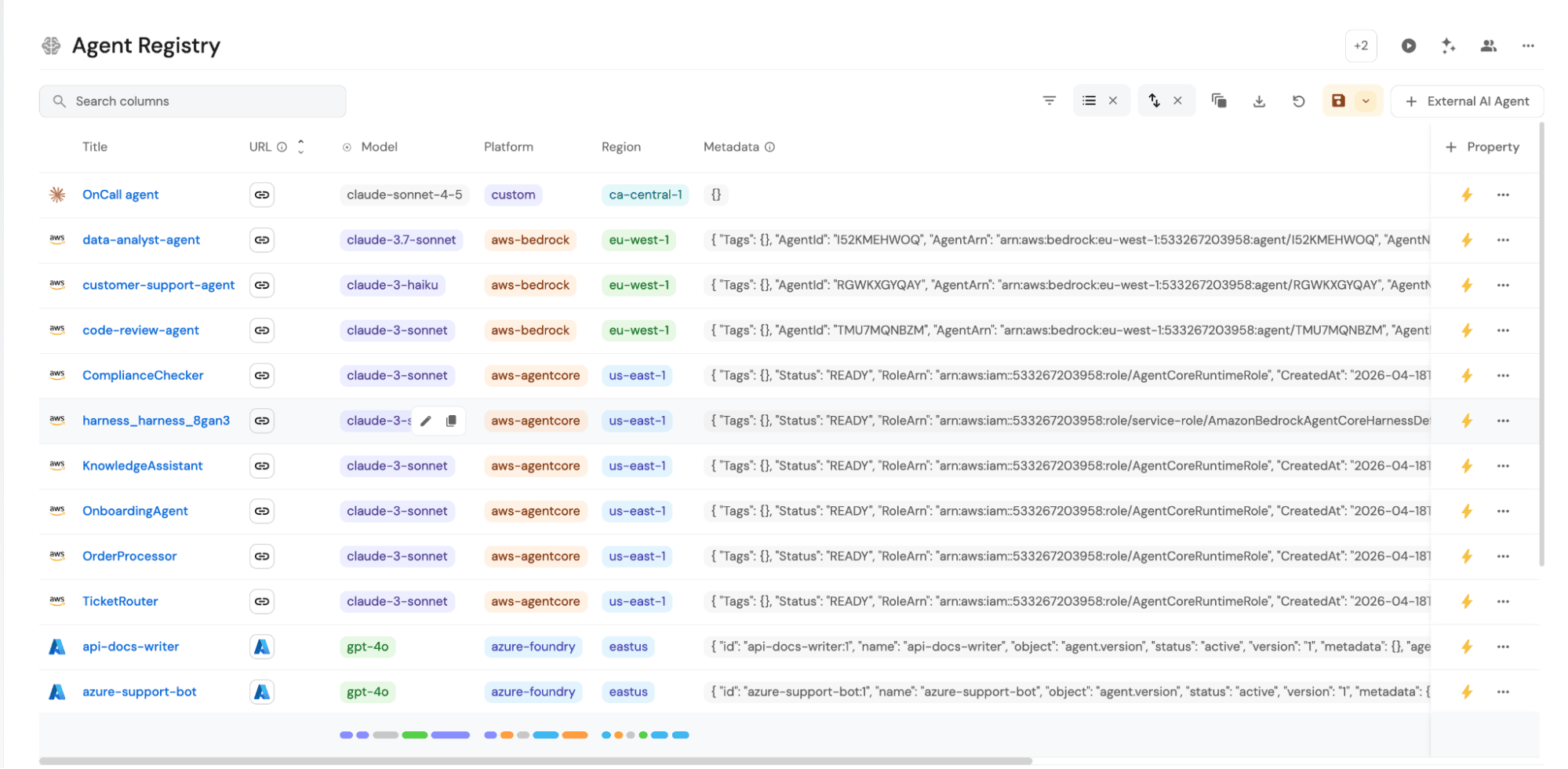
Once it's built - the effect shows up fast. Duplicates surface, abandoned agents become easy to retire, and risky permissions become easy to catch. The safe, approved agent becomes the one that's easiest to grab, which is how governance starts making teams faster instead of slower.
This is also where most organizations discover how bad the sprawl already is.
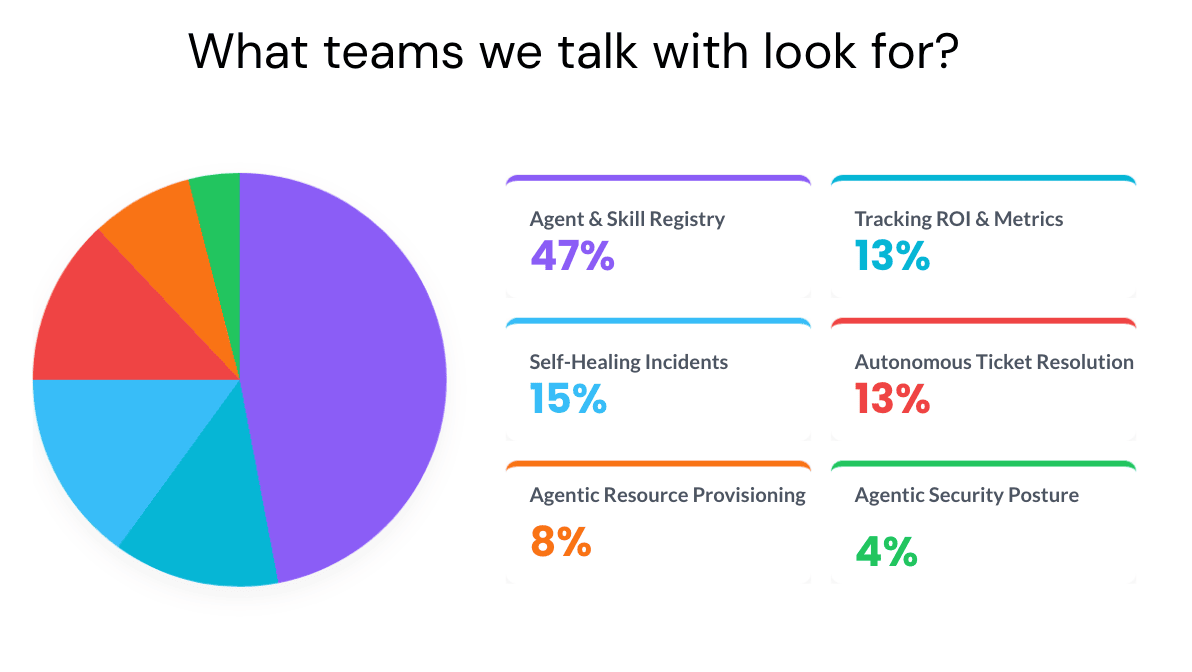
In Port, this is the pattern we hear most in conversations with engineering leaders. Through early 2026, an agent / skill registry was the single most requested capability, raised by 47% of the organizations we spoke with, reporting the exact same agentic chaos in their organization and the need for a registry.
Once built - you now have a live, self-updating inventory of every agent in your organization, with an owner and a scope for each. You've moved from unknown agents to a visible fleet.
But it's not enough - what those agents actually know about your org? because an agent is only as trustworthy as the information it acts on. Context, that's our next layer.
Step 2: Give agents the context they need with a context lake
Connect every agent to one governed source of truth by building a shared context layer to serve them.
The right context helps you trust the agents you build. An agent that opens a pull request or triages an incident is only safe if it's reasoning over real, current, permissioned information about your systems, rather than whatever it happened to scrape or was hardcoded to assume. Get the context wrong and a confident agent does the wrong thing quickly.
Today most teams solve this one agent at a time. One hardcodes service ownership, another scrapes it from a wiki, a third queries an API. Same information, wired up three fragile ways, none of them governed. That doesn't scale, and it quietly spreads the same stale assumptions across your fleet.
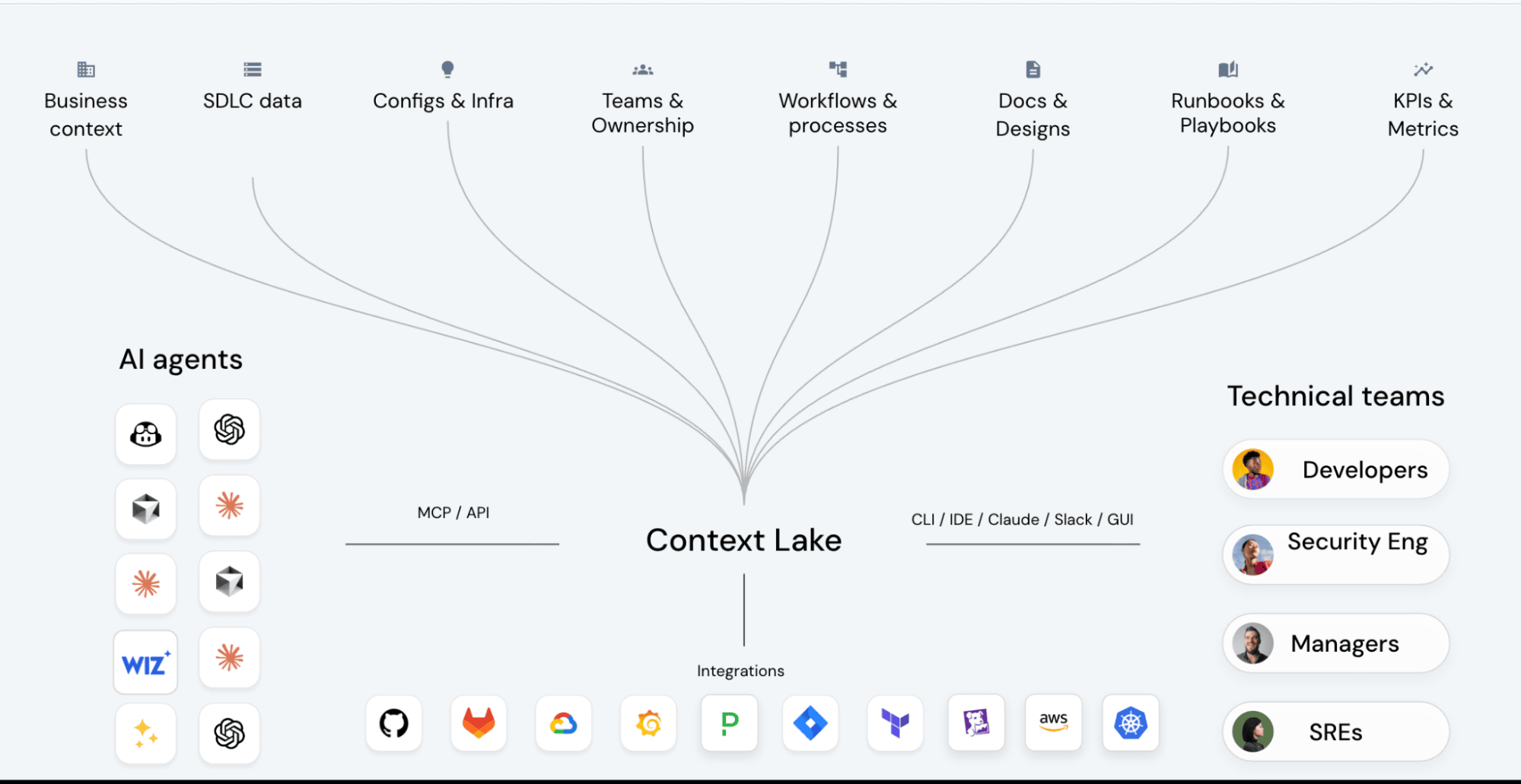
A context lake is giving every agent one governed source of truth: services, ownership, dependencies, current state, runbooks, configurations, code, incidents, and policy, in a single place agents read from. Build the context once, govern it once, and every agent draws from the same current view of engineering reality. The output gets better because the input is better, and the whole thing gets easier to audit because you know exactly what an agent could see. While doing that, you also save costs. In our recent research, we showed how a well-structured context lake can save 80% of costs for an engineering organization.
For you, the detail that matters isn't the plumbing experience of the developer. It's that agents pull context from a layer you control, instead of whatever a local integration happens to expose. That control is what makes the next layer, scoping, meaningful. You can only decide what an agent should reach once there's a governed context lake it reaches into.
Once built, you will have every agent drawing from one governed source of truth about your systems, instead of scraping or hardcoding its own. Agent output gets more reliable, and you know exactly what each agent could see.
If you already built a context lake, the next question is what each agent is allowed to do with it, because knowing your systems and being trusted to act on them are different permissions. That's the next layer - boundaries.
Step 3: Give every agent a boundary so you can sleep at night
Scope each agent's identity, access, and permissions to exactly what its task needs.
Every agent needs a defined boundary: what it can know, which tools it can use, which systems it can call, which sub-agents it can work with, and which actions it can take. At Port we call that boundary a capsule. The idea is simple: an agent gets access to everything it needs for its task, and nothing more.
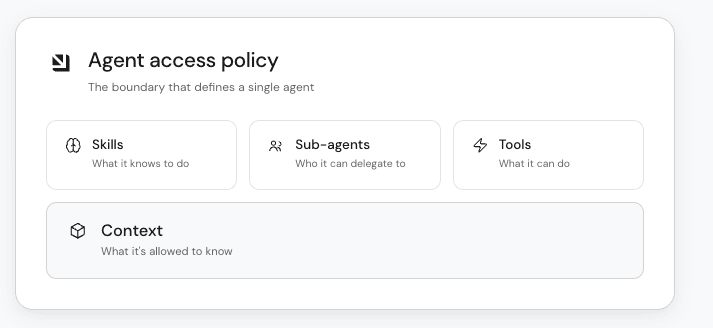
The boundary starts with identity. When an agent acts through a person's credentials, your audit trail blurs at the exact moment you need it sharp, because you can't tell whether the human or the agent took the action. A production agent needs its own identity, tied to its owner, purpose, scope, and lifecycle state. Identity comes before autonomy, always.
Most organizations aren't there yet: only 18% of security leaders are confident their current identity infrastructure can handle AI agents, and 84% doubt they'd pass an audit of agent access (Cloud Security Alliance and Strata Identity, 2026). As one identity architect put it, the question that matters for an agent isn't "who are you" but "what are you authorized to do right now."
Scoping this by hand doesn't survive contact with reality. Once teams create agents across different services, environments, and workflows, a spreadsheet or an approval thread breaks. You need a platform layer that applies scope consistently, keeps it tied to ownership, and changes or revokes it the moment the task, the risk, or the owner changes.
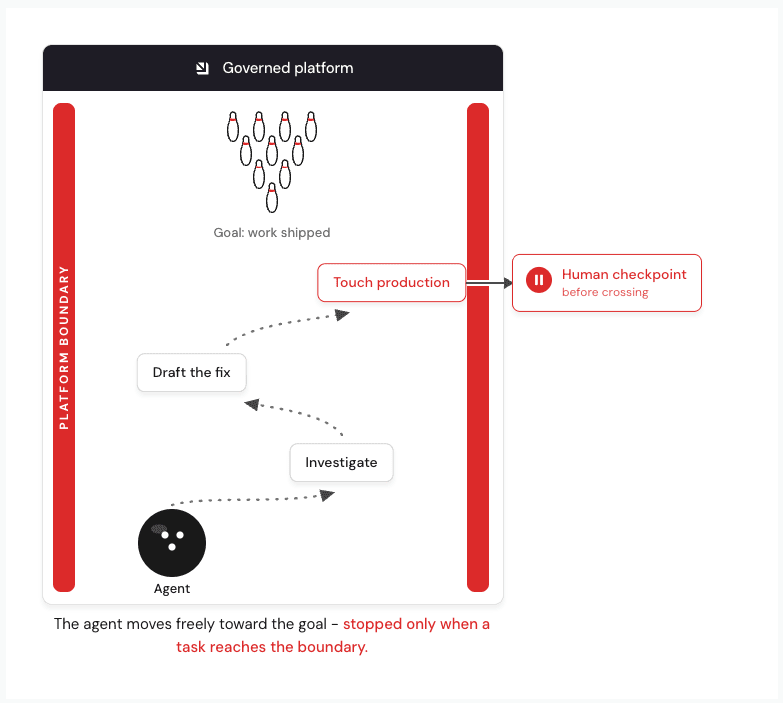
One more important detail - access control has two sides, and both matter. Human RBAC governs who can create agents, set their boundaries, approve risky actions, and change permissions. Agent permissions govern what the agent itself can do once it runs: which tools it calls, which data it reads, which systems it updates, and where it has to stop for a human. One decision worth making early: match each agent's access to where it runs and what data it touches. An agent summarizing low-risk tickets is not the same risk as one reaching customer data or pushing toward production, so it shouldn't carry the same access.
The boundary is not a one-time setup. It follows the agent's whole lifecycle, from request and review through provisioning, running, auditing, updating scope, revoking access when risk changes, and retiring the agent when it's done. That's what keeps governance current long after the first approval.
Once built, you will have every agent running under its own identity, with access scoped to exactly what its task needs and nothing more, kept current across its lifecycle.
So every agent now has an identity and a scope but how do teams get all of this by default, without wiring it up by hand every time? That's the next layer - golden paths.
Step 4: Build golden paths
Give teams a paved path to build and manage agents the right way by default.
Governance works when the approved path is also the easiest path. If a team has to leave their workflow, file a ticket, wait for a custom review, and wire everything themselves, they'll keep building locally and the sprawl continues.
These are called Golden paths, a concept introduced earlier in Platform engineering to guide developers through ways to develop, deploy and manage software. Now - we also need it for the agent lifecycle, like any other service.
A golden path for agent creation lets a team request an agent, pick a boundary, provision its runtime and credentials, and register it automatically, all in one flow. The same path handles publishing a reusable agent, updating its scope, and making approved agents easy for the next team to find. The approved path stops being a document nobody reads and becomes the actual route agents travel into production.
In practice, this looks like a self-service action. An engineer opens the platform, picks "create an agent" (or a skill, or an MCP connection), fills in a short form: what it's for, which boundary it gets, which team owns it. They hit submit. Behind that one form, the platform provides the runtime, issues the agent its own identity and scoped credentials, wires in the approved context, and registers it in the catalog automatically.
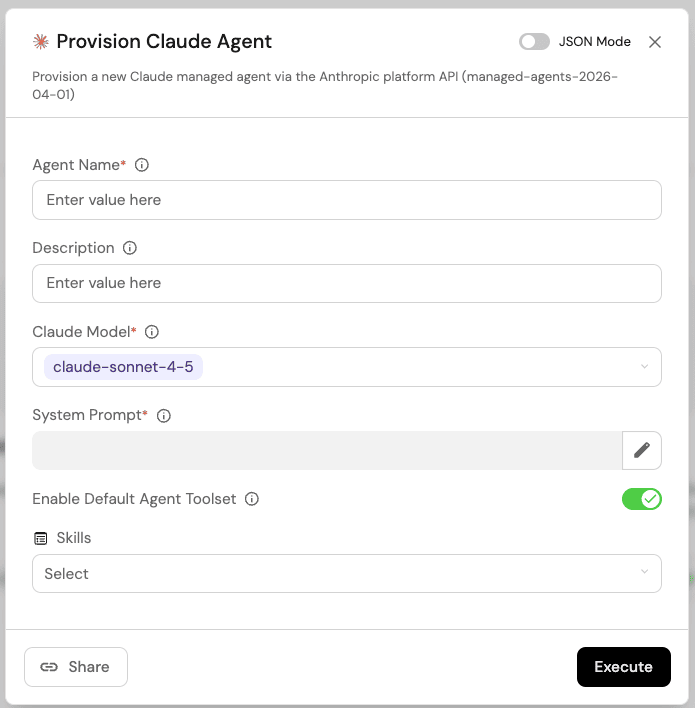
That path has to meet teams where they already build. Most organizations run more than one agent platform, whether that's Claude managed environments, Bedrock, or whatever IT has approved. The governance layer should work across those platforms rather than forcing every team into a separate tool just to be governed.
Then put the gates where the risk actually changes. A new skill gets a review because it widens what an agent can do. A high-impact action gets human approval because it can change production. An external data path gets its own check because it affects exposure. Same rule everywhere: the gate belongs at the moment the risk becomes real, not scattered as friction across the whole path.
Once built, you will have a golden path where teams request, build, and reuse agents that come pre-registered, grounded in context, and scoped by default, with gates at the points where risk is real. Doing it right is now the fastest way to do it.
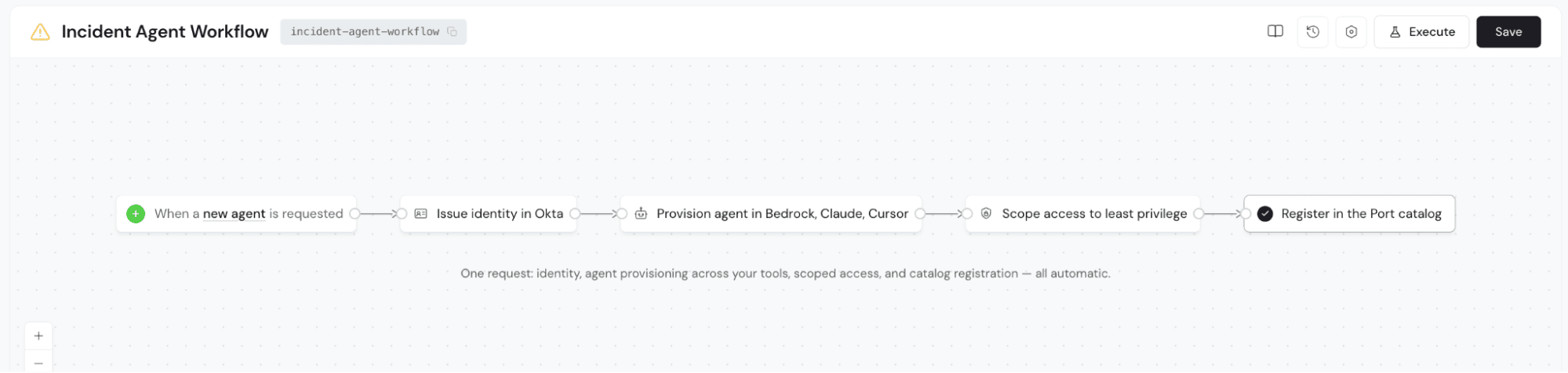
Teams can now build governed agents by default. The last question is the one you started with: can you let them run on their own? That's the top of the stack.
Step 5: Let agents run - start building agentic workflows
Use governed agents in production workflows with human-in-the-loop gates.
Workflows are where agents become part of an event-driven loop, not just something you call. A workflow ties the agent into the systems around it end to end, so it triggers on a real event and runs the whole use case through. Take incident triage: the moment an alert fires, a governed agent pulls together the recent deployments, monitoring data, and ownership, posts a summary to the on-call engineer, and a second agent digs into root cause, while the human still makes the call. Another example is ticket resolution. You kick it off when a new ticket lands: an agent picks it up, drafts a PRD, and runs it through to the point where a person signs off.
The pattern holds across these three: an event starts the loop, the agent does the gathering and the drafting, the human keeps the decision that matters (if needed), and every action is logged against the agent that took it.
This part is the payoff, and the reason to have built the other four layers. You started this playbook unable to say yes when leadership asked to scale agents everywhere, because scaling means letting agents act without a human watching each step, and you had no way to trust that. Now you do.
Start with bounded workflows. The agent runs the loop, and a human still approves the high-impact moments. That lets you put agents on real production work without pretending every judgment call is ready to hand off. Good first workflows are specific enough to control: incident triage, deep investigation, etc.
Each has a clear shape, a known set of systems, and natural points where a person can approve, reject, or redirect.
From here the gates move only as fast as your trust does. As a workflow proves itself, you widen the boundary and pull humans back to the decisions that genuinely need judgment. The end state is spec-to-verification loops that run with far less oversight, not because you stopped caring about control, but because the control is now built into every layer beneath the agent.
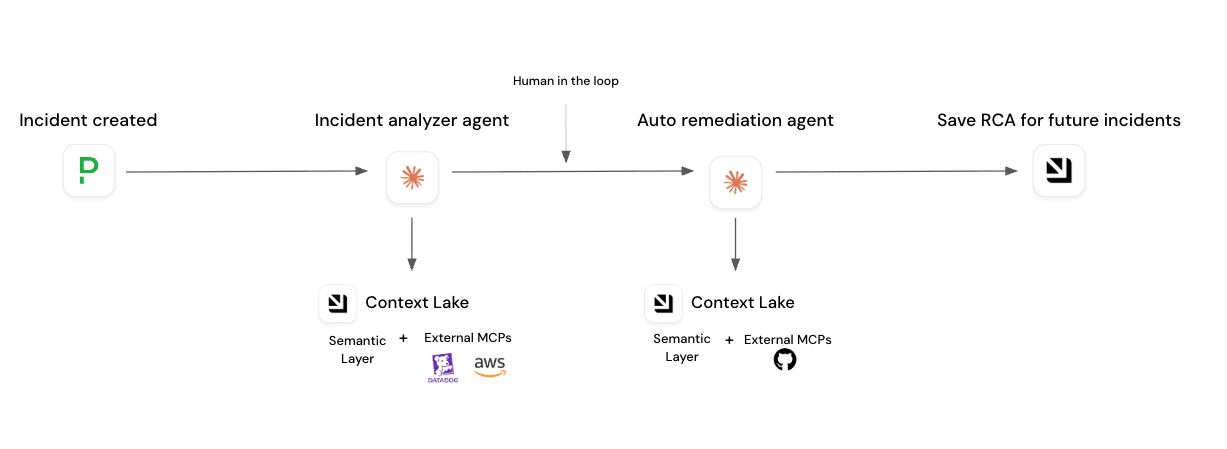
Following conversations with hundreds of engineering leaders, these are the most trending use cases for Agentic SDLC workflows:
- Self-healing incidents. The moment an alert fires, agents pull the service owner, recent deploys, runbook, and on-call, then suggest or run a first-response playbook while the on-call team approves each step. The engineer who gets paged makes one decision on a situation the system has already diagnosed, instead of starting from scratch.
- Autonomous ticket resolution. Agents turn a raw ticket into a structured spec, hand it to a coding agent with full context, and run it through to a safe release, while a risk check flags anything that shouldn't go straight to AI.
- Autonomous security management. Agents catch a new vulnerability, trace the affected service, and open a fix that stays behind a human gate.
- Agentic resource management. Agents handle resource setup and configuration and clean up what drifts from policy, so routine provisioning stops landing on a person.
Once built, you have governed agents running in real production workflows, autonomous where the boundary is clear and gated where judgment still matters.
Now, the last question is the one from your CFO: Is it worth the investment?
Which leads us to the final layer - ROI and feedback loops.
Step 6: Measure the ROI and close the loop
Track what agents return, and feed it back into the platform.
Autonomy without measurement is just faith with extra steps. The final layer is the one that makes the whole thing sustainable: prove what the agents are returning, and route that signal back into how you build the next ones. This is also the layer that keeps your budget, because the leaders who fund agentic engineering at scale are the ones who can show what it's worth.
Measure the things the business actually feels. Developer hours returned per workflow. Incidents resolved without a human touching them. Time from ticket to remediation. Percentage of tickets closed autonomously. Cost per run, so a workflow that quietly retries itself into a large bill gets caught. Pick a small number of metrics that map to outcomes leadership cares about, and track them per workflow so you know which agents earn their place and which don't.
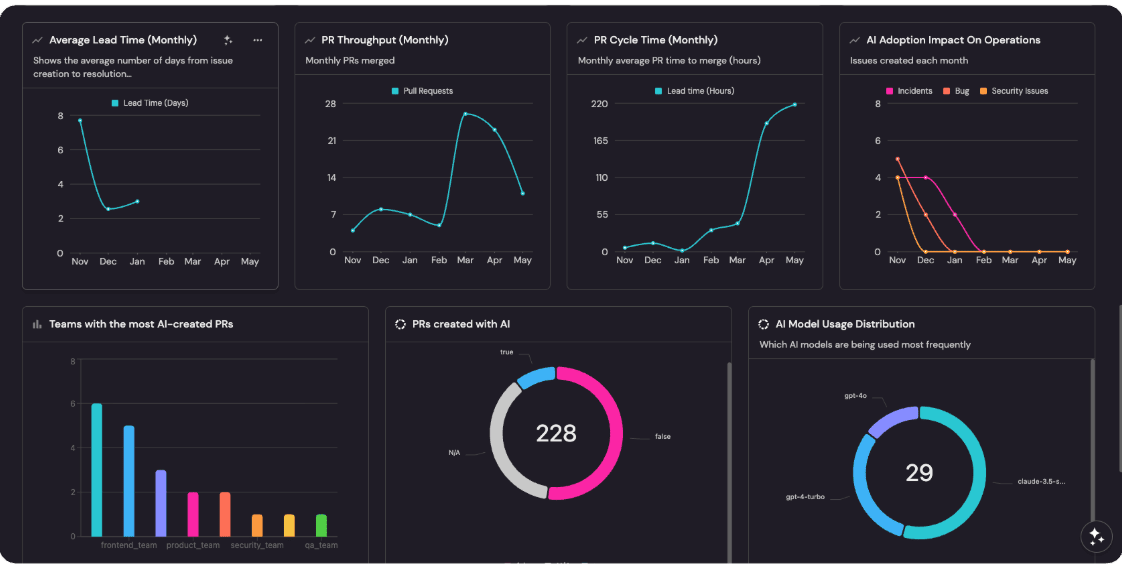
Then close the loop. The registry, context lake, and audit trail you built in the earlier steps are what make this possible, because every agent action is already recorded against an identity. Feed that data back: promote the workflows that return the most, tighten or retire the ones that don't, and use real usage to decide where the next agent should go.
The fun part is now: governance stops being a gate and becomes a feedback system that makes the whole fleet better over time.
DLocal, a cross-border payments processor handling over 500 million transactions a month, built an agent on Port that now resolves 45% of their engineering tickets end to end. The result: the capacity of a 20% larger engineering team at zero added headcount. Of course, the ROI measurement is included as part of their platform building, and that's how they learned about these numbers. [Link to the DLocal case study blog]
Once built, you have a clear, per-workflow view of what your agents return, and a feedback loop that turns that signal into a better platform. You can defend the investment and know where to grow it.
A recap of the 6 steps
Managing AI agents at scale, from visible fleet to measured autonomy.
The whole climb in one view. Each step builds what the one above it needs, and the right-hand column is the outcome you reach at each rung.
To do this at scale, you need a platform
Six layers of AI agent governance only hold as one control plane.
You could try to assemble these six layers from separate point tools: one product for discovery, another for identity, a third for workflows, a fourth for metrics. It works in a slide. It fails in production, because all six layers share one foundation of discovery, ownership, access, context, and audit. Build them separately and you build that foundation six times, ending up with catalogs that don't sync, access models that disagree, and audit trails that never reconcile.
Agents make this worse than it was for services, because agents act across all six layers at once. A single incident-triage agent needs to be discovered, grounded in context, scoped, built on a golden path, run under gates, and measured. If those live in six disconnected tools, the agent falls through the gaps between them, and the gaps are exactly where the incidents happen. At scale, agent governance has to be one control plane, not a stack of integrations you maintain by hand.
Port gives you all six layers, out of the box
The agentic SDLC platform for managing AI agents at scale.
Port is the platform for the agentic SDLC, and it delivers all six layers as one control plane. The registry lives in the catalog, auto-discovering agents, skills, and MCP servers across your environment. The context lake gives agents one governed source of truth about your systems. Capsules define the scoped identity and access each agent carries. Golden paths make the governed route the default way teams build. Human-in-the-loop workflows run agents in production with gates where risk is real. And because every action is recorded against an identity, the ROI and feedback loop come from the same system, not a bolt-on.
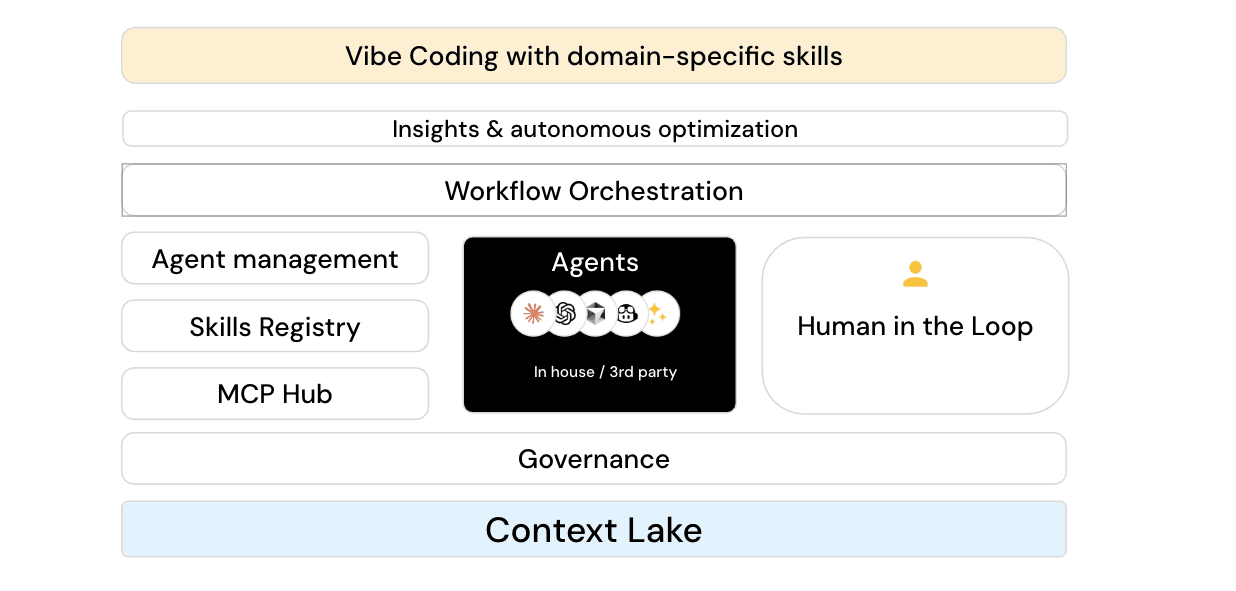
That's the difference between managing agents and chasing them. Port gives you the whole climb in one place, so agent governance becomes part of how engineering work moves, instead of a separate process trying to catch up after the agents have already spread.
The starting point is simple. Map your current agent fleet. Define the boundary every production agent must carry. Choose one governed workflow and scale it first.
How do you build an AI-Native engineering culture?
Here’s a handful of bold decisions some of the market leaders made to create more momentum than a year of careful planning.
- Hire or name an AI platform engineer - Someone has to own the control plane, the golden paths, and the standards the rest of the org builds on. Making it a real role signals that agentic engineering is a strategy, not a side project.
- Protect the time - Set aside a fixed share of every sprint for building your agentic SDLC, the same way you'd protect time for reliability or security. Agents that return developer hours are worth the hours you invest to build them right.
- Start where the resistance is highest - Pick the workflow your team complains about most, the 2 a.m. incident scramble or the security backlog, and make that your first governed agent. Momentum comes from solving a real pain, in public, where the whole org can see it work.
- Learn from teams who already did it - Organizations across financial services, insurance, logistics, and enterprise software are already running governed agents in production, from self-healing incidents to autonomous ticket resolution. The pattern is consistent: they started with visibility, built the layers in order, and scaled the workflows that returned the most. You can start the same climb this quarter. Pick one step, and turn on the lights.
(For the full set of moves, see [5 Radical Decisions to Kick Off Your Agentic SDLC].)
The agents are already here. Can you run them?
You have the playbook now, and it only pays off if you move. Agentic chaos isn't a reason to slow down, it's a sign your teams are already moving. What separates the organizations that scale from the ones that stall isn't how much they experimented, it's whether they built the proper infrastructure to support agents at scale.
So, where does yours start? Map your current agent fleet, define the boundary every production agent carries, and pick one governed workflow to scale first. Start with Port to see all six layers in one platform, or book a walkthrough with our team.


Get your survey template today
%201.svg)


Download your survey template today


Free Roadmap planner for Platform Engineering teams
Set Clear Goals for Your Portal
Define Features and Milestones
Stay Aligned and Keep Moving Forward
Create your Roadmap


Free RFP template for Internal Developer Portal
Creating an RFP for an internal developer portal doesn’t have to be complex. Our template gives you a streamlined path to start strong and ensure you’re covering all the key details.
Get the RFP template


Leverage AI to generate optimized JQ commands
test them in real-time, and refine your approach instantly. This powerful tool lets you experiment, troubleshoot, and fine-tune your queries—taking your development workflow to the next level.
Explore now
Check out Port's pre-populated demo and see what it's all about.
No email required
LIVE WEBINAR, Aug 18, 2026:
Context-aware Vibe Coding for Platform Engineering
Thursday, October 22 12:00pm EDT⋅6:00pm CET
To learn more about the new capability and to see a live demo, join our upcoming community session with GitHub
Move fast while staying in control
Build governed agentic workflows on one central platform.
See it in action:
Watch this video on generating Terraform with Port, or explore our public demo.
.png)
Check out the 2025 State of Internal Developer Portals report
No email required
Minimize engineering chaos. Port serves as one central platform for all your needs.
Act on every part of your SDLC in Port.
Your team needs the right info at the right time. With Port's software catalog, they'll have it.
Learn more about Port's agentic engineering platform
Read the launch blog
Contact sales for a technical walkthrough of Port
Every team is different. Port lets you design a developer experience that truly fits your org.
As your org grows, so does complexity. Port scales your catalog, orchestration, and workflows seamlessly.
Port × n8n Boost AI Workflows with Context, Guardrails, and Control
Port Builders Session: A Single, Governed Interface for All MCP Servers
Book a demo right now to check out Port's developer portal yourself
Apply to join the Beta for Port's new Backstage plugin


n8n + Port templates you can use today
walkthrough of ready-to-use workflows you can clone
From manual to autonomous engineering
One platform to build, govern, and operate the Agentic SDLC.
Port is open for you to try it
build your first agentic workflow today
%201%20(1).png)
.png)