How Platform Engineering Makes Loop Engineering Safe to Scale Across the Organization
How platform teams make coding agent loops safe to scale: shared context, ownership, standards, budgets, and governed workflows.

Key Takeaways
- A coding loop is one machine inside the software factory. Scaling it safely requires shared context and controls beyond the repository.
- Platform teams define the paved road: ownership, permissions, standards, budgets, approval points, and reusable execution paths.
- Production must teach the factory. Incidents, tickets, deployment results, human corrections, and token cost should change the next backlog, skill, policy, or workflow.
I am Baruch from Port. Let me show you something cool: we discovered the loop again.
Loop engineering is the craft of replacing one heroic prompt with a system that keeps an agent moving toward a measurable result. Geoffrey Huntley's Ralph loop keeps assigning the goal with fresh context; Peter Steinberger tells us to design the loops that prompt our agents; and StrongDM's software factory runs specs, scenarios, agent work, and independent verification without human code review. I want the StrongDM version in particular, a bounded loop that turns a spec into verified software.
It is also where the ownership question changes. One developer can tune a loop for one repository. Once dozens of teams run agents against production systems, somebody has to own the shared context, limits, permissions, evidence, and feedback paths. That somebody is the platform team.
Why the loop becomes a platform engineering responsibility
The atomic loop has a clean shape: a specification goes in, an agent works inside a sandbox, and an independent verifier decides whether the result ships or goes around again. Give it a bounded migration, a dependency update, a mechanical refactor, or greenfield work with a strong oracle, and it can run while I attend a meeting about developer productivity.
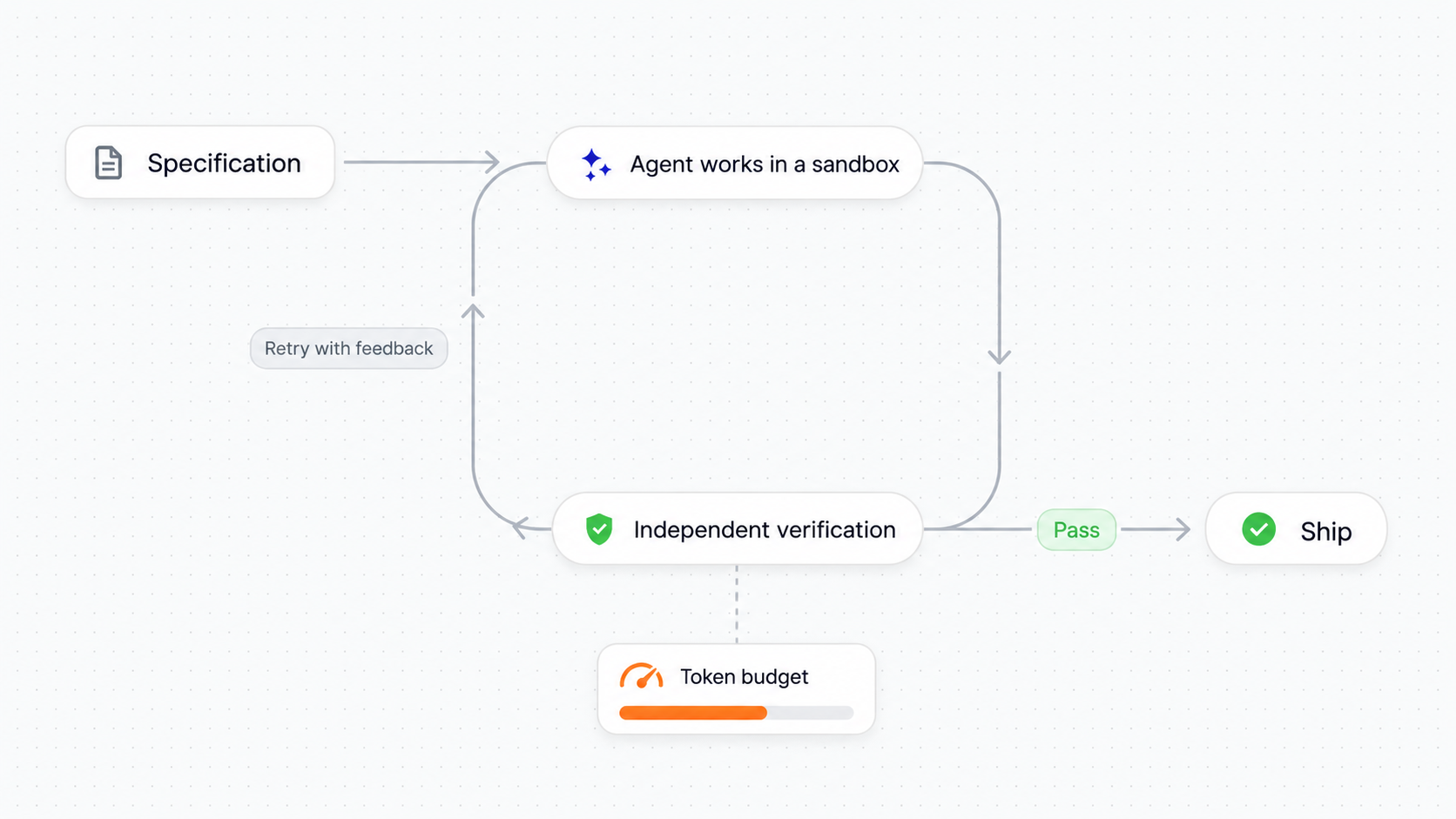
But a repository-local loop knows only what somebody put inside its context window. It does not automatically know which team owns the service, which customers depend on it, which SLO is already burning, which production action requires approval, or whether three other teams copied the same skill and changed it in three incompatible ways.
Platform engineering exists because local freedom creates organization-wide coordination work. The developer portal gave platform teams a place to model software, ownership, standards, and golden paths for humans. The move toward agentic engineering adds agents as another platform user, one that works much faster and has no instinct to stop before an expensive mistake.
So the platform team's job starts with the paved road each loop runs on: common context, common controls, and clear boundaries for where it may go.
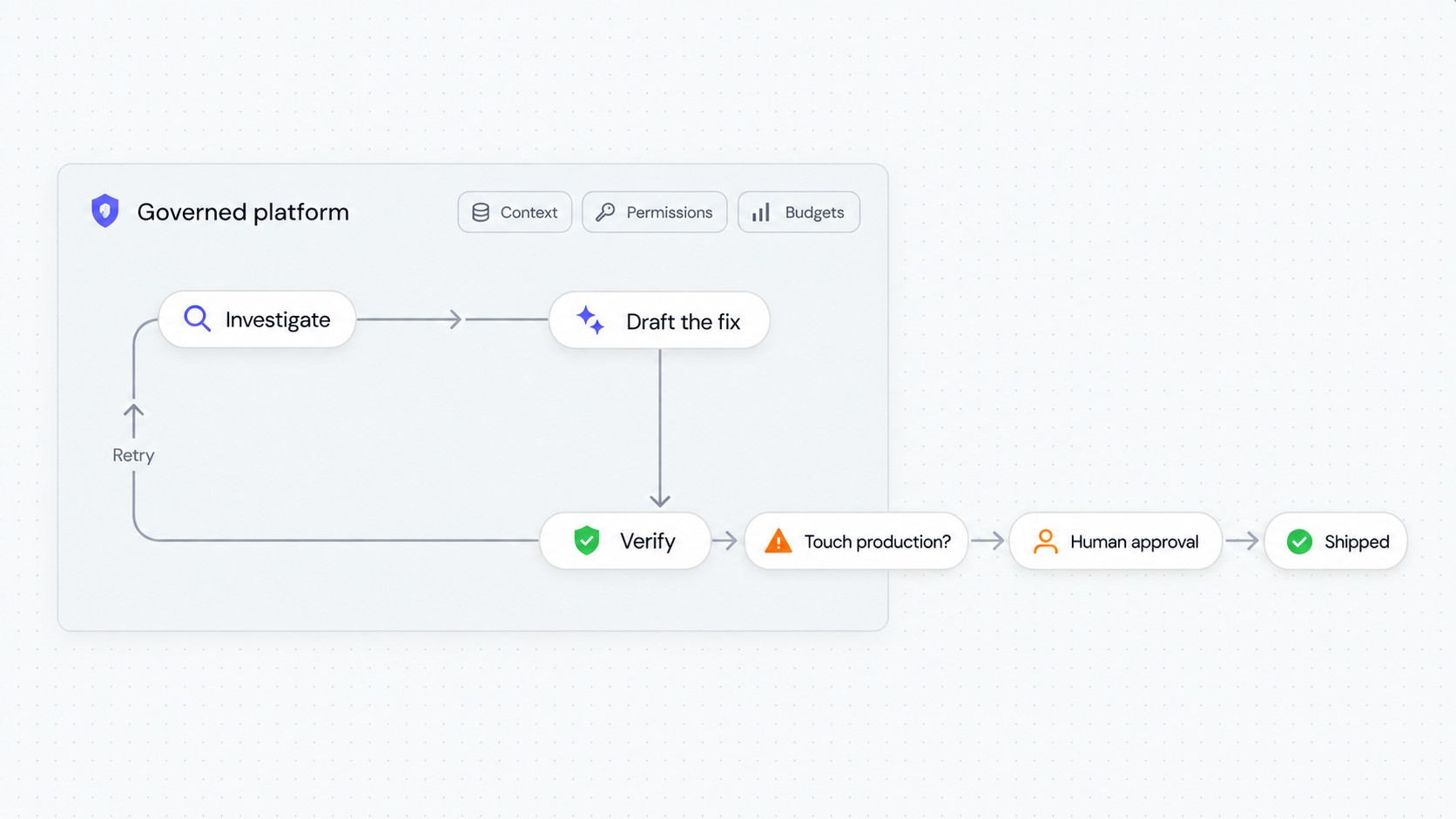
Inside that road, the agent can investigate, draft, and retry. Touching production lowers the barrier and brings in a person.
What breaks when the loop scales without platform oversight
For my first Port demo on LinkedIn's rooftop, I invented a company that prints conference T-shirts through an API. It started in Austin, then added facilities in Berlin and Osaka, where an M means three different things because apparently international sizing is where standards go to die.
We shipped a release that normalized the sizes and forgot to publish the documentation. Our documentation agent was a human named Aaron, and Aaron was on vacation. For nine days, customers opened tickets asking why their templates broke and why 2,000 conference shirts had arrived in the wrong size. The code had passed its local checks. The company still had customers to rescue.
At organizational scale, the same gap appears in less photogenic forms. Agents reconstruct ownership from stale files, teams encode conflicting definitions of "done," credentials spread through scripts, and token spend climbs while verification queues become the new constraint. Eliyahu Goldratt spent an entire novel, The Goal, explaining that making one station faster does not make the factory faster. We added an LLM and earned the privilege of learning it again.
The Ship stage hides the failure the atomic loop cannot see. Incidents, support tickets, SLO breaches, and rejected changes need a path back to the work queue, while repeated outcomes should change the skills, policies, gates, or workflows that produced them. Without those paths, the factory learns nothing.
What platform teams must own
Shared context and ownership
Agents need the current relationship between services, teams, environments, deployments, incidents, dependencies, and customers. Platform teams connect the systems that hold those facts and define the organizational model once, because otherwise every run becomes a multi-API research project billed in tokens and decorated with opinions.
Standards, budgets, and stop conditions
Platform teams define "production-ready" with checks an agent can run: security rules, operational requirements, quality bars, retry limits, and token budgets. They also name the point where a person must approve the risk, because business intent and accountability do not emerge from another trip around the loop.
Governed execution paths
The same production action should follow the same logic and permissions whether a developer clicks a form, a catalog event fires, a schedule wakes up, or an agent calls a tool. Developer workflow automation needs that audit trail plus one shared definition, so a team-specific script that happens to work this week does not qualify.
Measurement and factory improvement
Platform teams have to connect agent activity to delivery outcomes, so run count and token use sit beside change failure rate, incident recovery, documentation lead time, and human intervention. Port's guide to measuring agentic impact and ROI makes the distinction explicit: execution speed and end-to-end delivery speed are separate measurements. When SDLC automation produces more work at the bottleneck, the queue grows and the customer waits just as long for the same result.
Useful evidence from each run should change the next one. A rejected pull request can sharpen an evaluation, while human corrections belong in the relevant skill and incidents may expose missing gates. The platform team decides which evidence becomes shared capability. Save everything and you build a very expensive junk drawer.
Building the platform foundation the loop requires
In the T-shirt demo, I connected releases, services, print facilities, documentation pages, customer tiers, and ownership in Port. When the missing release appeared, a Workflow calculated the blast radius, drafted the docs and changelog, briefed support, and stopped for a person to approve the pull request. Later I asked the release-desk agent to issue customer credits. It refused because that workflow belonged to Customer Success, even after the room helped me try some prompt hacking.
Good agent.
That demo changed software, operated the result, and used the outcome to decide what happened next. Once I drew the whole system and put production back inside the picture, it looked like this:
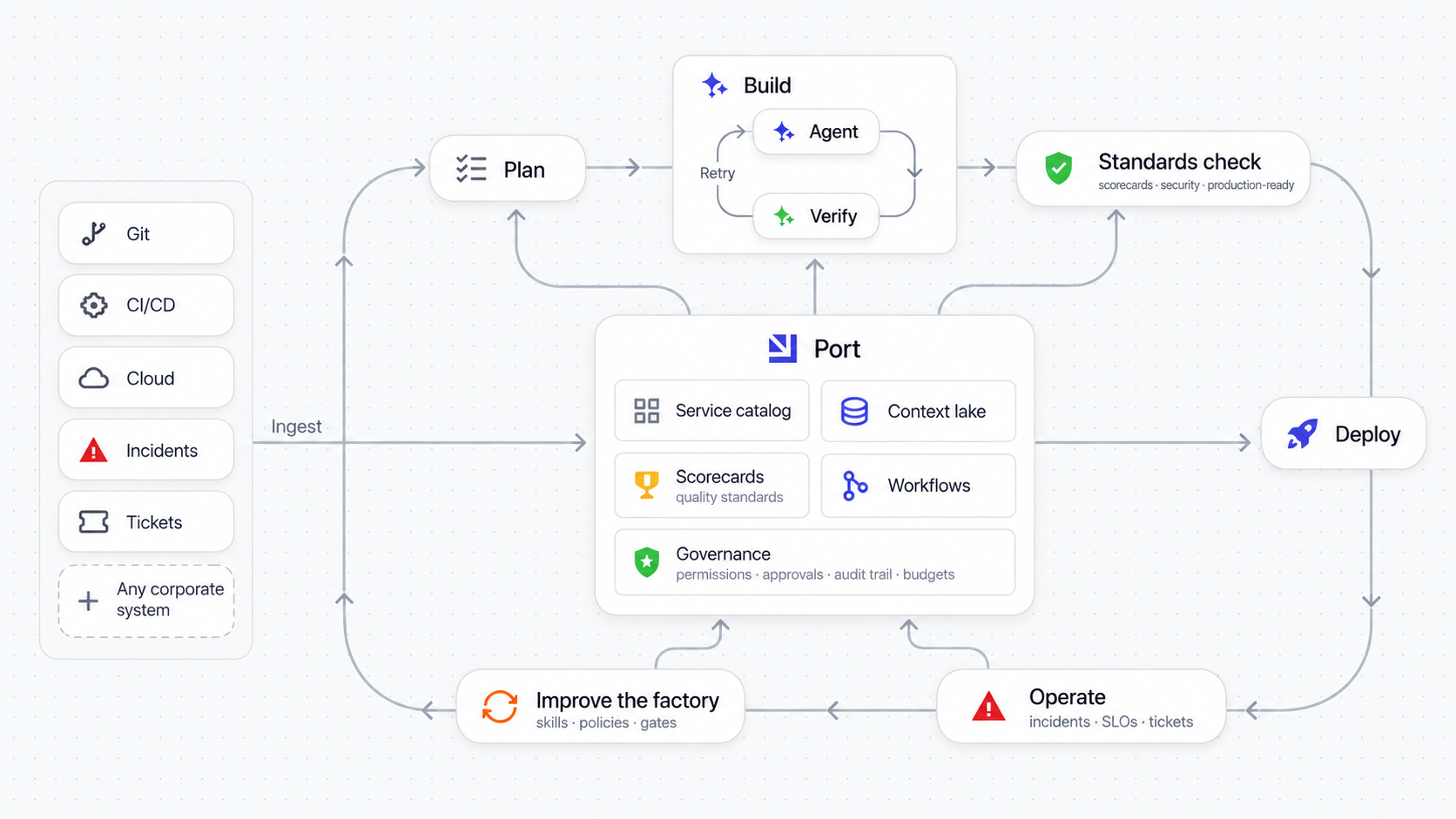
Port is the Agentic SDLC Platform around that customer-owned lifecycle. Its Context Lake ingests data from GitHub, Kubernetes, PagerDuty, Jira, and other tools into a customer-defined model. Blueprints describe concepts such as services and incidents, and integrations populate them with entities connected by relations. Scorecards continuously evaluate those entities against the organization's standards.
The graph knows only what its source data and organizational model contain. An integration that stopped syncing yesterday may point to an old owner, a bad mapping can connect an incident to the wrong deployment, and an agent cannot traverse a relationship nobody modeled. The graph may return the same wrong answer every time.
Congratulations, your error is reproducible.
A reproducible error is easier to find and fix, but it is still an error. People must own business intent, risk thresholds, novel exceptions, and accountability. Policies and approval gates constrain the reasoning that remains; they do not make production safe by declaration.
Port Workflows run the action layer. A human request, catalog event, agent tool call, or schedule can enter the same Workflow, which applies the same nodes, permissions, and audit record. That shared path matters more than the prompt because it keeps one team's agent from quietly inventing a second production process.
Then production closes the outer loop. Deployment results, incidents, human corrections, quality signals, and token cost can open work or change the factory's skills, policies, gates, and evaluation criteria. The platform team owns that feedback system across the organization; individual teams still own the software and the domain judgment inside it.
In the T-shirt demo, the next missing documentation page should open a ticket that feeds back into the documentation skill or release gate before Aaron takes his next vacation. That is the system I want platform teams to build.
FAQ
What does a coding-agent loop mean in software development?
It is a repeatable system that gives an agent a goal, lets it act, checks the output against a measurable bar, and retries or stops. A useful loop also defines its context, tools, budget, and halt conditions, so iteration produces evidence without becoming an impressively expensive infinite retry.
Why does platform engineering own it at organizational scale?
Repository tuning belongs with the team that owns the code. The coordination work crosses those boundaries: ownership, permissions, production standards, audit records, and cost controls all need one shared platform. Agents move faster than human developers, which makes reusable execution paths and central governance more important.
What breaks without platform oversight?
Context drifts, teams encode different quality bars, credentials spread, verification queues grow, and token cost stops correlating with delivery. The silent failure is repetition: production incidents never update the backlog or the rules, so agents keep generating changes through a factory that cannot learn from its own outcomes.
How do platform teams govern loops across engineering?
They connect engineering systems, model services and ownership, encode standards as checks, expose approved Workflows, scope permissions, record actions, and measure production outcomes. They also set budgets and human approval points. The common context and controls make autonomy reviewable without moving software ownership away from the teams.
How much of the factory-improvement loop should eventually improve itself? I do not know. Anyone claiming that boundary is settled probably has not left the system alone with production (or the token invoice) long enough.
PortCon, the Agentic SDLC Summit, takes place November 17-18, 2026, in San Francisco. Bring the architecture, failure story, or stubborn organizational constraint your agents found after the demo ended; those are the conversations platform teams need before autonomous loops become ordinary infrastructure.
Now that you've seen something cool, go build something cool.


Get your survey template today
%201.svg)


Download your survey template today


Free Roadmap planner for Platform Engineering teams
Set Clear Goals for Your Portal
Define Features and Milestones
Stay Aligned and Keep Moving Forward
Create your Roadmap


Free RFP template for Internal Developer Portal
Creating an RFP for an internal developer portal doesn’t have to be complex. Our template gives you a streamlined path to start strong and ensure you’re covering all the key details.
Get the RFP template


Leverage AI to generate optimized JQ commands
test them in real-time, and refine your approach instantly. This powerful tool lets you experiment, troubleshoot, and fine-tune your queries—taking your development workflow to the next level.
Explore now
Check out Port's pre-populated demo and see what it's all about.
No email required
LIVE WEBINAR, Aug 18, 2026:
Context-aware Vibe Coding for Platform Engineering
Move fast while staying in control
Build governed agentic workflows on one central platform.
See it in action:
Watch this video on generating Terraform with Port, or explore our public demo.
.png)
Check out the 2025 State of Internal Developer Portals report
No email required
Minimize engineering chaos. Port serves as one central platform for all your needs.
Act on every part of your SDLC in Port.
Your team needs the right info at the right time. With Port's software catalog, they'll have it.
Learn more about Port's agentic engineering platform
Read the launch blog
Contact sales for a technical walkthrough of Port
Every team is different. Port lets you design a developer experience that truly fits your org.
As your org grows, so does complexity. Port scales your catalog, orchestration, and workflows seamlessly.
Port × n8n Boost AI Workflows with Context, Guardrails, and Control
Port Builders Session: A Single, Governed Interface for All MCP Servers
Book a demo right now to check out Port's developer portal yourself
Apply to join the Beta for Port's new Backstage plugin


n8n + Port templates you can use today
walkthrough of ready-to-use workflows you can clone
From manual to autonomous engineering
One platform to build, govern, and operate the Agentic SDLC.
Port is open for you to try it
build your first agentic workflow today