Devin.ai: Software engineer vs. Full platform
Devin is Cognition’s autonomous software engineer. Here’s how it works, what it does well, and how it compares with Port, an agentic SDLC platform.



Devin can take a Jira ticket, write the fix, and open a pull request with no one at the keyboard. The harder question shows up when hundreds of tickets start landing across dozens of teams, and each one needs to know who owns the service, what depends on it, and whether it’s safe to touch right now.
This piece compares Devin with Port on that question. Devin is strong at getting one engineering task done autonomously. Port is the layer underneath many agents, Devin included, providing every team the same context, applies governance, and drives insights across the SDLC.
What Devin does well
Devin runs in a sandboxed environment with its own shell, editor, and browser. Teams can trigger Devin agent from within Slack, Microsoft Teams, Jira, or Linear, and it returns a pull request. On the enterprise side, Devin offers SSO, custom roles with role-based access control, IdP group integration, and audit logs. Devin Review and DeepWiki add code review and repository documentation. For a team that wants one capable autonomous engineer working through its backlog, that’s a real product with real enterprise controls.
The questions that appear at scale
Once Devin moves from one small team to the whole engineering organization, a different set of questions starts to matter:
- How does every agent know who owns a service and what depends on it?
- What stops an agent from changing a service during an open incident?
- When security updates a policy, how does every agent follow it?
- How do you keep a human in the loop for risky changes without creating a queue?
- How do you stop three teams from building the same skill three different ways?
Devin’s controls cover access. They define who can start sessions, which integrations exist, and what administrators can change. They don’t cover the questions above, which depend on who owns a service, what it depends on, and what is happening to it right now.
Where the context lives
Devin’s knowledge of a codebase comes from the repositories it works in, along with Devin Wiki and DeepWiki. That works well inside one repo.
Ownership, dependencies, and incident history sit somewhere else. They live in the service catalog, PagerDuty, Datadog, and Snyk. Across hundreds of repos, many teams write that knowledge into markdown files, one repo at a time, and keep those files current by hand.
Port’s Context Lake takes the other route. It models services, owners, dependencies, deployments, and incidents, and fills itself from the tools that already hold that data. Every agent reads from the same model, so a change in one place shows up everywhere.
Policies that read live data
Take a policy like “no agent changes a service with an open incident.” Enforcing it takes a check that reads live incident data at the moment the agent tries to act.
Port’s governance layer works that way. It scopes what each agent can see, restricts what it can trigger, and records what it did. Port’s policies run as conditions checked against live data at each step, so the latest incident or service state decides the outcome, not a line in a prompt.
Approvals also follow the same logic. A small UI fix that passes every policy moves ahead without waiting. A change to a payment service goes to the owner of that service. The routing depends on ownership and data sensitivity, not on whoever kicked off the work.
Dispersed teams, agents, and standards
Devin Enterprise supports multiple organizations under one enterprise admin, which helps with separation between business units. Standards that apply across every team still need a home, though. A company-wide rule, like approved models or required reviews, has to reach every team’s flow without someone updating each one by hand.
Port’s platform team sets company wide policies once, and every team’s flow inherits them. Teams add their own rules for their services, but they can’t override what the platform set.
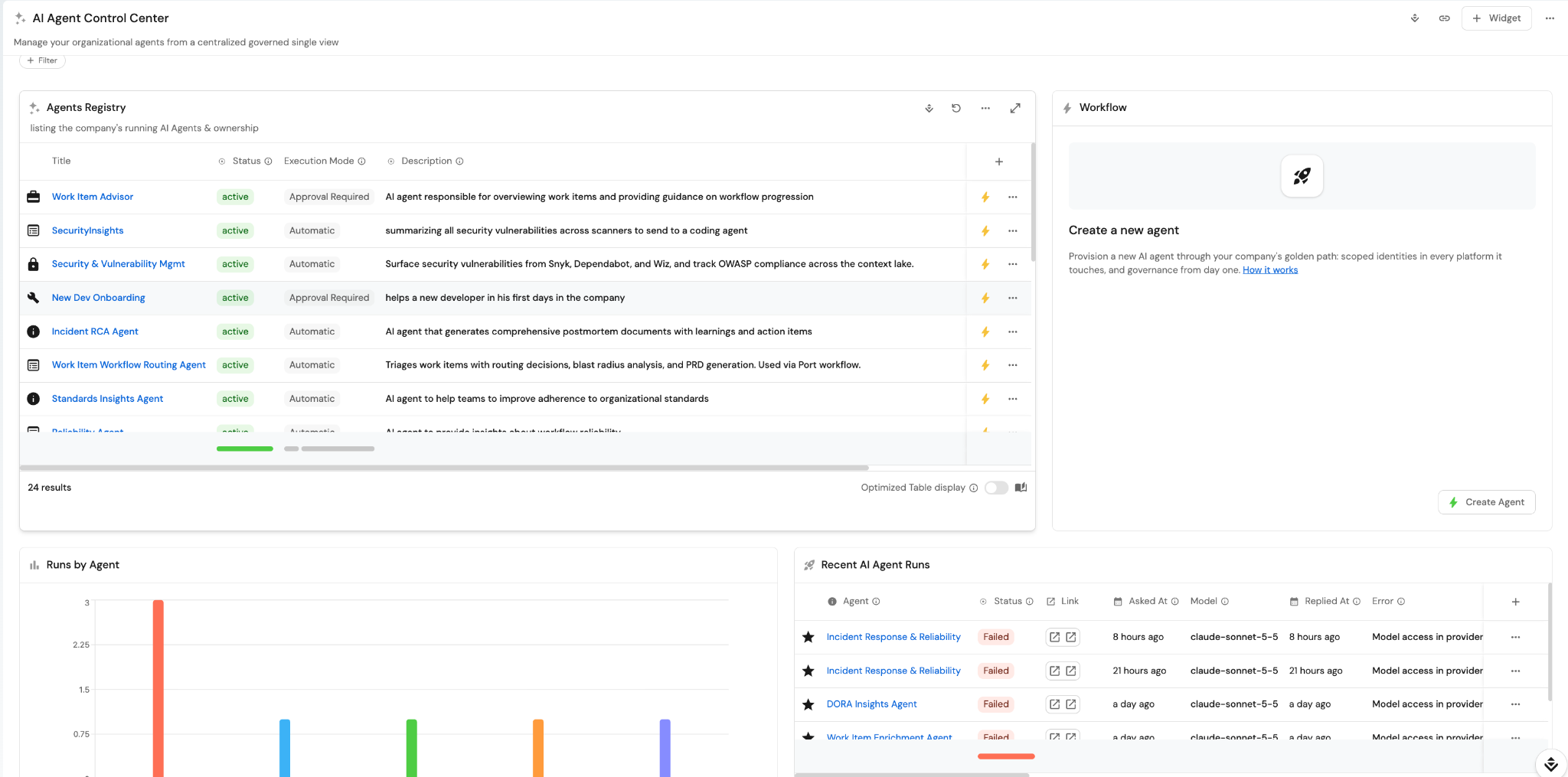
Most large organizations also run agents from more than one vendor. Port’s agent registry is built to find and govern those agents in one place, with owners, production readiness checks, and audit trails attached.
Devin vs Port
Devin does the build step well. An agentic SDLC platform also needs context, rules, and approvals that apply across every agent part of that platform, and below we show where the two differ.
Devin is ahead on writing and testing code, and on the range of work intake it covers. Those are key benefits, and a team that mostly needs faster code should weigh them first. Devin also tests its changes in its own environment, with recorded browser runs and screenshots. Those tests cover what Devin can see, so a passing test does not show that services outside the repository are safe. Devin doesn’t offer a service catalog or policy checks that run against live data.
If you switch agents, the catalog stays with you, since any agent can read it through MCP or the API. Model choice is a separate question: Devin CLI lets you pick among several providers’ models, and the catalog stays the same whichever one runs.
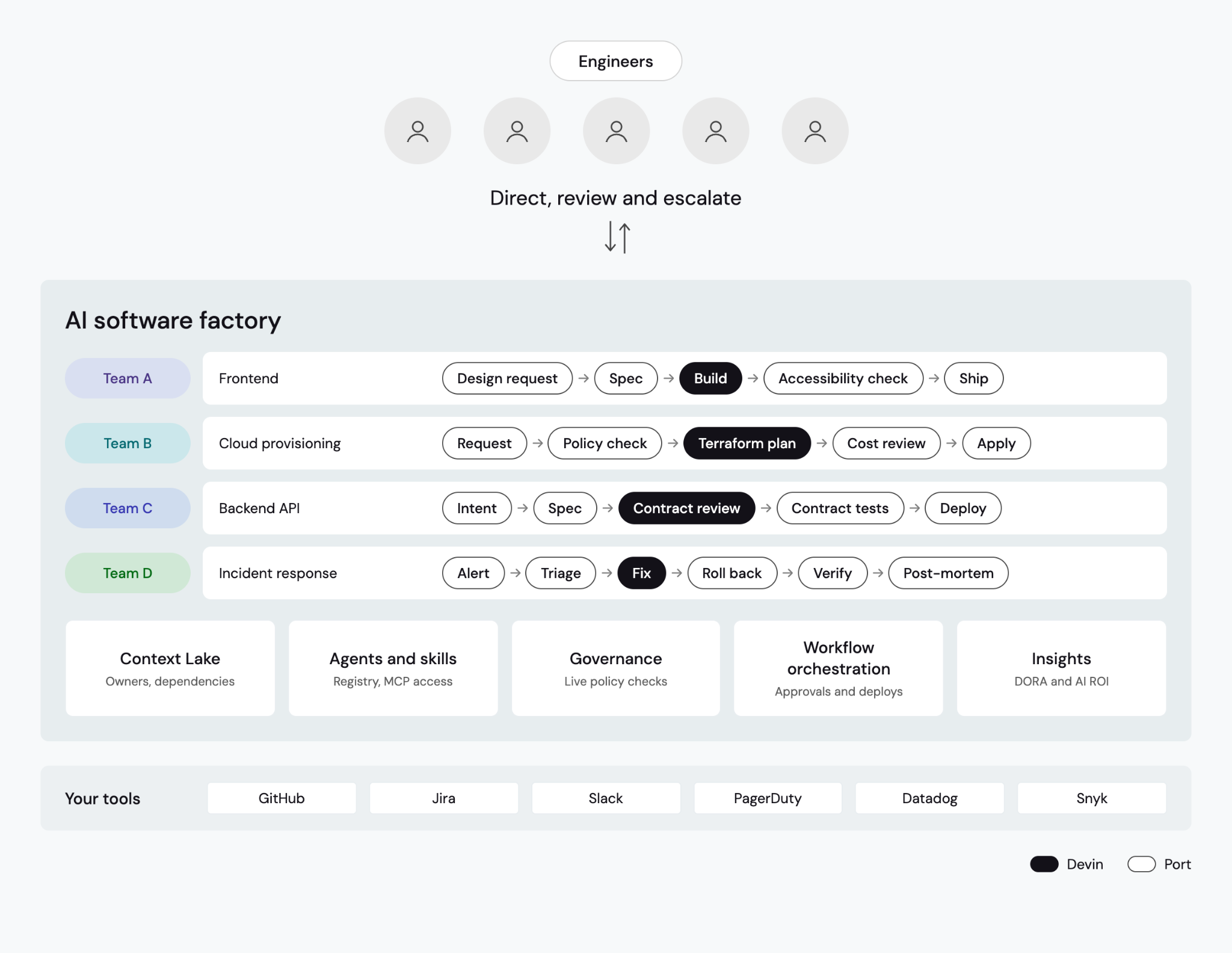
In the context of a software factory or a fully agentic SDLC: Devin is like a highly capable worker assigned to a specific task but would need the foundation of an entire manufacturing line, and the platform underneath it is the control plane that tells every station what the change touches.
Which one to pick
For a team that wants a strong autonomous engineer on a defined backlog, Devin is a good fit. It does the work and returns the result.
For an organization that needs many teams and many agents to share one picture of services, policies, and approvals, the platform question comes first. Most enterprises will need both: an engineer that does the work, and a layer that keeps every agent working from the same context, governance rules, and can also drive insights to optimize.
Start free at app.port.io, or book a demo to see it running against your own services and the coding agent you already use.
FAQ
What does Devin do?
Devin is Cognition’s autonomous software engineer. It takes a task from Slack, GitHub, Jira, or Linear, writes the change, runs the tests, and opens a pull request.
What is an AI software factory?
An AI software factory or agentic SDLC platform is a connected, repeatable system where agents do the engineering work. Port supplies the shared context, the workflows, and the governance the agents run within.
Is Devin an AI software factory?
No. Devin is one agent. The factory is the system Devin works inside.
Can Devin and Port be used together?
Yes, in both directions. Port exposes its catalog over MCP and API, so any MCP-capable agent can read it. Devin can read Port’s catalog and actions through MCP. A Port workflow can also start a Devin session through Devin’s API, so a rule in Port decides when Devin runs.
What are the alternatives to Devin?
For coding agents, teams commonly evaluate Claude Code, Cursor, GitHub Copilot, Replit Agent, and Rovo Dev. For the platform layer beneath them, teams evaluate Port, Backstage, Cortex, and OpsLevel.
When should you choose Devin?
Choose Devin when your work runs through GitHub and your ticketing tools, your team needs an agent that writes and tests code now, and your catalog and gating needs are still small.
Download the RFP guide


Get your survey template today


Download your survey template today


Free Roadmap planner for Platform Engineering teams
Set Clear Goals for Your Portal
Define Features and Milestones
Stay Aligned and Keep Moving Forward
Create your Roadmap


Free RFP template for Internal Developer Portal
Creating an RFP for an internal developer portal doesn’t have to be complex. Our template gives you a streamlined path to start strong and ensure you’re covering all the key details.
Get the RFP template


Leverage AI to generate optimized JQ commands
test them in real-time, and refine your approach instantly. This powerful tool lets you experiment, troubleshoot, and fine-tune your queries—taking your development workflow to the next level.
Explore now
Check out Port's pre-populated demo and see what it's all about.
No email required
LIVE WEBINAR, Aug 18, 2026:
Context-aware Vibe Coding for Platform Engineering
Thursday, October 22 12:00pm EDT⋅6:00pm CET
To learn more about the new capability and to see a live demo, join our upcoming community session with GitHub
Move fast while staying in control
Build governed agentic workflows on one central platform.
See it in action:
Watch this video on generating Terraform with Port, or explore our public demo.

Check out the 2025 State of Internal Developer Portals report
No email required
Minimize engineering chaos. Port serves as one central platform for all your needs.
Act on every part of your SDLC in Port.
Your team needs the right info at the right time. With Port's software catalog, they'll have it.
Learn more about Port's agentic engineering platform
Read the launch blog
Contact sales for a technical walkthrough of Port
Every team is different. Port lets you design a developer experience that truly fits your org.
As your org grows, so does complexity. Port scales your catalog, orchestration, and workflows seamlessly.
Port × n8n Boost AI Workflows with Context, Guardrails, and Control
Port Builders Session: A Single, Governed Interface for All MCP Servers
Book a demo right now to check out Port's developer portal yourself
Apply to join the Beta for Port's new Backstage plugin


n8n + Port templates you can use today
walkthrough of ready-to-use workflows you can clone
From manual to autonomous engineering
One platform to build, govern, and operate the Agentic SDLC.
Port is open for you to try it
build your first agentic workflow today