Product release notes - August 2026
August brings Port Workflows to General Availability (GA) as the governed orchestration layer for agents, automations, and approvals, alongside new Cursor Cloud Agent syncing and triggering directly from workflows and a wave of workflow, integration, and governance improvements rounds out the month.


Big
Port Workflows are now generally available
.png)
Port Workflows, the governed orchestration layer for agents, automations, and approvals, are now generally available.
Chain agents, automations, business rules, and human approvals into a single governed flow on shared data. Describe a use case to Port AI in plan mode or start from the visual, low-code builder—trigger the flow via a self-service form or automatically on catalog changes, and trigger GitHub Actions, GitLab, Jenkins, ArgoCD, or your preferred tooling as workflow steps.
Additional links:
Sync and Trigger Cursor Cloud Agents from Workflows
Port syncs Cursor cloud agents and runs into your Context Lake, and workflows can now create or trigger them directly.
See every managed Cursor cloud agent and run them alongside the rest of your software catalog. Specific integration action nodes were added to spin up a new Cursor agent or send a follow-up prompt to an existing one straight from a Port workflow, with optional completion tracking so the run waits until the agent finishes.
.png)
Additional links:
Medium
Track Claude and Cursor Skills Adoption and Usage
See which Claude and Cursor Skills are actually being adopted, reused, and worth scaling across your organization.
Track invocations, usage depth, active days, and sharing scope to spot Skills that are consistently reused across teams, then promote the proven ones into the Port Skill Registry.
%20(1).png)
Additional links:
Surface Missing Setup Steps Live in AI Chat
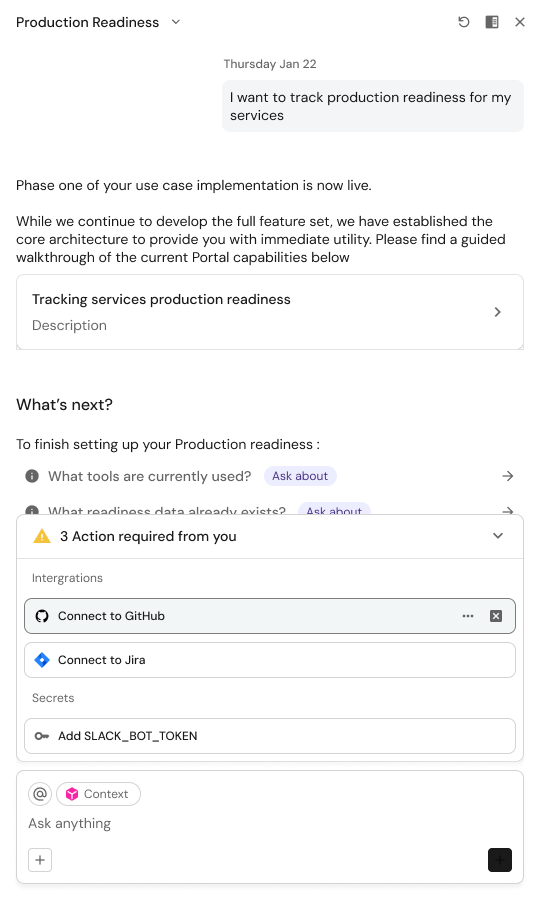
Port AI chat now shows a live checklist of the integrations and secrets you still need to connect to make what you built work.
As you build with Port AI, a checklist computed from the conversation tracks any missing integrations or secrets—click an item to connect it right from the chat.
Ingest Agent Skills and Plugins from GitHub and GitLab
GitHub Ocean and GitLab v2 integrations now have dedicated skill and plugin resource kinds so you can easily discover and catalog Agent Skills and plugin packages directly from your repos.
Add a kind: skill and/or kind: plugin resource to your integration mapping and it will discover SKILL.md files under common layouts like .claude/skills/** and .cursor/skills/**, while the plugin detects provider manifests for Claude, Cursor, Codex, and more.
Additional links:
Trigger Azure DevOps Pipelines from Workflows
Trigger and track Azure DevOps pipeline runs directly from a Port workflow, no custom webhooks required.
Add the Azure DevOps action node in Workflow Builder, set the Project and Pipeline ID, and optionally pass a branch, template parameters, or variables—Port queues the run, links straight to it in Azure DevOps, and updates the workflow status automatically as it completes.
Approve and Fill Workflow Inputs from Slack
Responders can now approve or fill out workflow input forms straight from a Slack DM instead of opening Port.
Add a Slack notification target to an Input node and each responder gets a DM that will complement the input node: A simple button-only forms submit on click, Detailed forms opened inside a Slack modal, or Slack link back to the full form in Port.
.png)
Scope Workflow Permissions to MCP Agent Invocations
Workflow permission policies can now target a dedicated MCP source, letting you control execution by AI agents separately from UI and API callers.
Add a policy rule on the source context using the new MCP value. For example, allow humans via the UI and agents via MCP while blocking direct API calls, or exclude MCP entirely from a sensitive workflow. This lets you restrict which workflows AI agents can trigger, such as blocking MCP execution on workflows with sensitive input nodes or destructive actions, while still allowing human and API access as usual. It gives teams granular control to adopt agentic workflows safely, without an all-or-nothing trust decision about what AI agents can execute.
Manage Workflows as Code with the Port Terraform Provider
Define and manage Port workflows in Terraform so changes go through the same review process as the rest of your config.
Define a port_workflow resource with its node and connections blocks, then run terraform plan and terraform apply as usual—no more managing workflows outside your review and promotion pipeline.
Additional links:
Browse Blueprints in the New Context Lake Catalog
Context Lake now includes a Catalog view for browsing blueprints, and new blueprints no longer automatically create an Interface catalog page.
Open Catalog in Context Lake to browse a blueprint's entities table and connect data sources, automations, and discovery. Creating a new blueprint no longer adds a catalog table under Interface by default, but you can still opt in via the API or add a page manually.
.png)
Merge Array Properties from Multiple Sources
Array properties can now merge values from multiple integrations, API callers, or manual edits without overwriting each other.
Enable multi sources ingestion on a string or number array property so each writer owns its own slice—for example, merge vulnerabilities reported by Snyk and Dependabot into one deduplicated list, plus manual edits from the UI.
.png)
Small
Track Both Identities for Impersonated Workflow Runs
Workflow runs triggered during a "view as" session now record both the admin and the impersonated user.
In the Runs table, the "Who triggered" column now shows "X as Y" for runs started while impersonating another user, and node run details show both "Triggered by" and "Viewed as" for the same attribution at the node level.
Skip Notifications for Approvals and Workflow Inputs
Approval steps for self-service actions and workflow Input nodes can now skip sending a notification entirely.
Set approvalNotification to type none on a self-service action, or an empty notifications array on a workflow Input node, to keep the approval step while skipping the notification.
Deep-Link Directly to Key Modals via URL
You can now open modals like Credentials or MCP servers directly by adding ?openModal=X to your organization's URL.
Append ?openModal=X to your organization home URL—for example, ?openModal=credentials opens the Credentials modal, or ?openModal=mcpServers opens the MCP servers modal.
Upload Custom Organization Logos Directly in Port
Organizations can now upload and manage their own logo directly in Port instead of hosting it externally.
Go to Settings → Logo, then upload, drag, or paste a PNG, JPEG, or SVG file up to 5 MB. Delete it anytime to fall back to Port's default logo.
.png)
Sync Multiple GitHub Organizations from a Single Integration
GitHub Ocean App authentication now auto-discovers and syncs every organization where the App is installed, all from one integration.
Transfer your GitHub App to the enterprise level, install it in each organization you want to sync, and leave github_organization unset—Port automatically discovers and syncs every org where the App is installed.
Manage Folders API
Create, update, and delete sidebar folders programmatically now that the Folders API is generally available.
Use the Create, Update, and Delete Folder API routes to manage nested sidebar folders as part of your onboarding scripts or infrastructure-as-code setup.
.png)
New Filtering and Sorting Options in Mapping
A batch of UX updates adds new filters and sorting to Mapping, plus smaller polish to sync status and the Ask AI button.
Filter Mapping by blueprint or by kind, for a cleaner, more focused view.
.png)
Navigate Governance with a New Categorized Layout
The Governance section now has a categorized layout with direct links to the Audit Log and Usage Dashboard pages.
Find governance tools faster with a clearer layout, organized into categories with quick links to the pages you use most.
.png)
Automatically Suspend Integrations After Repeated Sync Failures
Port now automatically pauses scheduled resyncs for integrations that keep failing, alerting admins before resources are wasted.
When an integration fails 3 or more times within a 7-day window, Port suspends its scheduled resyncs and notifies admins to investigate. Admins can trigger a manual resync anytime, and a successful sync automatically reactivates the schedule.
Protect Live Events from Data Loss During Crashes
Live Events now durably queue every webhook so a pod crash or restart can no longer drop events.
Every webhook is now durably written to Redis Streams through a dedicated ingestion service before processing, and any stuck or failed messages are automatically retried. Hosted integrations get this automatically; on-prem integrations can enable it by deploying the ocean-gateway service with a durable Redis instance.
Additional links:
Diagnose and Recover from Mass Entity Deletions
Get an actionable recovery flow when a resync deletes more than half your catalog entities instead of just a warning.
Open the mass-deletion callout on the integration's sync status tab and Port suggests the right recovery action based on the likely cause—run a full resync, roll back to the last mapping snapshot, reapply the current mapping, or open Port AI to diagnose and fix it.
.png)
Simplify Your UI: Hide Classic Actions and Automations
Ready to go all-in on Workflows? Admins can now give their org a clean, focused experience by hiding legacy actions and automations across the entire UI.
Turn on the toggle in Settings → Actions and Automations to remove classic actions and automations from the self-service hub, entity menus, search, dashboards, the builder, and the audit log. Existing actions and automations keep running via their triggers, the API, and Terraform, and the change is fully reversible.
New Guides
Manage Developer Environments
Governed workflows to create, extend, and tear down developer environments via GitHub Actions, with automatic TTL-based expiry.
https://docs.port.io/guides/all/manage-developer-environments
Provision Azure Resources With Ado MCP
A Port workflow that reads Terraform modules from Azure DevOps via MCP and has Claude Code open a convention-following PR.
https://docs.port.io/guides/all/provision-azure-resources-with-ado-mcp
Visualize Claude Skills Adoption
Dashboards showing how Claude Skills are adopted and reused org-wide, and where skill-related spend is concentrated.
https://docs.port.io/guides/all/visualize-claude-skills-adoption


Get your survey template today
%201.svg)


Download your survey template today


Free Roadmap planner for Platform Engineering teams
Set Clear Goals for Your Portal
Define Features and Milestones
Stay Aligned and Keep Moving Forward
Create your Roadmap


Free RFP template for Internal Developer Portal
Creating an RFP for an internal developer portal doesn’t have to be complex. Our template gives you a streamlined path to start strong and ensure you’re covering all the key details.
Get the RFP template


Leverage AI to generate optimized JQ commands
test them in real-time, and refine your approach instantly. This powerful tool lets you experiment, troubleshoot, and fine-tune your queries—taking your development workflow to the next level.
Explore now
Check out Port's pre-populated demo and see what it's all about.
No email required
LIVE WEBINAR, Aug 18, 2026:
Context-aware Vibe Coding for Platform Engineering
Thursday, October 22 12:00am EDT⋅6:00pm CET
To learn more about the new capability and to see a live demo, join our upcoming community session with GitHub
Move fast while staying in control
Build governed agentic workflows on one central platform.
See it in action:
Watch this video on generating Terraform with Port, or explore our public demo.
.png)
Check out the 2025 State of Internal Developer Portals report
No email required
Minimize engineering chaos. Port serves as one central platform for all your needs.
Act on every part of your SDLC in Port.
Your team needs the right info at the right time. With Port's software catalog, they'll have it.
Learn more about Port's agentic engineering platform
Read the launch blog
Contact sales for a technical walkthrough of Port
Every team is different. Port lets you design a developer experience that truly fits your org.
As your org grows, so does complexity. Port scales your catalog, orchestration, and workflows seamlessly.
Port × n8n Boost AI Workflows with Context, Guardrails, and Control
Port Builders Session: A Single, Governed Interface for All MCP Servers
Book a demo right now to check out Port's developer portal yourself
Apply to join the Beta for Port's new Backstage plugin


n8n + Port templates you can use today
walkthrough of ready-to-use workflows you can clone
From manual to autonomous engineering
One platform to build, govern, and operate the Agentic SDLC.
Port is open for you to try it
build your first agentic workflow today

.png)