Enforcing engineering standards with AI agents
An agent can patch hundreds of repos in an afternoon. Whether that helps or makes a mess comes down to five things you set up first.


.png)
You defined the standard months ago. Every service needs a CODEOWNERS file. Every repo needs an AGENTS.md so coding agents work from the same rules. Every production service needs an SLO, and every changelog needs to actually track changes. You wrote it up in a scorecard, announced it in the platform channel, and watched almost nothing happen. It stays the same.
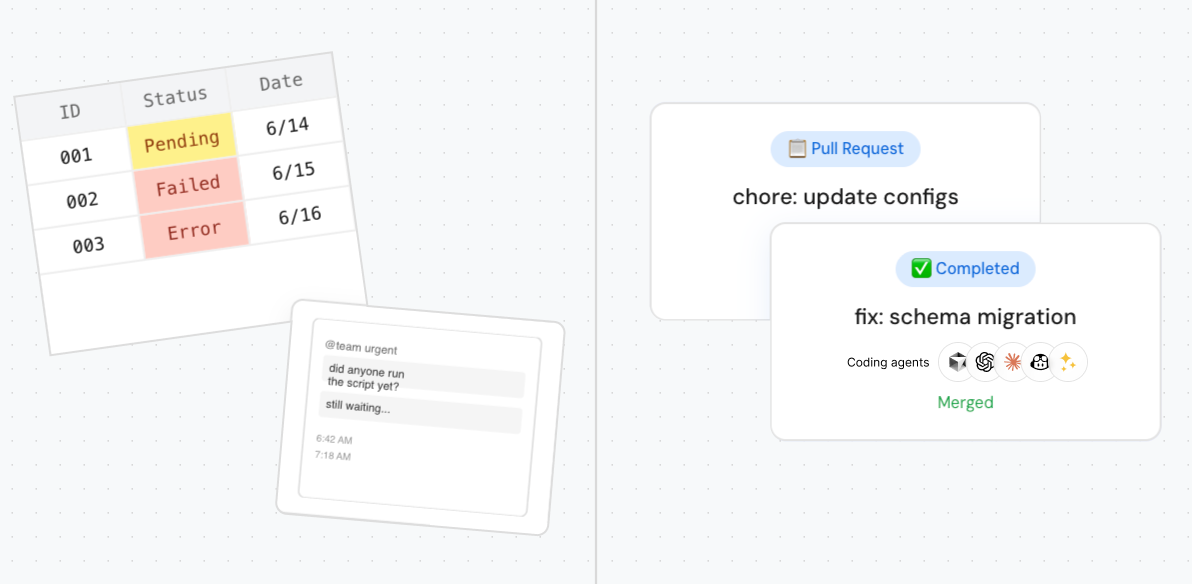
So you started chasing teams and getting these tasks prioritized. A spreadsheet with 200 rows, one per service, or a dashboard listing failing scorecards per service. A Slack nudge to each team lead. A follow-up when the nudge got ignored. 2 months later, coverage has crept from 55% to 62%. Stragglers persist. Platform engineering in 2026 isn't only about building the golden path - it exists, the templates work. The job is adoption: getting hundreds of services and dozens of teams to adhere to your standards.. Governance, not tooling, is the bottleneck. Everyone agrees on standards, but almost no one has a way to enforce them across the org that doesn't come down to nagging.
A new way to enforce engineering standards at scale
With agentic SDLC - a new model is taking shape. Now you can point an AI agent at the same scorecard. It reads the standard, finds the services that fail it, writes a fix for each one, and opens a pull request routed to the team that owns the service - where a developer will approve the update. Platform engineers can now review the exceptions instead of the whole list, and the initiative moves in days.
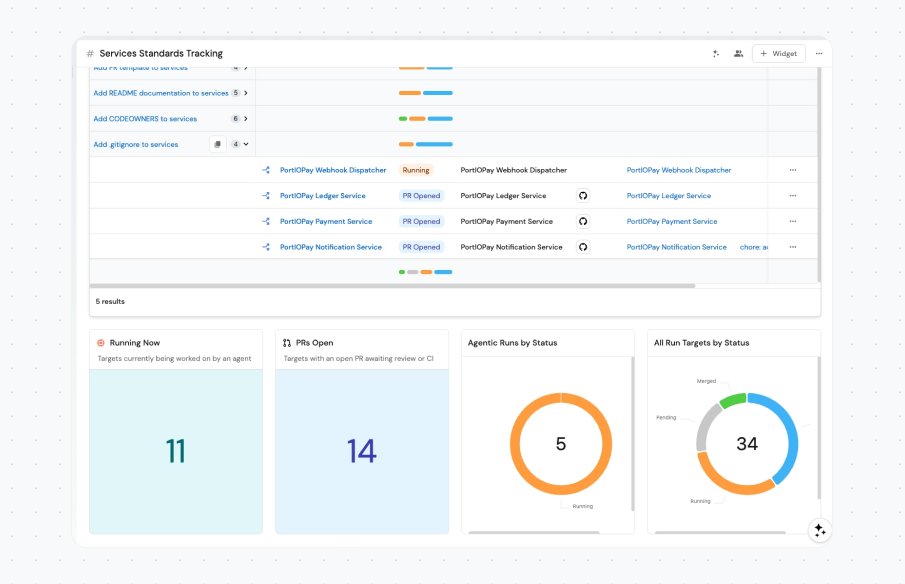
That's an agentic initiative: an agent proposes and routes the fixes, and you govern the rollout instead of executing every step on your own. This isn't "replace the platform team with AI." It's "let agents handle the linear grunt work so the platform team can spend its time on judgment."
Teams pulling this off are running better initiatives that actually get completed, faster. This is because the agent does the part that never scaled: touching every single repo. But without the right safeguards, the same reach becomes a liability. An agent let loose on 200+ repositories without the right foundation breaks things faster than any human could. Five key practices separate the teams scaling this from the teams quietly switching the agents back off.
5 keys to scaling scorecards enforcement with AI agents:
1. Agents run on the context you've already built
An agent enforcing a standard needs to know three things: which services fail the standard, what each service is made of, and who owns it. You already hold all three. The scorecard defines the standard and tracks which services pass it. The catalog holds the metadata (language, framework, tier, dependencies) per service. The ownership data indicates which team gets the pull request.
Skip any one of these and the agent guesses, leading to costly mistakes - at scale. Point it at "add a CODEOWNERS file to every repo" without scorecard state, and it opens pull requests against the 80 services that already have one. Give it no service metadata, and it writes a Go-shaped fix for your Python services. Give it no ownership data, and 200 correct fixes land as 200 pull requests on one platform engineer, or on the wrong teams, where they sit and rot. Context isn't the thing that makes the agent smarter. It's the input that makes the agent correct.
This is why the catalog and your scorecards matter now more than ever. They stopped being dashboards you look at. They became the context an agent acts on, which includes your deterministic guardrails defined as governance rules and standards that constrain what the agent is allowed to do.
.png)
2. Know why the agent did what it did
An agent that opens 200 pull requests with no explanation earns 200 rejections, not because the changes are wrong but because no reviewer merges a diff they can't reason about.
This is what changes when you run initiatives through one central platform instead of a pile of scripts and spreadsheets. Every fix carries its own paper trail: this service failed this scorecard check, here's the rule, here's the fix, here's why this version. A team lead who sees the agent flagged their service for a missing SLO that the platform standard requires merges it. One who sees an unexplained diff closes it and moves on. A single source of truth with the full context for what's failing and why gives reviewers the reasoning they need to trust the change, and it's how you debug the agent on runs where it got things wrong.
3. Humans stay in the loop
Agents are good at "apply this rule to every service that matches." They're bad at "know when the rule shouldn't apply." That gap is exactly where developers stay involved.
Take an SLO coverage initiative across 350 services. The agent proposes definitions for all of them, 340 are routine and the owning teams merge them, and 10 aren't: a legacy service headed for deprecation, a batch job where latency SLOs make no sense, a customer-specific deployment with its own contract. Those ten need a human who understands the business context. You review the ten and skip the 340. Designed right, the human checkpoint isn't the bottleneck. It's what stops the initiative from shipping confident, wrong changes.
Customers that get this right built the human checkpoint wherever it fits their workflows (before the initiative starts, on each PR, or before production), gated on service priority, so critical changes wait for sign-off while the rest merge through the team's normal review.
4. Every run teaches the next one
No agentic initiative lands on all services the first time. What matters is what the second pass costs you.
Run a CODEOWNERS rollout across 200 repos. 170 pass and merge. The other 30 fail, mostly shared services where the agent couldn’t find the right owning team. The Agentic SDLC Platform provides dashboards that show you which passed, which failed, and why. You read the board, pick the failures worth another pass, fix the rule for the agent, and send it back to fix only those. The 170 that already passed stay untouched. Do it any other way and every re-run starts from zero: all 200 repos again, the same 30 failures, the same manual cleanup, every time. That's the difference between running an agent once and running it as a system.
.png)
As teams mature, they add a second agent that triggers on failed runs. It looks at why the fix failed, proposes a correction, and opens a follow-up PR for the owning team to approve. The initiative starts closing its own gaps instead of waiting for you to re-run it by hand.
5. Ownership is how it scales
A coding agent can write 500 fixes, and that was never the bottleneck. Review is. One platform engineer can't approve 500 pull requests, but 500 owners can each approve the one that touches their service in minutes. Scaling the writing is easy; scaling the review is the whole game, and it only works when every change routes to the team that owns it.
This is where ownership data and access control stop being a security checkbox and start distributing the work. The agent knows the payments team owns the payments service, so that team gets the pull request and the authority to approve, edit, or reject it. You set the standard, the agent enforces it, and the owning team decides on their own service. Run a dependency bump across 500 repositories the old way and every pull request routes back to the platform admin. Distribute it, and 500 owners review in parallel while the platform engineer handles the exceptions. The same initiative finishes in days instead of a quarter, and what determines the speed of execution stops being the size of your platform team and becomes the scope of the work.
{{from_manual_to_autonomous_engineering}}
The system, not the tool
None of this is a new tool you have to go buy, and it isn't a separate campaign tracker bolted on top of your stack. You’re already running all the building blocks to do this: The scorecards that define your standards, the catalog that holds your service context, the ownership data that routes work to teams. What's new is pointing agents at that shared context and letting them do the part of governance that never scaled, while you keep the part of human judgment - that shouldn't be automated.
Platform engineering isn't going hands-off. It's going from "I execute every initiative" to "I design the system that runs them." The teams treating their catalog and scorecards as the foundation agents act on, not just a place to look things up, are the ones who'll spend 2026 governing the golden path instead of chasing it.
Get started today!


Get your survey template today
%201.svg)


Download your survey template today


Free Roadmap planner for Platform Engineering teams
Set Clear Goals for Your Portal
Define Features and Milestones
Stay Aligned and Keep Moving Forward
Create your Roadmap


Free RFP template for Internal Developer Portal
Creating an RFP for an internal developer portal doesn’t have to be complex. Our template gives you a streamlined path to start strong and ensure you’re covering all the key details.
Get the RFP template


Leverage AI to generate optimized JQ commands
test them in real-time, and refine your approach instantly. This powerful tool lets you experiment, troubleshoot, and fine-tune your queries—taking your development workflow to the next level.
Explore now
Check out Port's pre-populated demo and see what it's all about.
No email required
LIVE WEBINAR, Aug 18, 2026:
Context-aware Vibe Coding for Platform Engineering
Thursday, October 22 12:00pm EDT⋅6:00pm CET
To learn more about the new capability and to see a live demo, join our upcoming community session with GitHub
Move fast while staying in control
Build governed agentic workflows on one central platform.
See it in action:
Watch this video on generating Terraform with Port, or explore our public demo.
.png)
Check out the 2025 State of Internal Developer Portals report
No email required
Minimize engineering chaos. Port serves as one central platform for all your needs.
Act on every part of your SDLC in Port.
Your team needs the right info at the right time. With Port's software catalog, they'll have it.
Learn more about Port's agentic engineering platform
Read the launch blog
Contact sales for a technical walkthrough of Port
Every team is different. Port lets you design a developer experience that truly fits your org.
As your org grows, so does complexity. Port scales your catalog, orchestration, and workflows seamlessly.
Port × n8n Boost AI Workflows with Context, Guardrails, and Control
Port Builders Session: A Single, Governed Interface for All MCP Servers
Book a demo right now to check out Port's developer portal yourself
Apply to join the Beta for Port's new Backstage plugin


n8n + Port templates you can use today
walkthrough of ready-to-use workflows you can clone
From manual to autonomous engineering
One platform to build, govern, and operate the Agentic SDLC.
Port is open for you to try it
build your first agentic workflow today