Software Factory Architecture
Learn the five layers of software factory architecture and how context, orchestration, execution, governance, and observability enable scale.

Key Takeaways
- A software factory treats software delivery as a managed, repeatable production system, not a series of one-off projects.
- Software factory architecture differs from software architecture (structuring one application) and platform engineering (building developer tooling) - it's the connective layer tying intake, tooling, and quality gates into one system.
- AI coding agents changed the architecture: agents now need the context, guardrails, and audit trail a human engineer used to supply through judgment alone.
- A modern software factory architecture is typically built from five layers: context, orchestration, execution, governance, and observability.
- The right design scales with org size - small teams need lightweight structure; large or regulated organizations need centralized governance across many teams and agents.
What Is Software Factory Architecture?
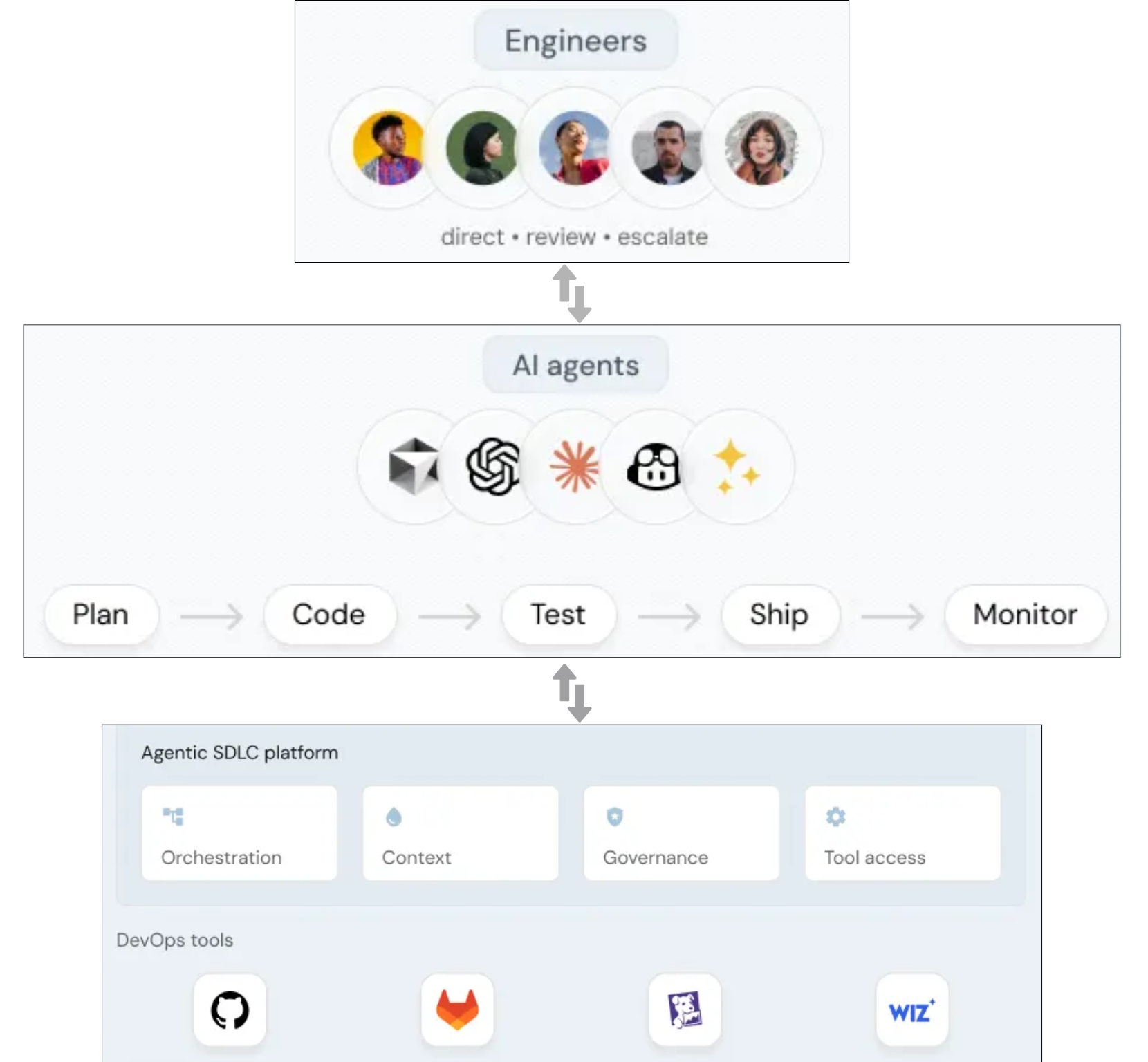
We like to think of a software factory the way you’d think of a well-run production line, or even as a car assembly line. Every change comes in the same way, goes through the same steps, and leaves behind numbers you can actually look at. A lot of teams still don’t work like this. A feature reaches production however its team figures out, and the next one might take a completely different route. Software factory architecture is the technical setup underneath that model. So a software factory architecture consists of a set of layers, systems, and connections that decide how work (software, in our case) gets into the pipeline, which tools pick it up, what checks it has to clear, and how you measure what came out the other end. the same architecture pattern is applied to building and shipping software in a systematic manner.
Well, it is easy to mix this up with software architecture, so let’s clear that up properly - Software architecture is about how one application is built on the inside: its components, the system design, its APIs, the way data moves around but a Software factory architecture looks at the bigger picture, it’s concerned with how software gets created/built and shipped across different stages of the SDLC & human teams for approvals, whatever those individual systems look like internally.
Platform engineering is the other term people tend to bring up, and honestly, there might be some overlap here - Platform engineering teams build the internal developer platform that engineers open every day for the ease of their daily activities. We’d still treat the two as separate ideas, though, because a platform is something you build, while a software factory is the whole way your organization delivers software.
Even though the concept of software factories is still evolving, it is believed that, in a software factory architecture, platform engineering takes care of the execution layer. Around it, the factory brings in orchestration, context, governance, and feedback loops, which are the parts that tie everything together. A strong platform on its own gives engineers good tools & adding those pieces is how it becomes a delivery system that both your engineers and your AI agents can rely on.
How Software Factory Architecture Has Changed in the AI Era
Before AI coding agents, a CI/CD pipeline automated the mechanical parts of delivery - build, test, deploy - while planning, coding, and review stayed manual. Throughput was capped by the number of engineers available to write code, and much of what made that code correct was never written down. Ownership, dependencies, and "the way we do things here" lived in the heads of people who had been around long enough to know.
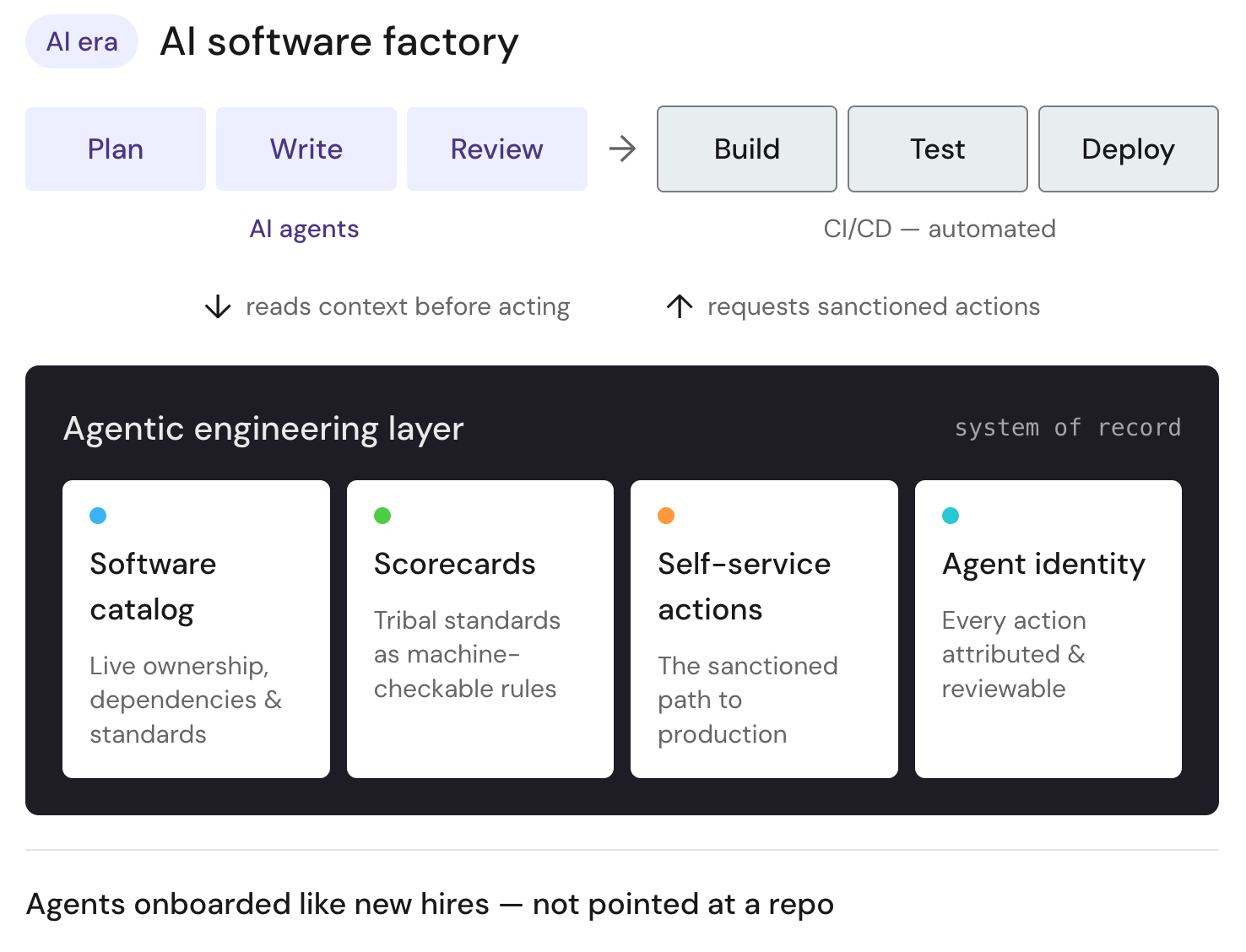
An AI software factory changes that assumption - Agents can plan, write, and review code, but only if the architecture gives them what a human engineer used to infer from experience: a live picture of service ownership, dependencies, and standards, plus explicit limits on what they can do unsupervised. Skip that, and the result isn't faster delivery - it's agentic chaos, where gaps in documentation and ownership get amplified rather than fixed.
The practical effect is that the center of gravity moves from the pipeline to the layer beneath it. A software catalog becomes the system of record agents read before they act. Scorecards turn tribal standards into checks a machine can evaluate. Self-service actions become the sanctioned path for anything that touches production, so an agent requests a deployment instead of improvising one. And every action carries an identity, which makes agent work reviewable rather than mysterious. That's why agentic engineering is treated as its own discipline: onboarding an AI agent into the SDLC with the same rigor as onboarding a new hire, not just pointing a model at a repository.
The Core Layers of a Modern Software Factory Architecture
It is important to know that a software factory is only as strong as the structure beneath it. Rather than a single platform or toolchain, a software factory is a set of interlocking layers, each responsible for a distinct part of how software gets built, shipped, and improved. Together, they give engineers and AI agents a shared foundation: a common source of truth, connected workflows, consistent guardrails, and feedback that closes the loop. Understanding these five layers is the first step toward designing a factory that scales without sacrificing speed, safety, or quality.
Context and Catalog Layer
We often describe this layer as the memory of the factory, because it keeps a live record of every service you run, who owns it, what it depends on, and the standards your organization has agreed to follow. Think of it as the place that answers the questions that usually end up buried in a Slack thread: who looks after the payments service, which version of the auth library we’re supposed to use, and what “production-ready” actually means for us. Engineers check it, AI agents check it, and nobody has to rely on the one person who’s been around long enough to remember how everything fits together.
In our view, almost everything else in the factory leans on this layer, so when it falls out of date, the problems quietly spread to every other part of the system. Work gets routed to the wrong team, guardrails check against old standards, and metrics roll up under the wrong owners. It matters even more once agents are involved. A new engineer can ask a colleague when something looks off, but an agent will usually act on whatever information it has, so the quality of that information shapes the quality of its work. Pulling updates automatically from your repos, cloud accounts, and incident tools keeps the catalog from turning into yet another stale wiki page that nobody trusts.
Orchestration Layer
Orchestration covers the workflows that carry a piece of work from the moment someone asks for it to the moment it’s live in production. That includes triaging requests, running CI/CD, provisioning infrastructure, deploying, and rolling back when something goes wrong. In our experience talking to engineering teams, most organizations already have every one of these steps in place somewhere, but they live in separate tools that don’t talk to each other, and people end up acting as the glue, copying ticket numbers and chasing approvals from one system to the next.
This layer connects those steps into one flow, so a change moves from stage to stage on its own and you can see exactly where it is at any point. Every change follows a known path, which makes delivery predictable and problems far easier to trace when something breaks. It also gives AI agents a reliable, well-defined set of workflows to plug into, which turns out to be one of the biggest factors in whether they’re actually useful.
Execution Layer
This is the layer where the actual building happens, and it’s the one most engineers picture first when they think about how software gets made. Engineers write code, review each other’s pull requests, and fix what breaks. Alongside them, AI agents take on scoped tasks, like implementing a small feature, updating a dependency across dozens of repos, or picking up a ticket and seeing it through to a merged change. The internal developer platform usually lives here too, giving everyone the environments, templates, and tooling they need to get going without waiting on another team.
The idea we’d push hardest in this layer is treating humans and agents as equals in how their work gets handled. An agent’s pull request should go through the same tests, reviews, and deployment path as anyone else’s. Giving agents a shortcut is risky, and putting them through a separate, heavier process usually means their work sits in a queue waiting for someone to look at it.
Governance and Guardrails Layer
Guardrails are the rules every change has to follow, no matter who or what made it. They cover approvals, access controls, security and compliance scanning, and blast-radius limits, which cap how much damage a single change can do if it turns out to be wrong. In a good setup, most of these checks run automatically in the background, and a person only gets pulled in when a decision genuinely needs human judgment.
Good guardrails let you ship quickly without holding your breath on every release. One bad config change can take down a service, and an overconfident agent can make the same mistake much faster and across far more repos than any single engineer could. Clear policies keep those mistakes small and catch them before they reach production. They also make it easier to give agents more freedom, because you know exactly what they can and can’t touch.
Observability and Metrics Layer
The final layer is all about measuring how well the whole factory is running, so you’re making decisions based on what’s actually happening instead of what people assume is happening. Most teams start with the four DORA metrics: deployment frequency, lead time for changes, change failure rate, and time to recover from failures. On top of those, you’ll want a clear view of agent-authored work, such as how often their changes get merged, how often they’re rolled back, and how much review time they take up from your engineers.
Without this layer, almost every conversation about improving delivery ends up coming down to gut feeling and whoever argues the loudest in the meeting. The numbers show you where work actually slows down, whether a process change helped, and whether agents are saving your team time or just shifting the effort into code review.
How to Design a Software Factory Architecture for Your Organization
If you are hoping for a single blueprint that works for every company, I’ll be upfront and say there isn’t one. The right software factory architecture depends on where your organization is today, how many teams and services you’re dealing with, and how much risk you can afford, and it should keep evolving as your company grows.
Starting small
When you are a smaller team, you can usually get surprisingly far with a lightweight catalog, a handful of shared pipelines, and a few simple guardrails for agents, such as requiring a human to approve every agent-authored change before it merges. At this stage, I’d put all your energy into getting everyone to work in a consistent way, because building a heavy governance model this early mostly creates chaos and delays that nobody has time to maintain. Start with the services you actually deploy, the owners you can name without having to ask around, and one golden path that’s good enough for other teams to copy. The catalog can do most of this as a starting point - The service name, owner, repo, slack channel, and other critical dependencies of the service.
Scaling across teams
After starting small and seeing the visible engineering efficiency, the next sensible step is to scale the working informal software factory pipeline setup to more teams or across all the teams. One thing to notice, things change once the company starts adding more teams and services, because the informal setup that worked fine at ten services begins to crack under the weight of fifty or a hundred. In my experience, this is usually the point where dedicated platform engineering tools start to make real sense. You need a proper context layer in place of the spreadsheets people have been quietly maintaining on the side, golden paths that are written down and agreed on, better to also include a DORA metrics score for each service and self-service provisioning so that every new request doesn’t end up stuck in the platform team’s queue.
Like I said, scorecards also become far more important at this stage than they were when you were small. Back then, everyone shared the same unspoken idea of what a good service looked like, mostly because the same few people built all of them. Once more teams are involved, those standards need to be written down clearly and measured regularly, otherwise every team slowly drifts toward its own definition of “production-ready.”
Large and regulated organizations
As of now, we talked about the regular companies, so what about the large or regulated organizations?
For large or regulated organizations, the priorities shift toward centralized governance and full auditability, often across hundreds of services and many agents working at the same time. Consistency and control matter most at this level, and I think that’s completely fair, because the cost of a single ungoverned mistake grows with every system that mistake can reach.
This is also where capabilities like agentic work management become genuinely useful, routing each ticket to the right human or agent, as long as your context and guardrails are already strong enough to support that safely. Agents should get their own identities and scoped permissions, so every action can be traced back to whoever or whatever started it. When an auditor or an incident review asks who changed something and why, you want to be able to answer that in a few minutes instead of spending days digging through logs.
Getting the order right
Whatever your company size is, the one lesson I’d stress most is that the order you build things in matters far more than the tools you choose. Start with the catalog, define your standards next, all the dependencies, tools connected and only then add automation on top. Else, it might create agentic chaos on top of tools chaos and might get overwhelming at times. When teams flip the order and automate first, they usually end up automating their inconsistencies, which simply means the same mess now spreads faster and to more places.
No matter how big or small your organization is, the design question stays the same. You need to know which layers exist today, who or what is allowed to act at each one, and how every one of those actions gets recorded. If you can answer those three questions clearly, you’re already in a much stronger position than most teams that are just getting started.
FAQ
What is software factory architecture?
It's the layered technical structure - context, orchestration, execution, governance, and observability - that lets an organization produce software as a repeatable, measurable process instead of a series of one-off projects, with both engineers and AI agents doing the work inside it.
What are the core layers of a software factory architecture?
Most implementations include a context and catalog layer, an orchestration layer connecting intake to delivery, an execution layer for humans and AI agents, a governance layer enforcing policy and security, and an observability layer measuring delivery performance to inform future planning cycles.
How does software factory architecture differ between small and large organizations?
Small organizations can run with a lightweight catalog and a few shared pipelines, adding structure as they grow. Large organizations need centralized governance, auditability, and consistent standards across many teams and agents, since the impact of an unguarded mistake scales with system count.
How does the platform team fit into software factory architecture?
The platform team typically owns the context, orchestration, and governance layers - building the internal developer platform, defining golden paths, and setting the guardrails that let developers and AI agents work independently while staying compliant with organizational standards and security policy.


Get your survey template today


Download your survey template today


Free Roadmap planner for Platform Engineering teams
Set Clear Goals for Your Portal
Define Features and Milestones
Stay Aligned and Keep Moving Forward
Create your Roadmap


Free RFP template for Internal Developer Portal
Creating an RFP for an internal developer portal doesn’t have to be complex. Our template gives you a streamlined path to start strong and ensure you’re covering all the key details.
Get the RFP template


Leverage AI to generate optimized JQ commands
test them in real-time, and refine your approach instantly. This powerful tool lets you experiment, troubleshoot, and fine-tune your queries—taking your development workflow to the next level.
Explore now
Check out Port's pre-populated demo and see what it's all about.
No email required
LIVE WEBINAR, Aug 18, 2026:
Context-aware Vibe Coding for Platform Engineering
Thursday, October 22 12:00pm EDT⋅6:00pm CET
To learn more about the new capability and to see a live demo, join our upcoming community session with GitHub
Move fast while staying in control
Build governed agentic workflows on one central platform.
See it in action:
Watch this video on generating Terraform with Port, or explore our public demo.

Check out the 2025 State of Internal Developer Portals report
No email required
Minimize engineering chaos. Port serves as one central platform for all your needs.
Act on every part of your SDLC in Port.
Your team needs the right info at the right time. With Port's software catalog, they'll have it.
Learn more about Port's agentic engineering platform
Read the launch blog
Contact sales for a technical walkthrough of Port
Every team is different. Port lets you design a developer experience that truly fits your org.
As your org grows, so does complexity. Port scales your catalog, orchestration, and workflows seamlessly.
Port × n8n Boost AI Workflows with Context, Guardrails, and Control
Port Builders Session: A Single, Governed Interface for All MCP Servers
Book a demo right now to check out Port's developer portal yourself
Apply to join the Beta for Port's new Backstage plugin


n8n + Port templates you can use today
walkthrough of ready-to-use workflows you can clone
From manual to autonomous engineering
One platform to build, govern, and operate the Agentic SDLC.
Port is open for you to try it
build your first agentic workflow today