What Does DX Do? Key Features, Use Cases, and Alternatives
What DX does: its engineering intelligence features, survey-based metrics, common use cases, where it stops, and the alternatives


Tl;DR: DX is an engineering intelligence tool, founded by the co-author of the DevEx framework, and advised by the researchers behind DORA and SPACE. The DX platform measures developer productivity, developer experience, and AI’s impact on the codebase. It is a tool for one job – reading how engineering is doing – and it does that well. But without being able to take action, it only gets you half way.
Acting on it – resolving what the metrics surface and running governed agents across the lifecycle – is the job of an Agentic SDLC Platform like Port, which produces those metrics itself and wires them to the services, standards, and agents that act on them. This guide covers what DX does well, where its reads stop, and what can take those metrics further.
What is DX?
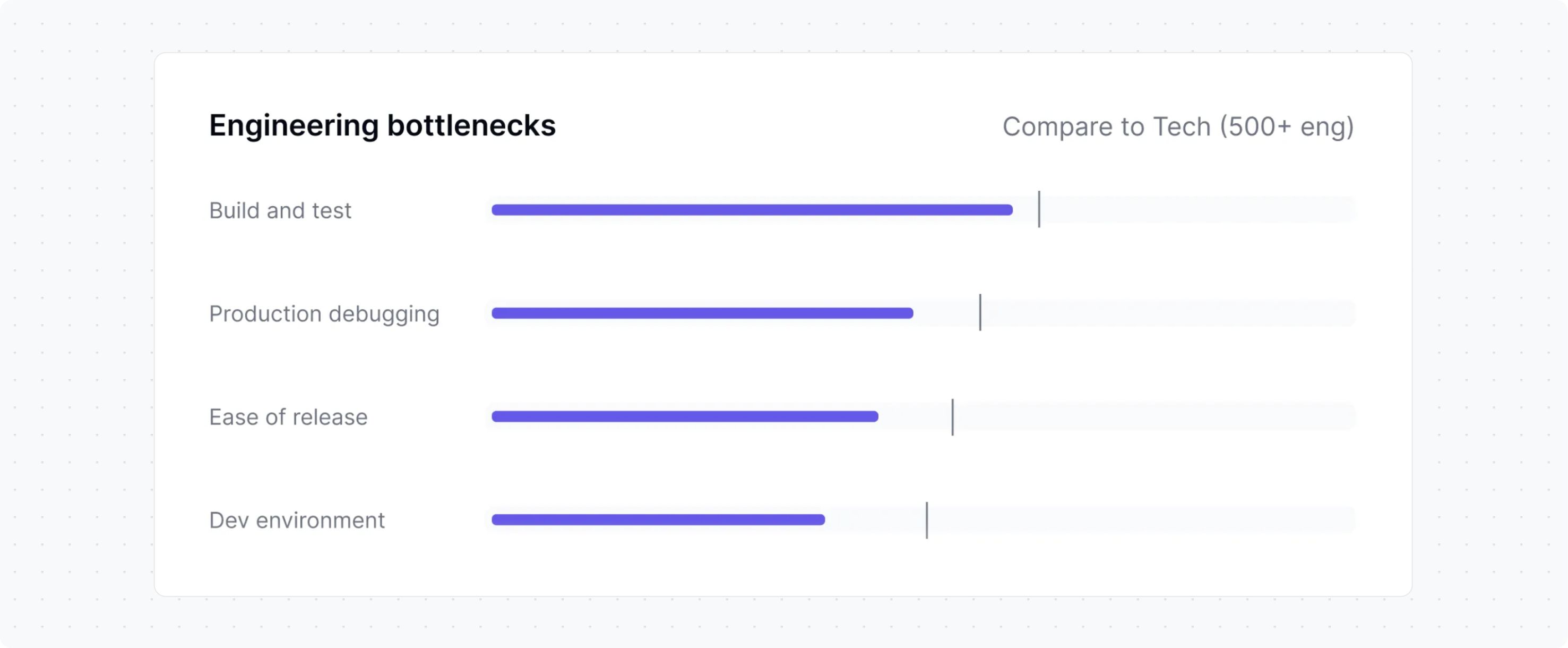
DX measures engineering health through its engineering intelligence platform. It was founded in 2021 and advised by the researchers behind DORA, SPACE, and DevEx. DX pairs self-reported developer surveys with system data from Git and Jira, and it’s now part of Atlassian. More than 600 companies run it, including Dropbox, Block, Pfizer, and Uber.
The product comes in two suites. DevEx Cloud captures how developers feel about their work, anchored on the Developer Experience Index (DXI). DX Data Cloud pulls delivery data from Git and Jira to track performance and allocation, anchored on DX Core 4, a framework that folds DORA, SPACE, and DevEx into four measures. DX AI answers questions about the data in plain language, and in 2026 DX added Fabric, a context layer with a systems catalog, context management, and agent-ops tooling.
DX is a research-backed pulse check on how engineering is doing. It holds a 4.6-out-of-5 average across roughly 280 G2 reviews and was named a Leader in Gartner’s first Magic Quadrant for Developer Productivity Insight Platforms. Engineers praise the depth of the metrics and the research behind them; the recurring gripes are survey fatigue, org-chart upkeep, and numbers that drift when people move between teams.
.png)
What problem does DX solve?
DX solves a problem every engineering leader feels: you can’t manage what you can’t see. Delivery health, developer friction, and now AI’s real effect on the codebase are mostly invisible without instrumentation, and DX gives leaders a trustworthy, research-grade insight on all three.
Three moments capture what most teams feel today, before a tool like this:
- Delivery feels slower, and it’s mostly anecdotal. Leaders sense that shipping has gotten harder, but the evidence is scattered across Git, tickets, and hallway conversations, so planning runs on opinion rather than numbers.
- Developer friction is real and unquantified. Engineers lose hours to slow builds, flaky environments, and constant context-switching, but there’s no dependable read on what that costs or whether last quarter’s fixes moved anything, so investment in developer experience goes to whoever argues the loudest.
- AI is reshaping the workflow, and its impact is a guess. Assistants and agents write more of the code every month, yet no one can say whether that’s speeding delivery or just adding review load, “is our AI investment paying off?” gets answered on instinct.
How does DX solve it?
DX turns scattered signals into a dependable read. It pulls system data from Git and Jira, layers in surveys, applies frameworks, and rolls the result up so leaders can drill from the whole org down to a single team. Delivery stops being anecdotes, developer friction gets a number, and AI’s footprint in the codebase turns visible instead of assumed. The output is a baseline you can take to the board.
Port (Agentic SDLC Platform) vs DX
An insight you can’t act on only gets you halfway, and that halfway point is where DX stops. Agentic SDLC Platforms like Port go the whole way, because engineering intelligence and the actions that resolve what it surfaces run on the same live catalog of services, owners, and dependencies. A metric that turns red arrives attached to the owning service, the standard it’s failing, and the workflow or agent that can fix it. Seeing the problem and resolving it are one motion, on one platform.
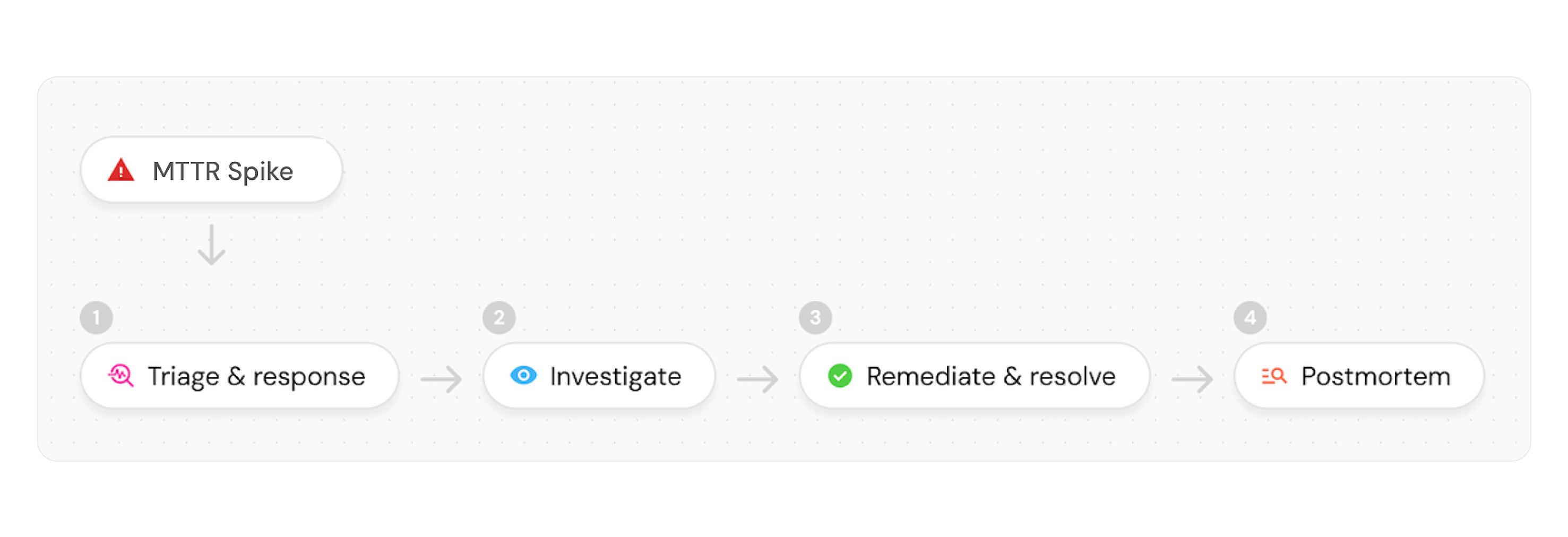
The difference is architectural. DX’s data model is arranged to report and benchmark, organized around teams, repos, and roadmap categories, and its catalog and agent-ops layer (Fabric) sits on top of that reporting engine. Port is built the other way around: the catalog is a live operating record that is both the context agents read and the control plane they act through, and the metrics are computed off that same catalog. That’s why DX can tell you a service is failing a standard but can’t block the deploy, and why Port can measure the same thing and then acton it.
That gap used to be tolerable. In the agentic era it isn’t, because a dashboard that shows the problem is only useful if something can act on it in the same place – and agents especially need somewhere to act, with metrics, real context, and guardrails. Measuring how much AI code you ship tells you the volume; Port also hands an agent the ownership, dependencies, and standards it has to work against to fix the root cause of a problematic metric, then measures whether it did.
How to choose, and where to start
Choose on what you need the tool to do. If the whole job is measuring engineering health and comparing against other companies, DX is a reasonable choice. If you need connected metrics you can act on – tied to services and owners, enforced by standards, resolved by agents and workflows – that’s an Agentic SDLC Platform like Port. Teams already run Port as their Agentic SDLC Platform that takes you from engineering insight to agentic action to measurable impact.
dLocal shows both halves on one platform. The NASDAQ-listed payments company handles more than 500 million transactions a month at 99.99% uptime, with 400 engineers across 60 teams. It built an internal agent, dCoder, on Port’s Agentic SDLC Platform, with the Context Lake as the single source of truth across services, ownership, infrastructure, and policies. dCoder pulls the services, owners, and team patterns it needs straight from that catalog. Today dCoder takes 45% of engineering tickets from ticket to review pull requests end to end. CTO Alberto Almeida saw a 20% increase in developer productivity and a 50% reduction in lead time. They measured the baseline, ran the agent on top of the context layer, and measured the lift afterward – all on Port, not on a measurement tool.
The fastest way to see it on your own stack is to start free: measure how a few of your services are doing, put an agent to work on what you find, and watch the numbers move. Or book a demo and we’ll walk your team through it.
FAQ
What does DX do?
DX is an engineering intelligence platform that measures developer productivity, developer experience, and AI impact by pairing developer surveys with system data from Git and Jira, using research-grade frameworks like the DXI and DX Core 4.
When does a team use DX?
When the job is to read how engineering is doing – developer experience, delivery performance, and how much AI is showing up in the codebase – and to benchmark that against a broad dataset of other companies.
What is the difference between measuring the SDLC and operating it?
Measuring observes the lifecycle and reports on it. Operating runs the lifecycle – and includes the measurement, so the metrics connect to the services, standards,workflows, and agents that act on them. DX measures. An Agentic SDLC Platform like Port does both, which is why a problem it surfaces is one it can also fix.
Is DX free?
No. DX is sold through contact-sales with no public price, starts at a one-year minimum, and is packaged as separate suites – DevEx Cloud and Data Cloud, with Fabric as a further line and usage tiers for MCP access. Port, by contrast, has a free plan with no time limit and publishes its pricing tiers.
What is an Agentic SDLC Platform?
It is the layer agents run on across the software lifecycle. It holds a live catalog of services, owners, and dependencies as both the context agents read and the control plane they act through, checks each action against your standards as it happens, keeps agents and tools in a registry you govern, and produces engineering intelligence metrics as one output of that same catalog.
What are the alternatives to DX?
For engineering intelligence specifically, tools like Swarmia, LinearB, and Jellyfish compete on metrics. For teams that want those metrics connected to an operating catalog with standards, workflows, and agents, the category to evaluate is the Agentic SDLC Platform.
Do I need both DX and an Agentic SDLC Platform?
Not to cover one job with two tools. An Agentic SDLC Platform like Port already measures and acts, so it produces the engineering intelligence and connects it to the workflows and agents that resolve what it finds.
Does Port replace DX?
For most of what DX does – measuring delivery, experience, and AI impact – yes, because Port produces those metrics itself, runs its own DevEx surveys, and ties the numbers to the services, standards, and agents that can act on them.


Get your survey template today
%201.svg)


Download your survey template today


Free Roadmap planner for Platform Engineering teams
Set Clear Goals for Your Portal
Define Features and Milestones
Stay Aligned and Keep Moving Forward
Create your Roadmap


Free RFP template for Internal Developer Portal
Creating an RFP for an internal developer portal doesn’t have to be complex. Our template gives you a streamlined path to start strong and ensure you’re covering all the key details.
Get the RFP template


Leverage AI to generate optimized JQ commands
test them in real-time, and refine your approach instantly. This powerful tool lets you experiment, troubleshoot, and fine-tune your queries—taking your development workflow to the next level.
Explore now
Check out Port's pre-populated demo and see what it's all about.
No email required
LIVE WEBINAR, Aug 18, 2026:
Context-aware Vibe Coding for Platform Engineering
Thursday, October 22 12:00pm EDT⋅6:00pm CET
To learn more about the new capability and to see a live demo, join our upcoming community session with GitHub
Move fast while staying in control
Build governed agentic workflows on one central platform.
See it in action:
Watch this video on generating Terraform with Port, or explore our public demo.
.png)
Check out the 2025 State of Internal Developer Portals report
No email required
Minimize engineering chaos. Port serves as one central platform for all your needs.
Act on every part of your SDLC in Port.
Your team needs the right info at the right time. With Port's software catalog, they'll have it.
Learn more about Port's agentic engineering platform
Read the launch blog
Contact sales for a technical walkthrough of Port
Every team is different. Port lets you design a developer experience that truly fits your org.
As your org grows, so does complexity. Port scales your catalog, orchestration, and workflows seamlessly.
Port × n8n Boost AI Workflows with Context, Guardrails, and Control
Port Builders Session: A Single, Governed Interface for All MCP Servers
Book a demo right now to check out Port's developer portal yourself
Apply to join the Beta for Port's new Backstage plugin


n8n + Port templates you can use today
walkthrough of ready-to-use workflows you can clone
From manual to autonomous engineering
One platform to build, govern, and operate the Agentic SDLC.
Port is open for you to try it
build your first agentic workflow today