How to turn engineering context into clear improvement priorities
Learn how to turn engineering context into improvement priorities, identify key gaps, and focus teams on changes that matter most.



Organizations collect more engineering data than ever. Dashboards track cycle time, review wait time, deployment frequency, reliability, and tool adoption. Yet they do not answer the question engineering leaders face repeatedly: where should we focus now?
Without a clear answer, priority often goes to whichever metric changed most recently or whichever problem was raised most loudly. Neither reliably reflects impact, leaving teams busy without necessarily improving outcomes.
The Engineering Intelligence Pulse helps engineering leaders and teams identify and rank the opportunities that matter most, so they know what to fix next.
What the Engineering Intelligence Pulse gives you
Each Pulse run produces a ranked set of improvement opportunities grounded in your engineering data. Each opportunity includes information such as:
- Evidence: What was observed and over what period.
- Context: The affected service, owning team, rationale, and priority.
- Next step: A recommended action and a clear measure of success.
For example, the Payments service, owned by the Checkout team, is slowing down because PRs wait an average of 26 hours for review, nearly four times the organization's average. The Pulse identifies limited reviewer coverage as the likely bottleneck and uses relationships in the Context Lake to recommend the right backup reviewer based on code ownership and recent contributions. The target is to reduce review wait time to under four hours.
Together, these give teams a detailed plan of action for deciding what to improve next.
How it works
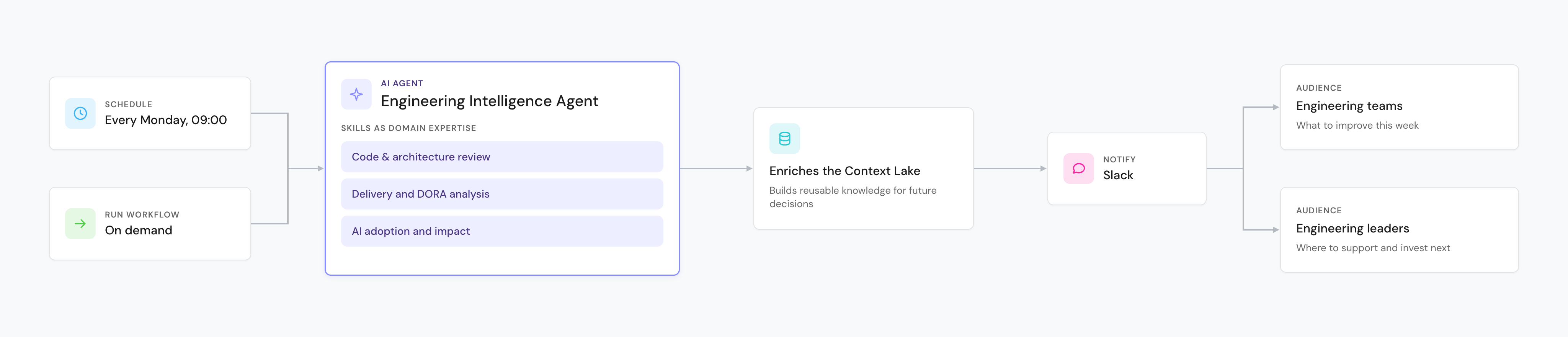
The Pulse brings together approved domain skills, the Engineering Intelligence Agent, and a customizable workflow.
Skills provide domain expertise
Each skill defines how to assess a specific engineering domain, including which data to examine, which comparisons are meaningful, and what qualifies as an opportunity for improvement. Organizations can tailor existing skills to their priorities, goals, and engineering context, or add new skills to assess additional domains.
The agent applies the expertise
The Engineering Intelligence Agent loads the approved skills and applies them to your engineering data. It combines the findings into one assessment and ranks the opportunities that matter most.
The workflow orchestrates the process
The workflow controls when the assessment runs, enriches Port’s Context Lake with qualified opportunities, and shares the top priorities in Slack. These opportunities become reusable context for other agentic workflows, while the orchestration can be customized to fit your organization’s processes.
How to set it up
Before starting, you need engineering data in Port, service-to-team ownership configured, and a Slack bot that can publish the brief.
- Set up the Engineering Intelligence Agent and add a domain AI skill.
- Create and schedule the workflow.
- Review the results in Port or Slack.
Follow the full step-by-step guide to set up the Engineering Intelligence Pulse in Port.
Start with one use case, such as identifying opportunities to improve delivery performance, and then expand to other engineering areas.
From priority to measurable improvement
The Engineering Intelligence Pulse is one example of how Port workflows can turn engineering data into action. Organizations can build their own workflows to identify bottlenecks and opportunities for improvement based on their goals, data, and engineering practices.
They can then use additional governed workflows to act on those opportunities and measure whether the expected improvement was achieved. This creates a repeatable path from insight to action to measurable impact.
Learn more about the use case in our guide: Create the Engineering Intelligence Pulse in Port.


Get your survey template today


Download your survey template today


Free Roadmap planner for Platform Engineering teams
Set Clear Goals for Your Portal
Define Features and Milestones
Stay Aligned and Keep Moving Forward
Create your Roadmap


Free RFP template for Internal Developer Portal
Creating an RFP for an internal developer portal doesn’t have to be complex. Our template gives you a streamlined path to start strong and ensure you’re covering all the key details.
Get the RFP template


Leverage AI to generate optimized JQ commands
test them in real-time, and refine your approach instantly. This powerful tool lets you experiment, troubleshoot, and fine-tune your queries—taking your development workflow to the next level.
Explore now
Check out Port's pre-populated demo and see what it's all about.
No email required
LIVE WEBINAR, Aug 18, 2026:
Context-aware Vibe Coding for Platform Engineering
Thursday, October 22 12:00pm EDT⋅6:00pm CET
To learn more about the new capability and to see a live demo, join our upcoming community session with GitHub
Move fast while staying in control
Build governed agentic workflows on one central platform.
See it in action:
Watch this video on generating Terraform with Port, or explore our public demo.

Check out the 2025 State of Internal Developer Portals report
No email required
Minimize engineering chaos. Port serves as one central platform for all your needs.
Act on every part of your SDLC in Port.
Your team needs the right info at the right time. With Port's software catalog, they'll have it.
Learn more about Port's agentic engineering platform
Read the launch blog
Contact sales for a technical walkthrough of Port
Every team is different. Port lets you design a developer experience that truly fits your org.
As your org grows, so does complexity. Port scales your catalog, orchestration, and workflows seamlessly.
Port × n8n Boost AI Workflows with Context, Guardrails, and Control
Port Builders Session: A Single, Governed Interface for All MCP Servers
Book a demo right now to check out Port's developer portal yourself
Apply to join the Beta for Port's new Backstage plugin


n8n + Port templates you can use today
walkthrough of ready-to-use workflows you can clone
From manual to autonomous engineering
One platform to build, govern, and operate the Agentic SDLC.
Port is open for you to try it
build your first agentic workflow today