Developer self-service forms are dead: stop maintaining the forms nobody fills out right
How to make your golden paths dynamic and developer-friendly, without writing another form


A developer fills out a self-service form to provision a new DB, but he’s unsure which instance size he actually needs, so he picks one at random, creating confusion and prompting a blame game. The platform engineer blames the developer for failing to read the fields. The developer blames the platform engineer for building a form that asks questions they can't answer. Both are right, and the DB still takes days to provision.
Platform engineers have spent years solving a hard coordination problem. You encapsulate complex infrastructure configs in developer-friendly forms, pass the values to Terraform modules and GitHub workflows, and call it self-service. It works until it doesn't.
{{from_manual_to_autonomous_engineering}}
What breaks, and why
Three things go wrong with static templates, and they compound over time.
- Maintenance becomes a tax. Every new policy, compliance requirement, or infrastructure change means running through every existing template and updating it. Organizations with mature IDPs carry dozens of templates. Keeping them consistent is a part-time job.
- Templates can't flex. Developers have edge cases. The form handles the 80% case, and for the remaining 20%, the developer either files a ticket asking for a new variation or bypasses the portal entirely and makes the change directly in the console. Both outcomes defeat the point of removing the tickets bottleneck while staying in control.
- The fields ask the wrong questions. "Should this run on EC2, EKS, or GCP?" is a reasonable question to a platform engineer. To the developer who owns the payment service and just needs to add a cache, it's not. They don't know the answer, and they shouldn't have to. The ping-pong that follows is friction you built in when you wrote the form.
The root issue is that forms can't reason. You make them as thorough as possible, ask all the right questions upfront, and still can't anticipate every combination of what a developer needs and what your infrastructure requires. You're encoding a decision into a fixed structure, and the decision changes faster than the structure.
.png)
What you get with context-aware agents
AI agents can do something forms never could: they can interview the developer in the developer's language, look up what already exists, apply your organizational policies without surfacing them as fields, and produce the output you would have produced yourself.
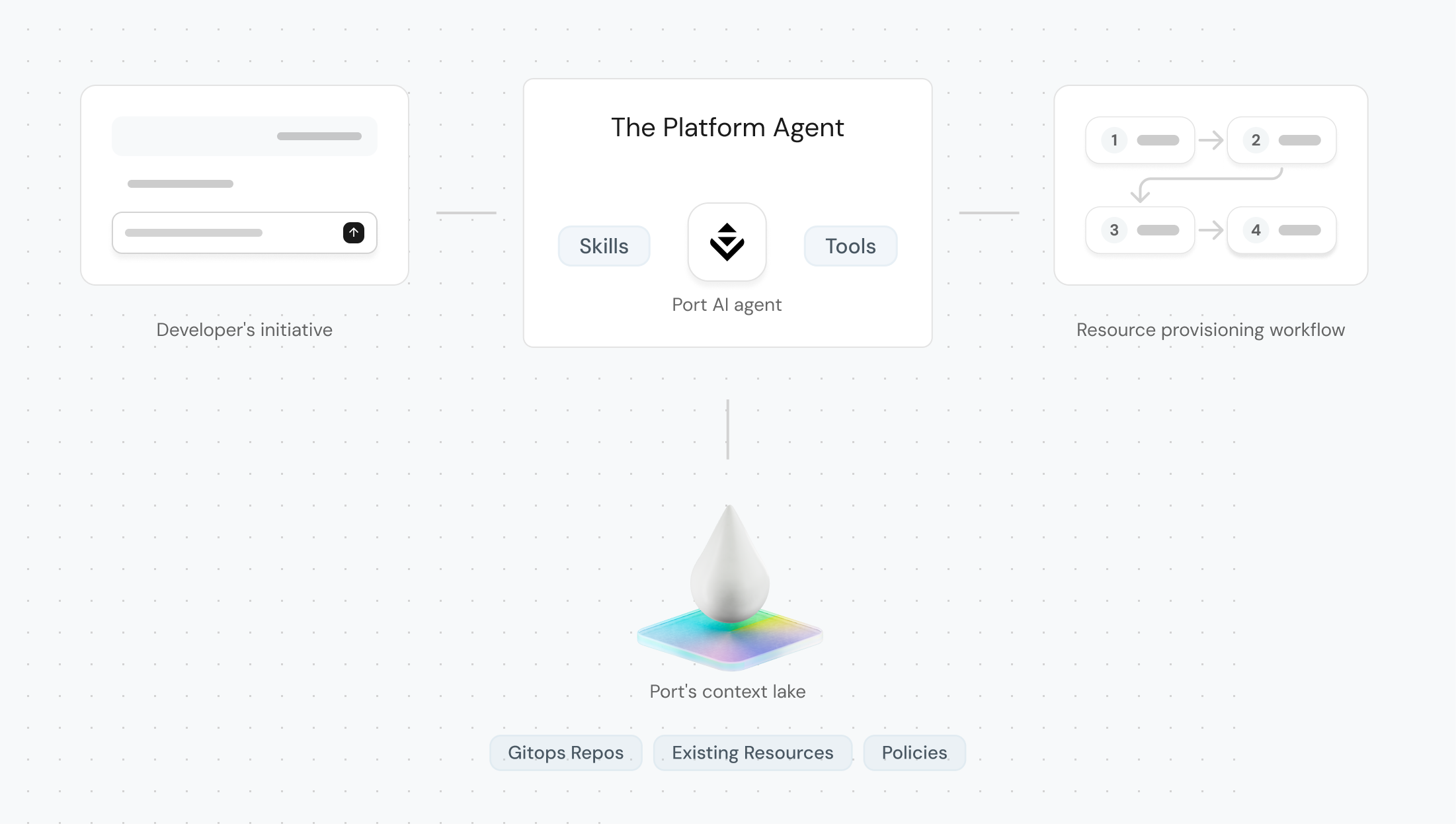
This only works with the right foundation. The agent needs to reason over the same context you use: your IaC repositories (Terraform modules, GitHub Actions workflows), your provisioned resources, your written policies. Without that context, you get a model that generates plausible-looking code with no knowledge of your actual standards. A rich context lake is the difference between an agent that reasons like a senior platform engineer and one that invents a new VPC.
Teach the agent how you think
Once you have the context, you can encode your reasoning into skills rather than forms. Each skill handles a step in the process.
- Ask the developer questions they can actually answer. Instead of "which region," ask what flows the service touches, which clients it serves, how mission-critical it is. The agent gathers what the developer knows; it figures out the infrastructure implications.
- Cross-reference what already exists. Before generating anything, check whether the same resource is already provisioned or already in a queue from another team. This removes duplication in both work and resources.
- Apply your organizational playbooks. Mission-critical services go in AWS. Payment flows require 90-day log retention. Services under a cost threshold skip the security review. The agent applies these rules without surfacing them as fields the developer has to interpret, using your existing templates (such as Terraform modules) to understand how those rules actually translate into infrastructure.
- Generate the code and open the PR. The agent uses your existing modules and configuration examples, produces the GitOps code, and opens a PR with a description that explains both what the developer asked for and how the agent translated it into your platform standards.
These steps appear linear, but the power no form can match is the ability to loop. If what the agent learns in step 2 or 3 raises a question that step 1 didn't cover, it goes back to the developer. It keeps going until it has the full picture it needs to be confident in its output.
Opening a PR is not the finish line, but it is where you decide how much you trust the agent, and that requires the right safety nets in place.
.png)
Stay in control
The right concern isn't whether AI will stray from your golden paths; it's whether you have the right mechanisms in place to catch them before they cause harm. These three patterns are key to staying in control:
Guardrails. Start conservatively with the tools you give your agents. Give them read-only permissions first: the agent can inspect, reason, and propose, but only a human can apply. As you build confidence in specific skills, you can expand permissions selectively. An agent that has produced 50 correct Redis provisioning PRs has earned a different trust level than one you deployed last week.
AI as a judge. Add a second agent whose only job is to review the first agent's output. It acts as the platform lead: it doesn't generate anything, it just examines the PR against your production stability, security, and cost criteria. The human queue receives a PR that has already passed two rounds of automated inspection.
.png)
Human in the loop. The easiest place to start, and still the most important safety gate. The agent stops at the PR. Your team reviews, fine-tunes, and merges. But if you instrument this correctly, every delta between the agent's output and the merged PR becomes a signal you can feed back into the skill. The human review stops being just a checkpoint and becomes a feedback loop that makes the agent more accurate over time. That's what lets you narrow the scope of review as confidence grows and remove the bottleneck.
How we do this at Port
Port's platform team is in the middle of this shift, using Port itself as the platform. Developers interact with a platform agent from Slack, their IDE, or their preferred coding agent. The agent connects to Port's MCP server, which surfaces the internal context lake: infrastructure state, organizational policies, and previous provisioning decisions. A set of skills handles questioning the developer, cross-referencing playbooks, and opening the PR.
We track three phases of Time to Resolve: discovery (ticket to work starting), implementation (work starting to PR), and review (PR to merge). Discovery dropped from days to minutes once the agent took over the developer interview and eliminated the friction with the platform team. Implementation time per request is similar to a well-filled form, but the compounding savings show up elsewhere: every edge case that would have spawned a new template variation, or triggered a maintenance pass across existing ones, the skill is dynamic enough to resolve. The review phase is where we're investing most right now as we build out the feedback loop.
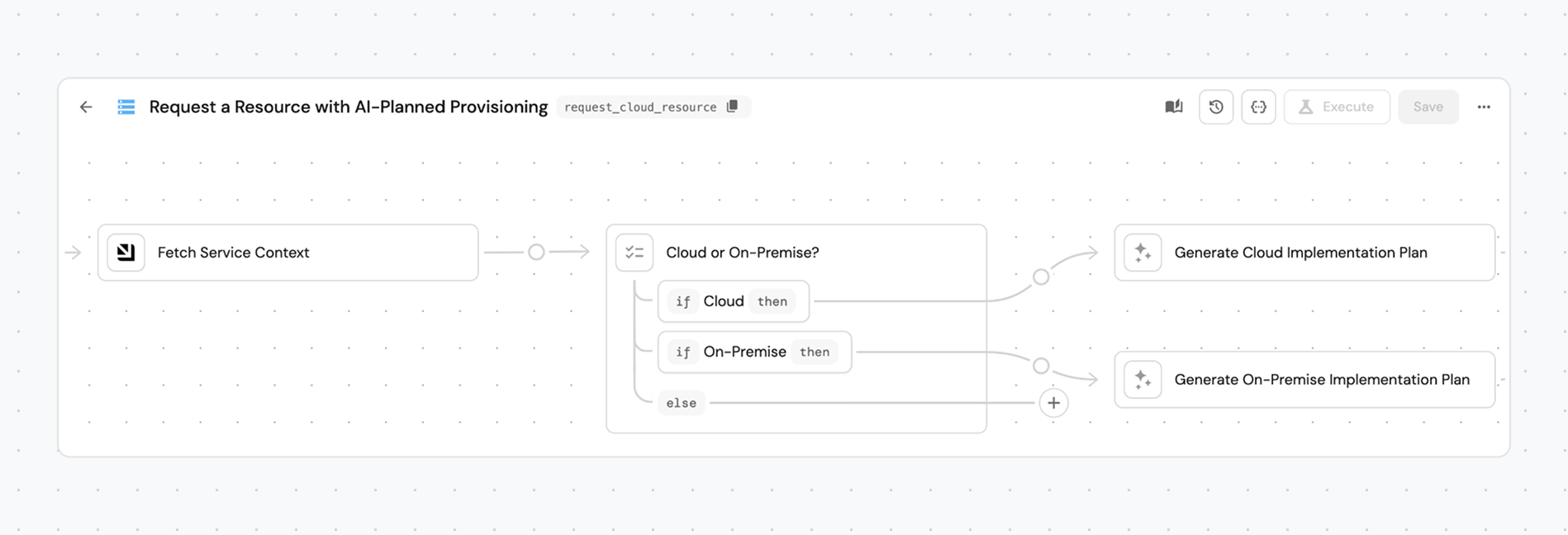
Port's workflows handle the sequencing across steps. Skills handle the reasoning within each step. That separation matters: the orchestration is explicit and auditable, while the reasoning is adaptive.
Start small, move fast
You don't need to migrate everything at once. Pick one resource type (where the ping-pong is worst, or the setup is the easiest) and start there. Test it with your team, then get it to early adopters. When new requests come in, don't go back to the old way. Instead, translate your way of thinking into another skill you can serve.
What happens next tends to be self-reinforcing. Instead of asking developers to find the portal, locate the right form, and fill it out with fields they don't understand, you're meeting them in Slack or their IDE, asking questions in their language. Your governed path becomes the easiest path to getting infra done, leaving no reason for developers to bypass you. When something is good, even if not perfect or yet complete, it makes developers hungry for more. Once you achieve that, you will never write a developer form again.
{{public_demo}}


Get your survey template today
%201.svg)


Download your survey template today


Free Roadmap planner for Platform Engineering teams
Set Clear Goals for Your Portal
Define Features and Milestones
Stay Aligned and Keep Moving Forward
Create your Roadmap


Free RFP template for Internal Developer Portal
Creating an RFP for an internal developer portal doesn’t have to be complex. Our template gives you a streamlined path to start strong and ensure you’re covering all the key details.
Get the RFP template


Leverage AI to generate optimized JQ commands
test them in real-time, and refine your approach instantly. This powerful tool lets you experiment, troubleshoot, and fine-tune your queries—taking your development workflow to the next level.
Explore now
Check out Port's pre-populated demo and see what it's all about.
No email required
LIVE WEBINAR, Aug 18, 2026:
Context-aware Vibe Coding for Platform Engineering
Move fast while staying in control
Build governed agentic workflows on one central platform.
See it in action:
Watch this video on generating Terraform with Port, or explore our public demo.
.png)
Check out the 2025 State of Internal Developer Portals report
No email required
Minimize engineering chaos. Port serves as one central platform for all your needs.
Act on every part of your SDLC in Port.
Your team needs the right info at the right time. With Port's software catalog, they'll have it.
Learn more about Port's agentic engineering platform
Read the launch blog
Contact sales for a technical walkthrough of Port
Every team is different. Port lets you design a developer experience that truly fits your org.
As your org grows, so does complexity. Port scales your catalog, orchestration, and workflows seamlessly.
Port × n8n Boost AI Workflows with Context, Guardrails, and Control
Port Builders Session: A Single, Governed Interface for All MCP Servers
Book a demo right now to check out Port's developer portal yourself
Apply to join the Beta for Port's new Backstage plugin


n8n + Port templates you can use today
walkthrough of ready-to-use workflows you can clone
From manual to autonomous engineering
One platform to build, govern, and operate the Agentic SDLC.
Port is open for you to try it
build your first agentic workflow today