How mature is your autonomous software development?
Take the quiz to find your stage in AI driven development, and see what's missing for your team to become AI native.


.png)
Some engineering teams now let AI agents write code, fix bugs, and open pull requests on their own. Most teams are not there yet. They are somewhere in between, using AI more than last year but unsure how far they have actually come or what to do next.
That in-between is where teams stall in autonomous software development, and they stall in a few recognizable ways. Some move fast but lose track of what their agents are doing, with no registry of what exists. Some add so many rules that work slows to a crawl. Some run pilot after pilot that never ships. The way a team is stuck says a lot about what it should fix.
{{from_manual_to_autonomous_engineering}}
This quiz sorts teams by three axes:
- AI maturity: how much real work your agents do, from autocomplete to finishing tasks on their own.
- Velocity: how fast that work actually reaches production.
- Governance: how well you can see and control what your agents are doing.
Answer nine questions, about two minutes, and you get one of five profiles plus the first thing to tackle next.
What does autonomous software development actually mean?
Autonomous software development is an enterprise engineering practice where ai agents independently consume context, write code, and run validation test suites under systematic, platform-level policies.
An agent that autocompletes a function assists a developer. An agent that reads a ticket, pulls the context, writes the code, runs the tests, and opens a pull request under set policies is doing the real thing. The five profiles below mark where teams get stuck between those two points.
The five profiles
Each profile is a combination of the three axes the quiz measures. Find the one that sounds like your week.
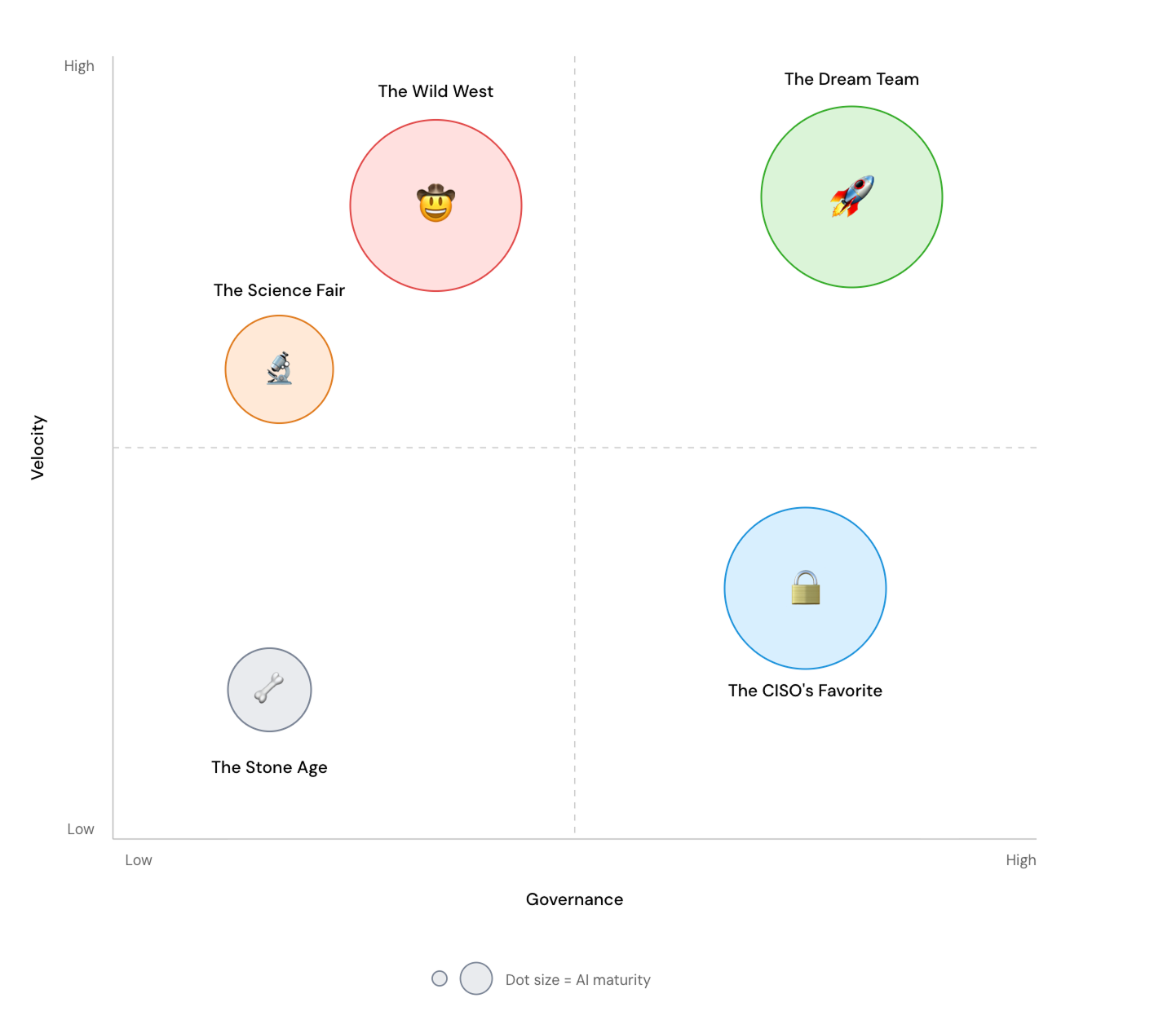
The map shows how velocity runs up the page and governance runs across it, so the two teams that solved only one of the two sit in opposite corners, while the Dream Team is the only profile that climbed both at once. That gap is the whole game.
Take the quiz
Pick the one answer that matches your team today, then reveal your result at the end.
🦴 The Stone Age
What it says about your org: You still move by hand, and AI has not changed how the work gets done. That is a clean slate, not a failure, but the clock is the risk, because while you wait for proof other teams are already shipping with agents.
Your next step: Pick one well-scoped, low-risk workflow, like ticket triage or test generation, and let an agent own it end to end with a human approving the result. Prove it on that one workflow before you scale, and track it from day one so the value is on the table when you ask for more investment.
🔬 The Science Fair
What it says about your org: You have no shortage of energy, with demos everywhere and almost none of them in production. They break on real work because they run on pasted-in prompts instead of real context.
Your next step: Stop starting new pilots and finish one. Take an agent that already works, give it live context like ownership, dependencies, and deploy history so it survives a real codebase, and put one human owner on it who is accountable for shipping, not for demoing.
🤠 The Wild West
What it says about your org: You move fast with agents everywhere, writing code, triaging tickets, and taking real action, and nobody knows how many exist, what they can reach, or who owns them when one breaks. The speed you depend on sits one bad agent away from an incident.
Your next step: Put every agent in one registry with a named owner and defined access so you can see what is running. Then gate the irreversible actions like merges and deploys behind a human, and leave the rest to move.
🔒 The CISO's Favorite
What it says about your org: Nothing slips through. Every agent is reviewed, every action approved, every permission scoped, and the security team sleeps well. The cost shows up in the backlog, where developers wait in approval queues and route around the process to get anything done.
Your next step: Make the safe path the fast path. Swap manual, ticket-based approvals for a golden path that is governed by default and self-service by design, and save the human approval for the genuinely risky actions while the safe ones run on their own.
🚀 The Dream Team
What it says about your org: You are the rare team whose agents move fast because they are governed, not in spite of it. Context flows on its own, every agent is owned and scoped, humans gate the risky calls, and you can show the impact in numbers.
Your next step: Take the same foundation to what is next. Bring your skills and MCP servers into the registry and governance model you already run, so reuse scales as fast as your agents do, and keep measuring delivery and quality so the return stays provable as you grow.
What your result really measures
Every question maps to one piece of the foundation that autonomous software development runs on, and each profile is stuck because it is missing a specific one. The Stone Age has none of them yet. The Science Fair has agents but no context lake, so its demos run on pasted-in prompts and fall apart on a real codebase. The Wild West has agents and speed but no registry, so nobody can see what is running or who owns it when one breaks. The CISO's Favorite has governance but no golden path, so every action waits in an approval queue and velocity dies. The Dream Team has all of it: a registry so you can see what exists, a context lake so agents stop guessing, human approval gates so a bad action cannot ship, scoped access so an agent cannot reach what it should not, orchestration so steps connect, and measurement so you can prove it works.
The pattern is the point. The Wild West and the CISO's Favorite are not stuck because their models are worse, since everyone runs the same models. They are stuck because each one built only half of the foundation that lets software development ai agents move fast and stay safe at once. Build the whole thing and you move from one profile to the next. For how the safety pieces work, see our guide to guardrails and human-in-the-loop control, and for what changes in your team as agents take on more, the future of engineering roles.
FAQs
What is autonomous software development?
Autonomous software development is an engineering practice where software development AI agents consume context, write code, run tests, and open pull requests under set policies, while engineers direct and review the work. It is the step past coding assistants, where agents finish whole tasks instead of suggesting lines.
How is autonomous software development different from ai driven development?
AI driven development is the broad move toward using AI across the software development lifecycle, from autocomplete to agents. Autonomous software development is the mature end of that move, where agents run multi-step work on their own and humans own the outcome rather than each step.
What does agentic ai in software development need to run safely?
Agentic AI in software development runs safely on a shared foundation: a registry so you know which agents exist, a context lake so agents work from real information, human approval gates on irreversible actions, scoped least-privilege access, orchestration across steps, and measurement to prove impact. Speed without that foundation gives you the Wild West, and control without speed gives you the CISO's Favorite.
Why do most autonomous development pilots never reach production?
Most pilots break because the agents run on pasted-in prompts instead of real context, so they fall apart the moment they meet a real codebase. Give agents live context like ownership, dependencies, and deploy history, and put one human owner on the work who is accountable for shipping it, not just for the demo.
How do you measure the ROI of software development ai agents?
Measure software development ai agents the way you measure any delivery change: their effect on delivery speed and quality over time, tracked continuously rather than by gut feel. Teams that cannot show the impact in numbers tend to lose the budget for it, so measuring from day one matters as much as the agents.
Find out what your result means for your roadmap.
Port gives you the registry, context lake, governance, and orchestration to move from your profile toward the Dream Team.


Get your survey template today
%201.svg)


Download your survey template today


Free Roadmap planner for Platform Engineering teams
Set Clear Goals for Your Portal
Define Features and Milestones
Stay Aligned and Keep Moving Forward
Create your Roadmap


Free RFP template for Internal Developer Portal
Creating an RFP for an internal developer portal doesn’t have to be complex. Our template gives you a streamlined path to start strong and ensure you’re covering all the key details.
Get the RFP template


Leverage AI to generate optimized JQ commands
test them in real-time, and refine your approach instantly. This powerful tool lets you experiment, troubleshoot, and fine-tune your queries—taking your development workflow to the next level.
Explore now
Check out Port's pre-populated demo and see what it's all about.
No email required
LIVE WEBINAR, Aug 18, 2026:
Context-aware Vibe Coding for Platform Engineering
Thursday, October 22 12:00pm EDT⋅6:00pm CET
To learn more about the new capability and to see a live demo, join our upcoming community session with GitHub
Move fast while staying in control
Build governed agentic workflows on one central platform.
See it in action:
Watch this video on generating Terraform with Port, or explore our public demo.
.png)
Check out the 2025 State of Internal Developer Portals report
No email required
Minimize engineering chaos. Port serves as one central platform for all your needs.
Act on every part of your SDLC in Port.
Your team needs the right info at the right time. With Port's software catalog, they'll have it.
Learn more about Port's agentic engineering platform
Read the launch blog
Contact sales for a technical walkthrough of Port
Every team is different. Port lets you design a developer experience that truly fits your org.
As your org grows, so does complexity. Port scales your catalog, orchestration, and workflows seamlessly.
Port × n8n Boost AI Workflows with Context, Guardrails, and Control
Port Builders Session: A Single, Governed Interface for All MCP Servers
Book a demo right now to check out Port's developer portal yourself
Apply to join the Beta for Port's new Backstage plugin


n8n + Port templates you can use today
walkthrough of ready-to-use workflows you can clone
From manual to autonomous engineering
One platform to build, govern, and operate the Agentic SDLC.
Port is open for you to try it
build your first agentic workflow today