Cut token usage 80% with a Context Lake

Backstage

Run agentic engineering workflows on top of your existing Backstage investment.
CategoryInternal Developer Portal
SolutionSelf-Healing Incidents, Autonomous Ticket Resolution
ResourcesDocs

INTEGRATION OVERVIEW

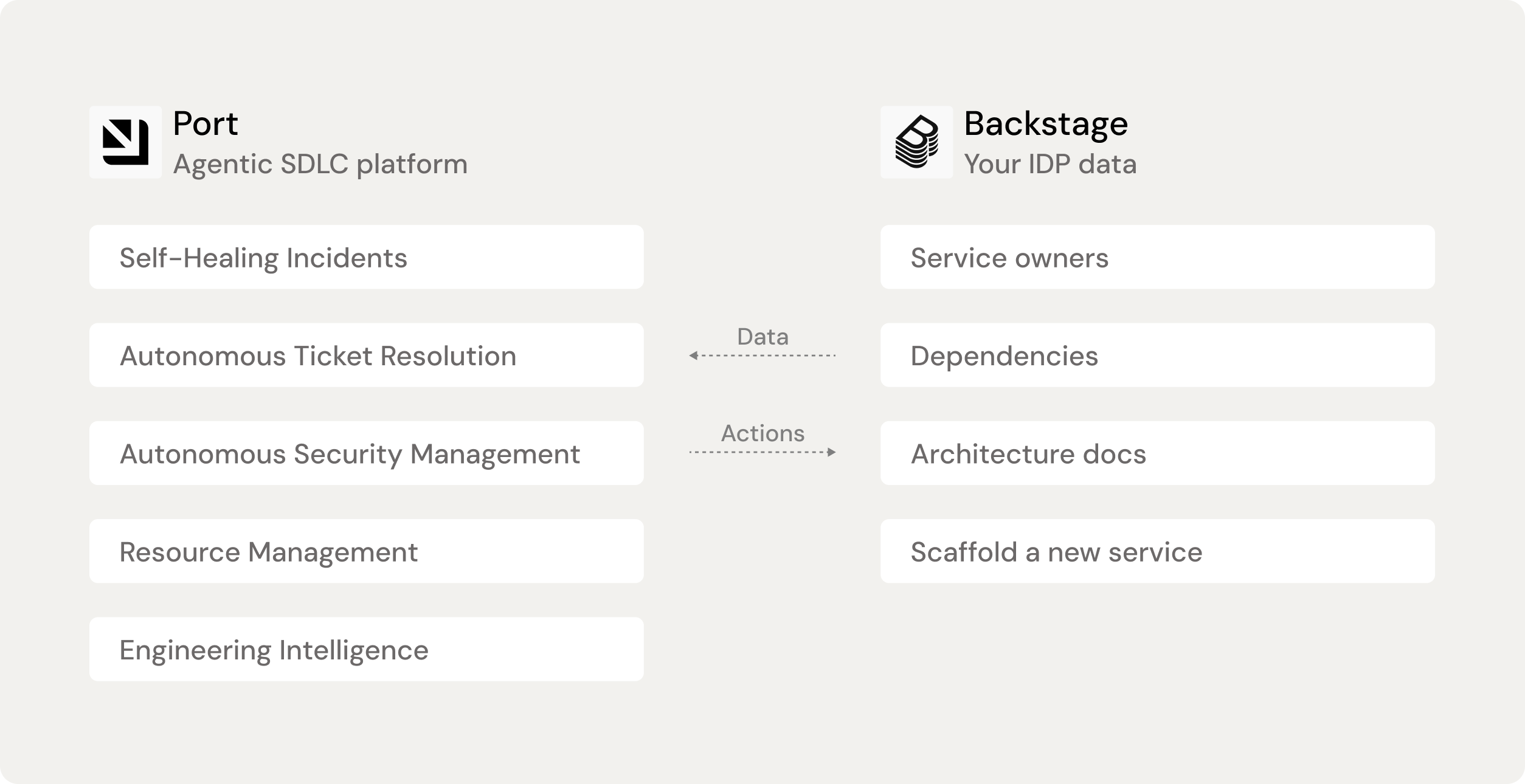
You've built out Backstage. Ownership is defined, services are cataloged, golden paths exist. The Port and Backstage integration turns that foundation into the context and execution layer for autonomous engineering workflows - without rebuilding anything.

Integration Benefits

  • Instant context: Port ingests your Backstage data into the Context Lake - agents and workflows have grounding context from day one.
  • Always current: Port queries Backstage live via MCP, so agents reason over real-time catalog state, not a stale snapshot.
  • Backstage actions, orchestrated: Scaffolder actions run as native steps inside Port Workflows - composable with GitHub, Jira, PagerDuty, and your full stack.
  • Full SDLC signal: Port enriches Backstage context with signals from across your toolchain - agents see the full picture, not just the catalog.
  • Governance built in: RBAC, human-in-the-loop approvals, and audit trail apply to every workflow that touches Backstage.

USE CASE

Resolving incidents faster with Backstage service context

When a production alert fires, the biggest bottleneck isn't the fix - it's finding who owns the service, what depends on it, and where to look. That context lives in Backstage. Port's self-healing workflow pulls it automatically.

The opportunity

You're one layer away from autonomous engineering workflows.

  • Your catalog context isn't reaching your workflows: Service ownership, dependencies, and TechDocs exist in Backstage - but when an incident fires or a ticket lands, engineers still hunt for that context manually instead of having it assembled automatically.
  • Your Scaffolder actions could do more: The templates and golden paths you built handle provisioning well - but they're triggered manually and can't participate in larger, multi-system agentic workflows.
  • Your engineers are still coordinating what agents could handle: Incidents, ticket triage, and service scaffolding still require manual coordination - not because the context isn't there, but because there's no agentic layer to act on it.

Solution: The agentic layer your Backstage investment was missing

When an alert fires, Port's self-healing workflow queries Backstage for service ownership, dependencies, and runbook context - automatically, before the on-call engineer even opens their laptop. The right owner gets paged, the blast radius is mapped, and a remediation plan is assembled from actual service data. Engineers review and approve. Port executes. What used to take 20 minutes of manual context-gathering happens in seconds, grounded in the catalog your team already built in Backstage.

MORE USE CASES

  • Autonomous Ticket Resolution: Port queries Backstage TechDocs and the service graph to generate a grounded PRD and scaffold a PR.
  • Autonomous Security Management: Port enriches every finding with Backstage service ownership and dependencies to prioritize and route remediation.
  • Resource Management: Port uses Backstage service context to govern provisioning requests and enforce standards.
  • Engineering Intelligence: Port combines Backstage catalog data with DORA metrics and deployment signals for a unified engineering view.

BETTER TOGETHER

Port's agentic workflows run on any engineering context - GitHub, Jira, PagerDuty, cloud providers, and more. For teams running Backstage, that existing investment becomes an immediate advantage: service ownership, TechDocs, and golden paths flow straight into Port's Context Lake and workflow engine, grounding every agent in the catalog your team already built. That way, your Backstage catalog becomes part of Port's Context Lake - a single source of engineering knowledge that both your developers and your agents can act on.


Starting with Port is simple, fast, and free.