What does the JFrog Agent Skills Registry do? Key features, use cases, and alternatives
What the JFrog Agent Skills Registry does, the problems it solves, where it fits in an Agentic SDLC stack, and its alternatives.



TL;DR: The JFrog Skills Registry stores, scans, signs, and versions the agent skills your developers write, so every skill an agent picks up is vetted before it runs. That governs the skill at rest. How that skill is certified for use, scoped to an owner, and cleared to production is governed by an Agentic SDLC Platform, and a maturing organization runs both.
This guide is for platform teams and engineering leaders working out how to govern the agent skills their developers are already writing. It covers what the JFrog Agent Skills Registry does, the problem it solves, where it sits in an Agentic SDLC stack, and when you also need governance that follows a skill onto the path to production.
What is the JFrog Agent Skills Registry?
JFrog launched the Agent Skills Registry in 2026 and calls it the first enterprise-grade private skills registry. JFrog built Artifactory, the artifact repository that sits at the center of many CI/CD pipelines, and this registry extends that model to AI. It holds agent skills, MCP servers, and models in one system of record, scans them for vulnerabilities and malicious payloads, signs them, and puts approval workflows in front of them.
The pitch is that agent skills are the new packages of AI. A skill is a small file that hands an agent procedural knowledge, and JFrog treats it the way it treats any other package you would not ship unscanned. The first runtime integration is NVIDIA NemoClaw, where every skill an agent uses is pulled from a trusted, scanned source, and the registry is compatible with Agent Skills, ClawHub, and OpenShell.
What problem does the JFrog Agent Skill Registry solve?
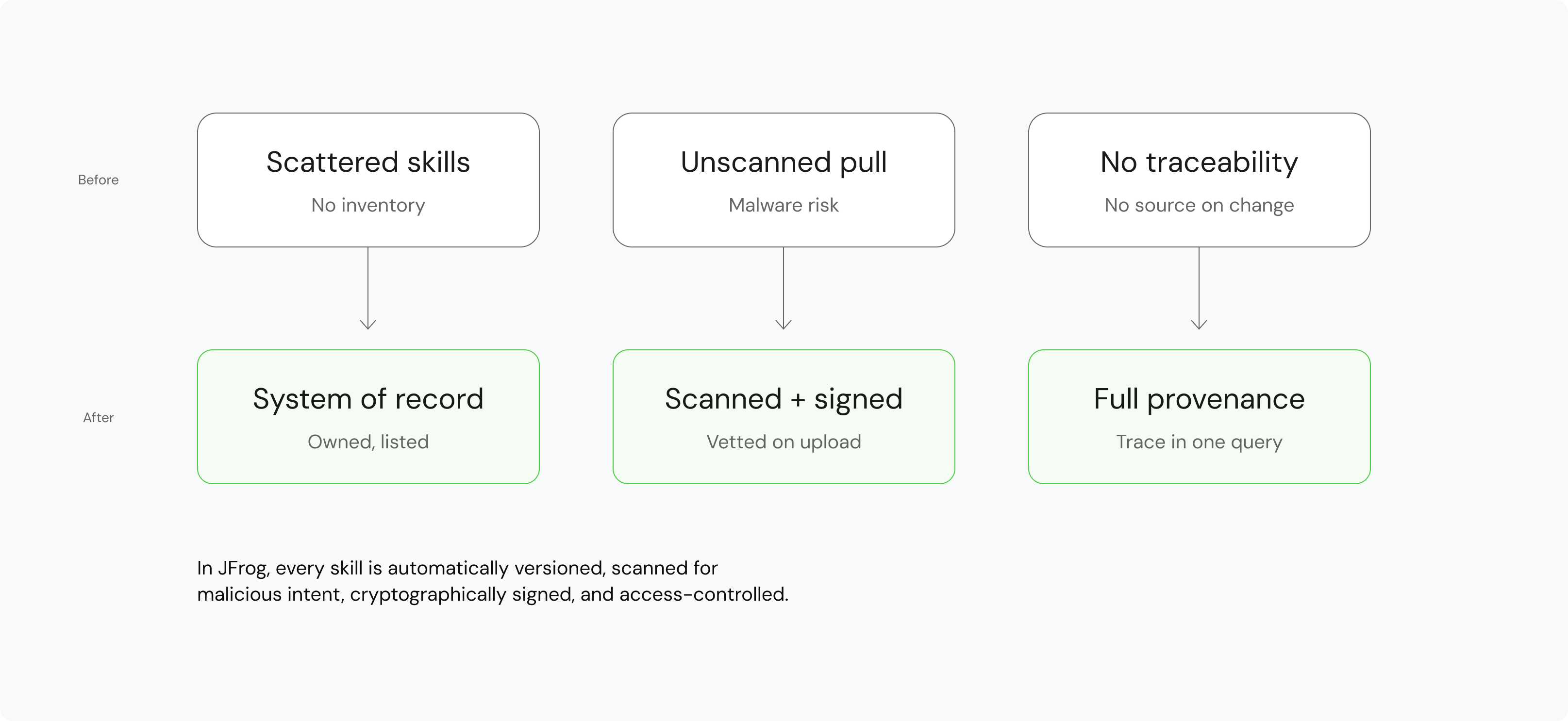
Skills spread faster than anyone governs them. A skill is easy to write and easier to copy, so within a few weeks the same procedural knowledge lives in a dozen places and no one owns any of it. A registry exists to pull that sprawl back under control. Three moments capture what most teams feel before they have one.
First, skills live in personal repos and scattered context files, so no one can say which skills the organization’s agents are actually running. The cost shows up as shadow skills you cannot inventory, and the metric it hits is skill inventory coverage, the share of running skills that are registered and owned.
Second, an agent pulls a skill straight from a public hub and nothing scans it for malicious payload or a prompt injection before it runs. That is raw attack surface, and the metric is the share of skills scanned and signed before an agent can use them.
Third, when a skill causes a bad change, no one can trace which version ran, where it came from, or who signed off on it. The cost is a forensic dead end during an incident, and the metric is time to trace the offending skill version, its source, and its approver.
How does JFrog Agent Skill Registry solve it?
JFrog treats a skill like a package and puts it through the same supply chain as any other artifact, which closes all three pains cleanly.
The scattered skills come back into one system of record, so inventory coverage rises from guesswork to a number and every skill has an owner and a home. The unscanned pull is gone because scanning and signing happen on upload, and a policy gate stops an agent from using anything that has not passed, which takes the share of vetted skills to whatever your policy demands. The forensic dead end closes too, because immutable versioning and provenance turn “which version ran and who approved it” from an afternoon of digging into a single query.
One thing stays outside that boundary by design. JFrog governs the skill up to the moment an agent picks it up. It vets the artifact, confirms it is safe to adopt, and records where it came from. Whether that skill should exist at all, whether it duplicates one you already have, whether it first your models and budget, who owns it, what it is allowed to touch, and whether it has cleared the gates to production, those are different questions, and the next section is about who answers them.
Approaches to build your Agentic SDLC stack, and where the JFrog Agent Skill Registry fits
A secure skills registry is one layer of an agentic stack, not the whole of it. The useful way to place JFrog is to ask what sits next to it. On its own, the registry is the shelf your skills are stored on, vetted and versioned and ready to pull. Around that shelf you still need the parts that decide what happens when a skill leaves it: the ownership and dependency map that says who owns it and what it touches, the certification that catches duplicates and checks the model fit and cost, the least-privilege scope an agent is granted through a golden path, and the promotion gates it clears before production.
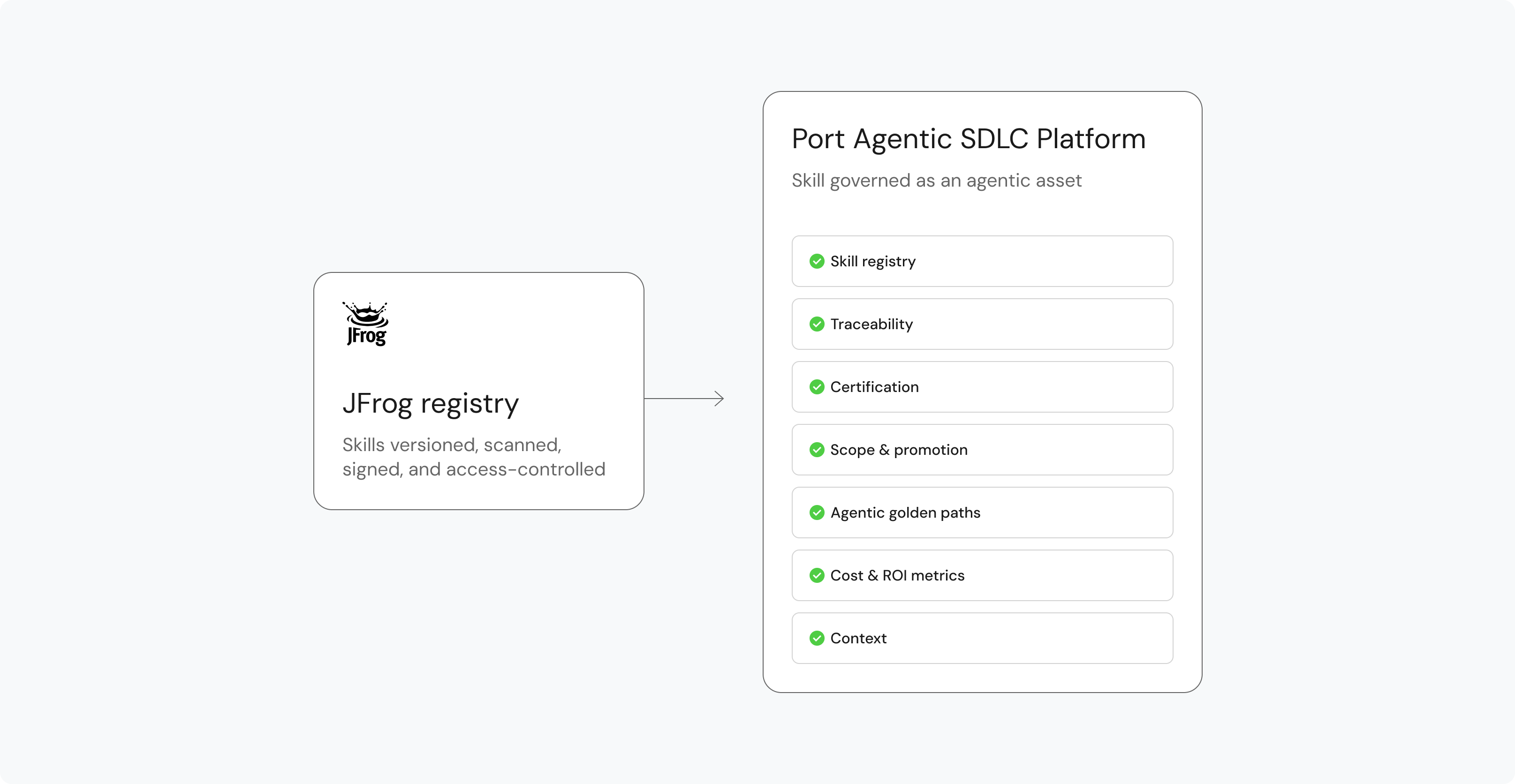
You can wire those parts together yourself around a standalone registry, and some teams do. The alternative is an engineering-native Agentic SDLC Platform where the platform governs how that skill is certified, owned, scoped, and promoted before an agent uses it. Because a platform like this consumes skills straight from a registry like JFrog’s, the two slot together rather than compete: JFrog can be the vetted source your agents pull from, and the platform governs what they do with what they pulled.
The standalone registry has real strengths worth naming. JFrog’s supply-chain security on the artifact is deep, it works across many agent frameworks, and it reached the market first. The limit is the scope rather than quality, since a registry governs the artifact itself, not the skill’s place in your engineering estate, its owners, dependencies, cost, and promotion path, which you would otherwise wire together yourself.
Port (Agentic SDLC Platform) vs JFrog Agent Skills Registry
One root cause explains every row below. JFrog applies the package-repository model to skills, and that model governs an artifact before it is consumed by scanning, signing, versioning, and approving it. A skill is more than a file to be stored. It is an asset an agent will use, and the questions that decide whether it is a fit for that, whether it duplicates one you already have, whether it fits your models and budget, who owns it, what it is allowed to touch, and whether it has cleared the gates to production, are not answered by scanning the file. JFrog secures the package. Port governs the skill as an agentic asset: traced, certified, scoped, and promoted.
How to choose, and where to start
If your agents are already writing and pulling skills, you need both halves of the picture: a vetted source the skills come from, and governance that carries them along the path to production. Teams reach for a secure registry because the at-rest pains bite first. They reach for an Agentic SDLC Platform when the question shifts from ‘is this skill safe to adopt’ to ‘is it fit to use, who owns it, what is it allowed to touch, and has it earned its way to production.’
dLocal, the crossborder payments company that clears more than 500 million transactions a month across 40 emerging markets, built an agent called dCoder on Port that takes a ticket from scope to deployed PR by pulling the services, owners, and patterns it needs straight from Port. Their CTO, Alberto Almeida, says the agent now handles 45% of all their tickets, and Port is where he tracks what it ships and its rejection rate. That is the skill governed as part of an owned, scoped agent rather than just the artifact vetted: the agent is scaffolded on a golden path, draws its context from Port, and its pull requests come back for review.
The bottom line
The JFrog Agent Skill Registry scans, signs, versions, and approves the skills your agents pull, so each skill is vetted and traceable before it ever runs. Port governs the same skill as a governed agent asset: traced to an owner and its dependencies, certified for fit, scoped through a golden path, and promoted to production, and it consumes skills straight from JFrog so the two run together.
The deciding question is whether your next gap is securing the skill at rest or governing what it does in motion, and for most maturing teams the answer is both.
Start free and build a proof of concept with Port or book a live demo.
FAQ
What does the JFrog Agent Skill Registry do?
It stores, scans, signs, and versions against skills, MCP servers, and models in one system of record with approval workflows, so every skill an agent uses is vetted and traceable before it runs. It governs skills at rest.
What is an Agentic SDLC Platform?
It is the control plane for agents and skills your teams build across the software lifecycle. It maps every agent, skill, and MCP server to its owners and dependencies in a registry, certifies skills for fit before production, scaffolds agents on golden paths with least-privilege scope, gates their promotion from local to pilot to production, and tracks their cost and ROI on the registry.
Is the JFrog Agent Skills Registry and Agentic SDLC Platform?
No. It is the secure registry skills are stored and vetted in. An Agentic SDLC Platform governs those skills as agent assets, certified, owned, scoped, and promoted to production. The registry works the at-rest layer, the platform governs the path to production.
Do I need both a skills registry and an Agentic SDLC Platform?
Most maturing teams end up with both. A secure registry keeps the skills your agents pull vetted and traceable, and an Agentic SDLC PLatform governs how a skill is certified, scoped, and promoted before an agent uses it in production. Because a platform like Port consumes skills from a registry like JFrog’s, this is a progression rather than a choice between the two.
What are the alternatives to JFrog Agent Skill Registry?
For the at-rest registry job, alternatives include other artifact and AI-asset registries that scan and version skills. For the in-motion job, the category to evaluate is the Agentic SDLC Platform, of which Port is one example.
Port vs JFrog Agent Skills Registry: what is the real difference?
JFrog governs the skills as a stored artifact, scanned, signed, and versioned before use. Port governs the same skill as an agent asset: traced to its owners and dependencies, certified for fit, scoped through a golden path, and promoted to production. They cover different halves of the skill’s life and connect where Port consumes JFrog’s skills.
When should you choose the JFrog Agent Skills Registry?
When your first priority is supply-chain security on the skill artifact itself across many agent frameworks. Pair it with an Agentic SDLC Platform to certify, scope, and promote those skills to production.
{{from_manual_to_autonomous_engineering}}


Get your survey template today
%201.svg)


Download your survey template today


Free Roadmap planner for Platform Engineering teams
Set Clear Goals for Your Portal
Define Features and Milestones
Stay Aligned and Keep Moving Forward
Create your Roadmap


Free RFP template for Internal Developer Portal
Creating an RFP for an internal developer portal doesn’t have to be complex. Our template gives you a streamlined path to start strong and ensure you’re covering all the key details.
Get the RFP template


Leverage AI to generate optimized JQ commands
test them in real-time, and refine your approach instantly. This powerful tool lets you experiment, troubleshoot, and fine-tune your queries—taking your development workflow to the next level.
Explore now
Check out Port's pre-populated demo and see what it's all about.
No email required
LIVE WEBINAR, Aug 18, 2026:
Context-aware Vibe Coding for Platform Engineering
Thursday, October 22 12:00pm EDT⋅6:00pm CET
To learn more about the new capability and to see a live demo, join our upcoming community session with GitHub
Move fast while staying in control
Build governed agentic workflows on one central platform.
See it in action:
Watch this video on generating Terraform with Port, or explore our public demo.
.png)
Check out the 2025 State of Internal Developer Portals report
No email required
Minimize engineering chaos. Port serves as one central platform for all your needs.
Act on every part of your SDLC in Port.
Your team needs the right info at the right time. With Port's software catalog, they'll have it.
Learn more about Port's agentic engineering platform
Read the launch blog
Contact sales for a technical walkthrough of Port
Every team is different. Port lets you design a developer experience that truly fits your org.
As your org grows, so does complexity. Port scales your catalog, orchestration, and workflows seamlessly.
Port × n8n Boost AI Workflows with Context, Guardrails, and Control
Port Builders Session: A Single, Governed Interface for All MCP Servers
Book a demo right now to check out Port's developer portal yourself
Apply to join the Beta for Port's new Backstage plugin


n8n + Port templates you can use today
walkthrough of ready-to-use workflows you can clone
From manual to autonomous engineering
One platform to build, govern, and operate the Agentic SDLC.
Port is open for you to try it
build your first agentic workflow today
.png)
.png)