Top 6 Backstage Alternatives for 2026
Compare six Backstage alternatives by features, data models, maintenance needs, and AI agent support to find the right developer portal for your team.


Key Takeaways
- Backstage is a framework you build on, not a product you install. The greatest expense around it is the cost of hiring people to build on it. Roadie's 2025 State of Backstage research found that organizations happy with their self-hosted setup dedicate 3 to 12 full-time engineers to it.
- The alternatives fall into two camps. Roadie and Spotify Portal take the hosting off your plate but keep Backstage's data model, while Port, Cortex and OpsLevel replace the framework with their own catalog and data model.
- Atlassian Compass is being phased out. Atlassian plans to end support on December 31, 2027 and is moving customers to DX, so a new Compass rollout makes no sense in 2026.
- Every tool on this list now exposes its catalog over MCP, which means the useful comparison is depth: whether agents can run actions or only read, and whether those actions go through the same permissions, approvals and audit trail as a human's.
- Port is the closest fit if you want a flexible data model, day-2 self-service and governed agent access without maintaining a portal codebase, and it's free for up to 15 seats.
For many platform teams, Backstage turns out to be the most expensive option for an internal developer portal, even though the license costs nothing. Spotify open-sourced it in March 2020, contributed it to the Cloud Native Computing Foundation (CNCF), and in the process more or less defined what an internal developer portal is supposed to do. Teams run into problems after the first git clone when they realize Backstage requires Node.js infrastructure, continuous maintenance of React dependencies, and a dedicated engineer to manage it long-term. They expected a portal they could deploy and update, but instead inherited an open-source project they have to build, staff, and upgrade indefinitely.
That gap between expectation and reality is why so many teams end up searching for Backstage alternatives. In 2026, the alternative you consider needs to serve agents as well as developers. Coding agents need the same context your engineers do (who owns a service, what it depends on, which standards it's failing) and they need guardrails on the actions they can take.
Below we walk through six Backstage alternatives, what each one is good at, where it falls short, and the questions your team should answer before committing to any of them.
The top 6 Backstage alternatives in 2026
The first three options below replace Backstage with their own catalog and data model. Atlassian Compass, listed fourth, is being sunsetted but we listed it to be through. The last two options are Backstage itself, hosted and operated by someone else.
1. Port
Port keeps what people actually wanted from Backstage, a catalog, self-service and scorecards, without handing you a codebase to maintain. The biggest difference is the data model. You decide what a service, a cluster or a feature flag looks like and how they relate to each other, so the catalog reflects how your engineering org really works instead of squeezing everything into Backstage’s handful of entity kinds.
All of that data lands in one place Port calls the Context Lake. A question like “which tier-1 services have a critical vulnerability and no on-call owner?” gets a single answer rather than three open browser tabs.
Self-service is usually where teams see value first. Developers can roll back a deploy, request temporary database access that goes through an approval step, or spin up an environment that deletes itself after a day, and every one of those runs on the pipelines you already have.
Agents are where Port stands out this year. Through the Port MCP server, Claude, Cursor or Copilot can read your catalog and run actions with exactly the permissions a person would have.
If you’re on Backstage today, the migration guide shows how to bring your existing catalog over.
The trade-offs are that you need to spend time defining your data model before you import your data, and that Port only runs as SaaS. It’s free for up to 15 seats, and paid plans start at $30 per seat per month.
2. Cortex
Cortex began as a tool for engineering leaders who wanted to know which services met their production-readiness standard. Its scorecards are still one of the best things about it. You write rules against catalog metadata and integration data, group them into levels or points, and use Initiatives with due dates to push teams toward a target. Its Eng Intelligence module puts delivery metrics in the same product, so a production-readiness program and the numbers behind it live side by side.
Scorecards can also live as code. Cortex picks up YAML definitions placed in a .cortex/scorecards directory of their own repository, which suits teams that want every change to a standard to go through pull-request review like any other change.
The catalog has moved past its old fixed shape and now takes custom entity types, with ownership synced from identity providers. Cortex also ships an MCP server you can run locally in Docker or connect to remotely, so a coding assistant can check who owns a service or how it scores before it opens a pull request.
Cortex has issues around latency. According to Cortex's documentation, scorecards evaluate every four hours by default and can't be scheduled more often than that. Very large scorecards may need a longer window to stay within rate limits, although you can trigger an evaluation manually.
3. OpsLevel
OpsLevel competes on time to value. Connect your Git provider and it detects components from repositories, attaches owners and scores everything against a built-in maturity rubric. This means you can put a populated catalog in front of leadership within days rather than after a quarter of modeling work.
The data model lets you define custom component types with their own JSON-schema properties and custom relationships between types, which covers libraries, pipelines or feature flags hanging off a service. A hosted MCP server at app.opslevel.com/mcp plugs into Claude Code, Cursor and VS Code and gives assistants ownership, dependency and documentation data during an incident or while they write code. Configuration can sit next to the code as well, through an opslevel.yml file in each repository, the Terraform provider or the GraphQL API, and a self-hosted edition is available for teams that can't send catalog data to a SaaS vendor.
The catch is how current the data is. Some integrations sync on a schedule (the Wiz integration, for example, re-syncs once a day), so the catalog can trail the source of truth by hours. OpsLevel's center of gravity is also still maturity and ownership rather than self-service, so if your main goal is letting developers provision and operate infrastructure from the portal, test that path during the trial. Pricing is quote-based, with a median contract of roughly $25,200 a year according to Vendr.
4. Atlassian Compass
Atlassian Compass used to be the go-to option for Jira-heavy organizations because it puts components, ownership and scorecards next to tools developers already log into every day. That changed in April 2026, when Atlassian announced that Compass was being phased out and that its catalog and scorecards would move into DX Fabric, the platform it acquired after buying DX.
Atlassian's migration documentation says teams that don't move to DX Fabric will lose access when their contract ends or when support stops, which is planned for December 31, 2027. The move to DX also leaves work behind. Components, custom fields, dependencies and owners sync across, but scorecards don't and have to be rebuilt, alerts and on-call features have to move to Jira Service Management, and Jira can't yet link a work item to a DX entity, which removes one of the main reasons teams chose Compass in the first place.
On the DX side, Atlassian's own comparison lists a Terraform provider, automatic import of repositories from your source control tool (they arrive in a pending state until someone approves them) and a nightly sync from Atlassian Teams. In DX, each user can belong to only one team and every team needs a lead, so anyone who sits in several Atlassian Teams gets assigned to just one of them during import. This detail surprises teams who expect to be able to assign users to multiple teams. Once the migration kicks off, you get one month with access to both products to finish the move.
Even before the announcement, Atlassian Compass had gaps that impacted platform teams. Its templates only scaffolded new services, and there were no day-2 actions or automations that could trigger a pipeline, an IaC change or a time-boxed permission from the catalog.
5. Roadie
Roadie has run Backstage as a SaaS product since 2020. It suits a team that’s decided to use Backstage as their framework but don’t want to host it. Roadie takes care of hosting, upgrades, authentication, search and the TechDocs pipeline, while you keep the open-source plugin ecosystem and can publish private plugins of your own through Roadie's CLI. Roadie holds SOC 2 Type 2, and it connects to GitHub, GitLab, Bitbucket and Azure DevOps, including their self-hosted editions.
Roadie's pricing page lists a Teams plan at $24 per contributing developer per month for organizations of 50 to 150 developers (people who don't write code log in free), plus a custom-priced Growth plan for 100 or more developers that adds custom RBAC, REST API access and a secure on-prem connection. Scorecards cost extra on both. As of October 2026 both portal plans are marked as available to existing subscribers only, and the plan Roadie now leads with is Enterprise Context, a graph of services, teams and dependencies packaged for agents and humans. Confirm what a new customer can actually buy before you shortlist it.
Because Roadie runs Backstage as a hosted service, it fixes the operational challenges without changing the architecture. You still work with Backstage's fixed entity kinds and its Scaffolder-centered approach to self-service, which are the same data-model and day-2 limits covered earlier.
6. Spotify Portal for Backstage
Spotify Portal is Backstage hosted and run by the team that created it, Spotify’s Platform Developer Experience team. It reached general availability in October 2025 after about 18 months in beta. It includes the premium plugins Spotify used to sell separately, such as Soundcheck for scorecards, RBAC, Insights and Skill Exchange. The GA release also bundled Confidence, Spotify's experimentation platform, and added a Tech Insights view to Soundcheck for tracking the technical health of the whole software ecosystem.
Spotify also addressed the two complaints self-hosters raise most often. A Catalog Wizard lets teams create and update catalog entries in the UI instead of hand-editing YAML, and Portal Studio together with a new template editor cuts down the TypeScript needed to build integrations and Scaffolder templates. AiKA, Spotify's AI assistant, can call third-party MCP servers and trigger actions in Portal, and it also works as an MCP server itself, so Cursor or Copilot can read Portal data. Because Portal shares Backstage's core, Spotify says you can migrate an existing self-hosted instance into it.
Portal hits the same ceiling as Roadie, since it's still built on Backstage's data model and plugin architecture. In a trial, check how far the Catalog Wizard gets you with entities Backstage doesn't model natively and what a day-2 action looks like from request to completion. Spotify doesn't publish prices, so expect a trial followed by a sales conversation.
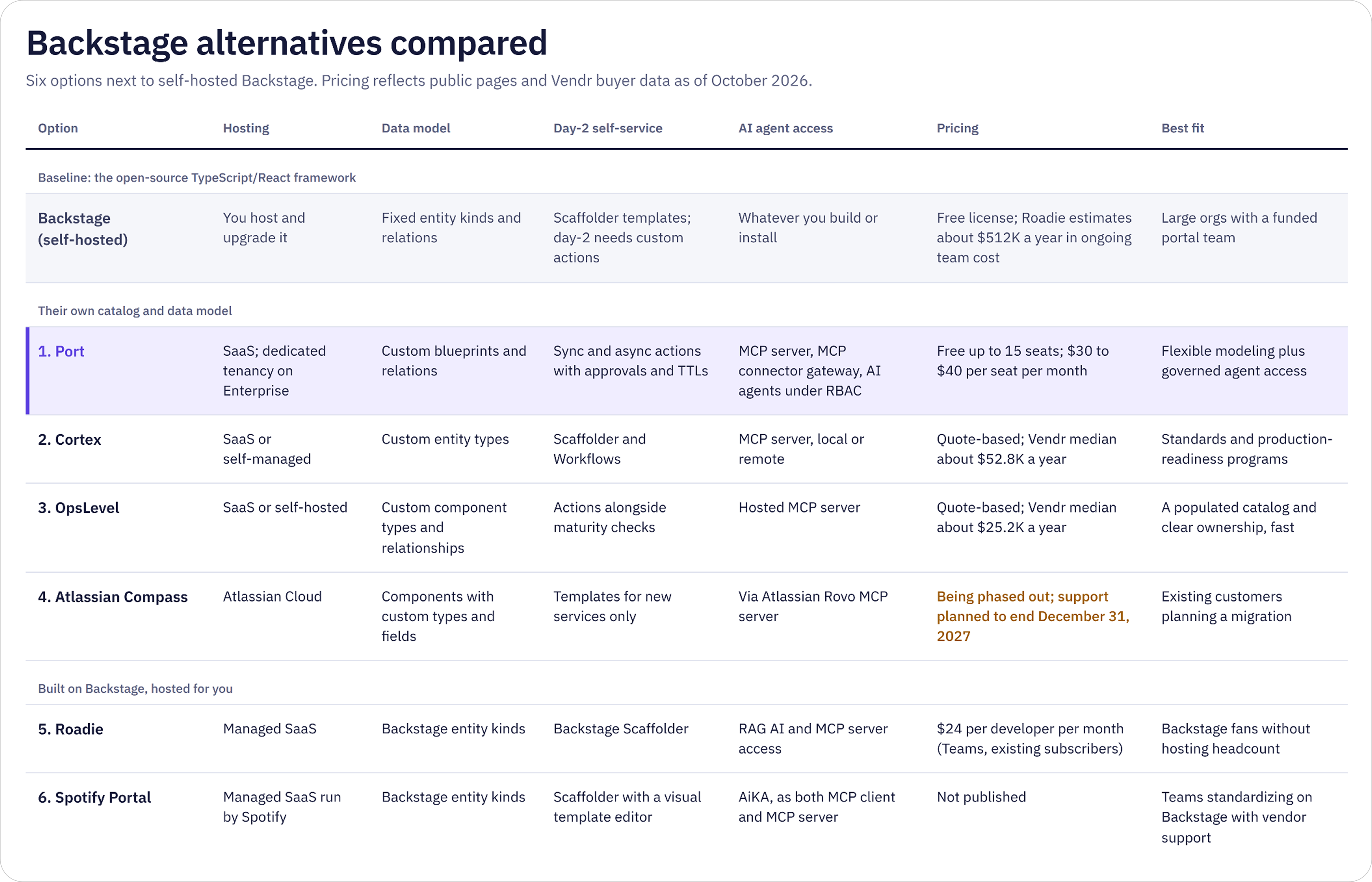
Backstage Alternatives Compared
The table puts all six options next to self-hosted Backstage as a baseline. Pricing reflects public pages and Vendr's buyer data as of October 2026.
How to Choose Between Backstage Alternatives
Feature checklists make every internal developer portal look the same, so start by asking yourself these questions. Answer these as a team before you book demos, and you'll walk into each one knowing what to test.
- Do you want Backstage, or what Backstage was supposed to give you? If your organization is committed to the plugin ecosystem and has custom plugins it can't rewrite, a managed Backstage like Roadie or Spotify Portal keeps that investment. If what you actually wanted was a trustworthy catalog and working self-service, you're free to pick a portal with its own data model.
- What does your catalog need to model? List every entity beyond services that you'll want to see and act on, such as cloud resources, environments, vulnerabilities, incidents, feature flags and the AI agents your teams run. Count how many of them fit a fixed set of entity kinds without workarounds.
- Where does the data come from, and how current is it? Ask each vendor which sources are auto-discovered, which rely on YAML that developers maintain, how often each integration syncs and how often scorecards evaluate. A catalog that's hours out of date can't gate a deploy.
- What happens after a developer clicks the button? Pick one real day-2 request, for example temporary write access to a production database that expires after 48 hours, and trace it end to end: the form, the approval, the pipeline that runs, the TTL that revokes access and the audit record it leaves.
- How will AI agents use it? Check whether agents can only read the catalog or can also run actions, whether those actions respect the same RBAC and approvals as people do, and whether you can see which agents and MCP servers are active across the organization in the first place.
- Who maintains it, and what will it cost over three years? Multiply the engineers you'd dedicate by their fully loaded cost and compare that with seat pricing. Use a free tier or trial to measure time to a first useful scorecard, not just time to login.
- How stable is the product's roadmap? Compass customers are migrating on Atlassian's schedule, and Roadie's portal plans are now listed for existing subscribers only. Ask each vendor how long they've committed to the product you're buying.
Here's how the answers tend to map to the Backstage alternatives. Teams that need to model far more than services and want agents acting through the portal usually land on Port. Teams whose main goal is a standards program consider Cortex, and teams that mostly need a trustworthy ownership map in a hurry look at OpsLevel. Teams committed to Backstage but not to hosting it compare Roadie and Spotify Porta. Compass customers should evaluate alternatives now while they still have a runway before support ends at the end of 2027.
Frequently Asked Questions
What is the best alternative to Backstage for a small platform team?
Maintenance capacity matters more than features here, because a small team can't spare engineers to run a portal. That rules out self-hosted Backstage for most, since 56% of adopters in Roadie's 2025 survey call upgrades their biggest pain point, and on a small team upgrades can be done at the expense of feature work. A SaaS portal with a free tier lets you prove value before spending anything. Port is free for up to 15 seats and 10,000 entities with no time limit, which is enough for a pilot.
How long does it usually take to migrate from Backstage to another portal?
Moving the catalog data is the fast part. Port's open-source backstage-import script reads components and resources from the Backstage API and maps them to blueprints, so your existing catalog shows up before you rebuild anything. The long pole is custom plugins and Scaffolder templates, which become integrations and self-service actions. A handful of plugins usually means weeks of work, while a heavily customized instance takes longer, so move one golden path at a time.
How much does it cost to run Backstage in-house?
The license is free, but the people needed to build on it aren't. Roadie's 2025 State of Backstage research found that self-hosted teams dedicate 3 to 12 full-time engineers, and Roadie's own model puts year one at about $762,000 (three engineers plus roughly $12,000 of infrastructure) and $512,000 a year after that. Your number will depend on local salaries, but headcount, not hosting, is what makes the bill add up.
What is the difference between an internal developer portal and an internal developer platform?
An internal developer platform is the set of tools and workflows developers use to build, deploy and run software: CI/CD, infrastructure as code, Kubernetes, cloud accounts and the golden paths that connect them. An internal developer portal is the interface on top of that platform, where developers and agents find services, check ownership and standards, and trigger self-service actions. Backstage and every alternative in this article are portals.
Do Backstage alternatives support AI agents?
Yes, and in 2026 it's becoming a deciding factor. Port, Cortex, OpsLevel, Roadie and Spotify Portal all expose catalog data over MCP, and Compass data is reachable through Atlassian's Rovo MCP server. To see the real difference, ask an agent to roll back a tier-1 service through each portal and watch what happens: whether it can act at all, whether it hits the same approval step a human would, and whether the audit log records which agent did it.
Download your survey template today


Get your survey template today


Download your survey template today


Free Roadmap planner for Platform Engineering teams
Set Clear Goals for Your Portal
Define Features and Milestones
Stay Aligned and Keep Moving Forward
Create your Roadmap


Free RFP template for Internal Developer Portal
Creating an RFP for an internal developer portal doesn’t have to be complex. Our template gives you a streamlined path to start strong and ensure you’re covering all the key details.
Get the RFP template


Leverage AI to generate optimized JQ commands
test them in real-time, and refine your approach instantly. This powerful tool lets you experiment, troubleshoot, and fine-tune your queries—taking your development workflow to the next level.
Explore now
Check out Port's pre-populated demo and see what it's all about.
No email required
LIVE WEBINAR, Aug 18, 2026:
Context-aware Vibe Coding for Platform Engineering
Thursday, October 22 12:00pm EDT⋅6:00pm CET
To learn more about the new capability and to see a live demo, join our upcoming community session with GitHub
Move fast while staying in control
Build governed agentic workflows on one central platform.
See it in action:
Watch this video on generating Terraform with Port, or explore our public demo.

Check out the 2025 State of Internal Developer Portals report
No email required
Minimize engineering chaos. Port serves as one central platform for all your needs.
Act on every part of your SDLC in Port.
Your team needs the right info at the right time. With Port's software catalog, they'll have it.
Learn more about Port's agentic engineering platform
Read the launch blog
Contact sales for a technical walkthrough of Port
Every team is different. Port lets you design a developer experience that truly fits your org.
As your org grows, so does complexity. Port scales your catalog, orchestration, and workflows seamlessly.
Port × n8n Boost AI Workflows with Context, Guardrails, and Control
Port Builders Session: A Single, Governed Interface for All MCP Servers
Book a demo right now to check out Port's developer portal yourself
Apply to join the Beta for Port's new Backstage plugin


n8n + Port templates you can use today
walkthrough of ready-to-use workflows you can clone
From manual to autonomous engineering
One platform to build, govern, and operate the Agentic SDLC.
Port is open for you to try it
build your first agentic workflow today